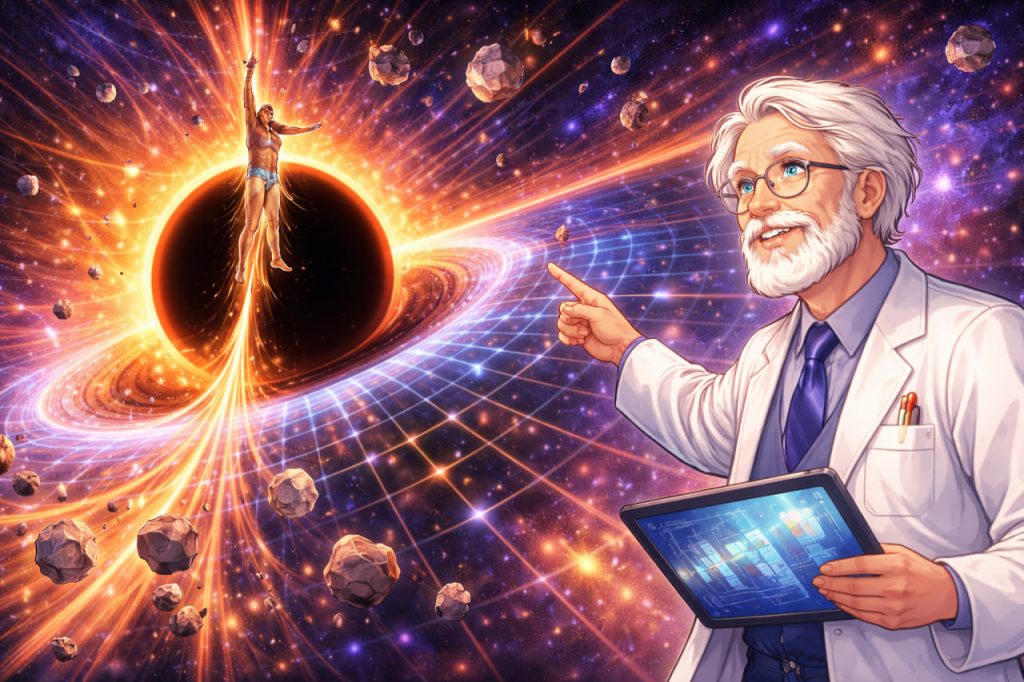
Tidal forces near a black hole are among the most extreme effects predicted by modern physics. They arise not from a mysterious new force, but from the way gravity changes over distance in strongly curved spacetime. While tidal forces exist everywhere in the universe—including on Earth—they become dramatically stronger near compact objects such as black holes. Understanding these forces is essential for explaining phenomena like spaghettification, orbital instability, and the limits of survivability near a black hole. Tidal forces reveal how gravity acts differently across space, not just how strong it is at a single point.
What Tidal Forces Actually Are
Tidal forces occur when different parts of an object experience different gravitational acceleration. Gravity weakens with distance, so the side of an object closer to a massive body is pulled more strongly than the far side. This difference stretches the object along the direction of gravity and compresses it in perpendicular directions. On Earth, tidal forces are responsible for ocean tides caused by the Moon. Near a black hole, the same principle applies—but the gradient of gravity is vastly steeper.
Why Black Holes Produce Extreme Tidal Effects
Black holes concentrate enormous mass into a very small region of space. This causes gravity to change extremely rapidly over short distances. Near the event horizon of a small (stellar-mass) black hole, the difference in gravitational pull between a person’s head and feet can be immense. This leads to intense stretching forces that no known material can withstand. The closer one gets to the black hole, the stronger this differential acceleration becomes.
Spaghettification: A Consequence of Tidal Forces
One of the most famous results of black hole tidal forces is spaghettification. As an object falls toward the black hole, it is stretched lengthwise and squeezed sideways, eventually forming a long, thin shape. This effect is not caused by impact or heat, but purely by tidal gravity. Importantly, spaghettification occurs well before reaching the central singularity. It is a direct illustration of how tidal forces, not overall gravity, determine physical destruction.
Large vs. Small Black Holes
Not all black holes produce the same tidal experience at the event horizon. Supermassive black holes, found at the centers of galaxies, have much weaker tidal forces at their horizons because their mass is spread over a larger radius. In such cases, an object could theoretically cross the event horizon without immediate destruction. Tidal forces would only become lethal much deeper inside. This highlights a key insight: stronger gravity does not always mean stronger tidal forces at the same relative boundary.
Why Tidal Forces Are Central to Black Hole Physics
Tidal forces help define the physical limits of objects near black holes and influence how matter accretes and emits radiation. They play a role in shaping accretion disks, tearing apart stars, and producing energetic flares when matter is disrupted. From a theoretical standpoint, tidal effects also help test predictions of general relativity in extreme conditions. Studying them improves our understanding of spacetime curvature itself, not just black holes.
Interesting Facts
- Tidal forces depend on gravity differences, not absolute gravity strength.
- Spaghettification occurs before reaching the singularity.
- Supermassive black holes have gentler horizons than small ones.
- Tidal forces can tear stars apart, creating observable flares.
- Earth’s ocean tides are caused by the same basic physics.
Glossary
- Tidal Forces — forces caused by differences in gravitational pull across an object.
- Spaghettification — extreme stretching of an object due to tidal gravity.
- Event Horizon — the boundary beyond which escape from a black hole is impossible.
- Singularity — a region where spacetime curvature becomes infinite in classical theory.
- Spacetime Curvature — distortion of space and time caused by mass and energy.