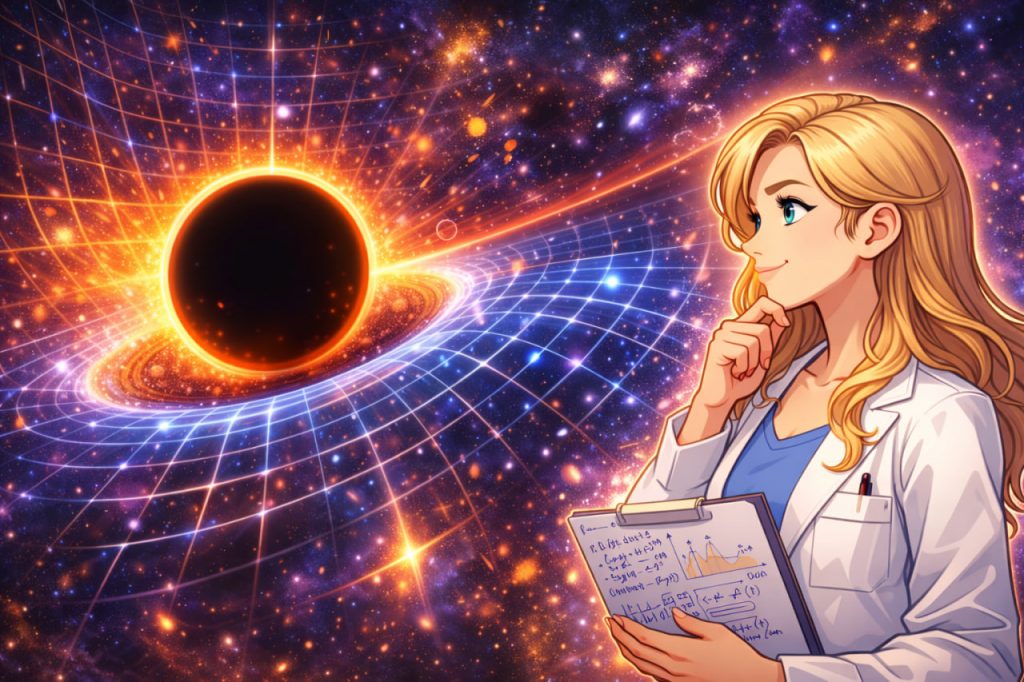
The event horizon is one of the most intriguing and misunderstood concepts in modern physics. It is commonly associated with black holes, yet it is not a physical surface or object in the usual sense. Instead, the event horizon represents a boundary in spacetime, beyond which events can no longer influence an outside observer. Once this boundary is crossed, information cannot escape back to the rest of the universe. Understanding the event horizon is essential for grasping how gravity, space, and time behave under extreme conditions.
The Basic Idea of an Event Horizon
At its core, an event horizon marks the limit of causal connection. Outside this boundary, signals such as light or particles can still travel outward and be detected. Inside it, all possible future paths lead deeper inward, making escape impossible. This does not mean objects are destroyed at the horizon; rather, the structure of spacetime itself prevents any return. The event horizon is defined by geometry, not by material properties.
Event Horizon and Black Holes
In the context of black holes, the event horizon forms at a specific distance from the center, depending on the black hole’s mass. For a non-rotating black hole, this boundary is known as the Schwarzschild radius. From the perspective of a distant observer, an object approaching the horizon appears to slow down and fade, never quite crossing it. From the falling object’s own perspective, however, it passes through the horizon without experiencing anything locally dramatic. This difference arises from how time behaves in strong gravitational fields.
Why Light Cannot Escape
The event horizon is often described as the point where the escape velocity equals the speed of light. Beyond this boundary, even light lacks sufficient energy to move outward. This is not because light slows down, but because spacetime is curved so strongly inward that all paths point toward the center. The horizon therefore represents a limit imposed by spacetime geometry rather than a force acting on light.
Event Horizons Are Not Solid Surfaces
A common misconception is that the event horizon is a physical barrier. In reality, it has no thickness, texture, or material presence. An observer crossing it would not feel a sudden impact or wall. Only far deeper inside the black hole do tidal forces become extreme enough to cause physical destruction. The horizon itself is best understood as a mathematical boundary defining what regions of spacetime can communicate.
Why Event Horizons Matter
Event horizons play a central role in some of the deepest problems in theoretical physics. They are essential to understanding black hole thermodynamics, Hawking radiation, and the information paradox. Studying horizons has also influenced ideas about quantum information and the nature of spacetime itself. Far from being a niche concept, the event horizon sits at the crossroads of gravity, quantum theory, and cosmology.
Interesting Facts
- An event horizon is a boundary of information, not matter.
- Crossing the horizon feels uneventful to a falling observer.
- Larger black holes have weaker tidal forces at the horizon.
- Event horizons are central to the black hole information paradox.
- Similar horizon concepts appear in cosmology as well.
Glossary
- Event Horizon — a boundary beyond which information cannot escape to an outside observer.
- Spacetime — the combined structure of space and time in physics.
- Escape Velocity — the speed required to overcome gravitational attraction.
- Schwarzschild Radius — the radius defining the event horizon of a non-otating black hole.
- Causality — the relationship between cause and effect in spacetime.