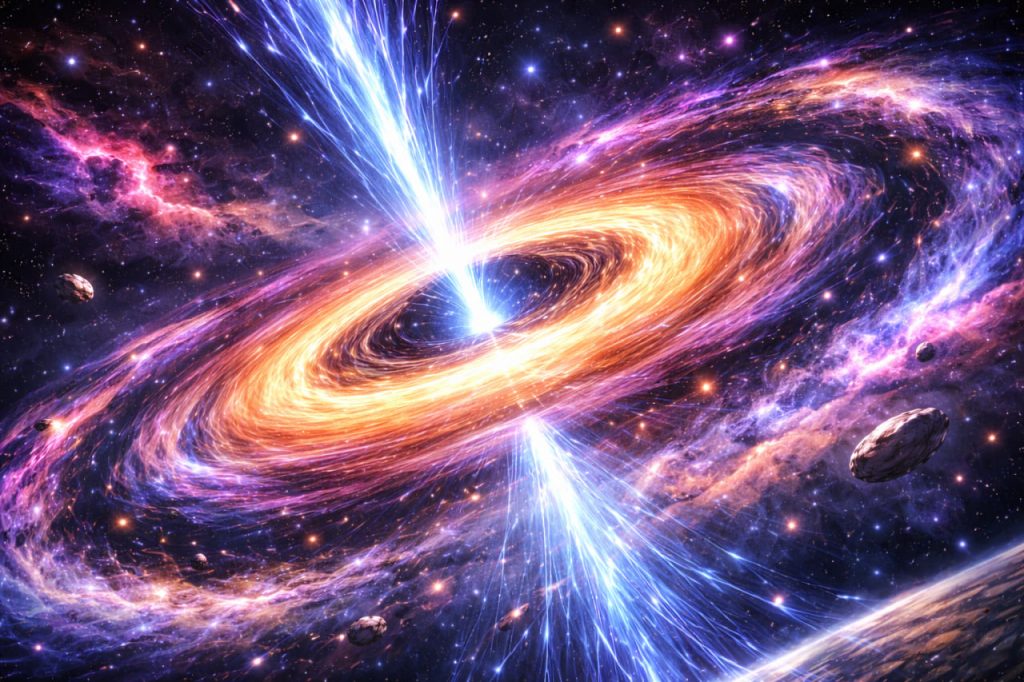
Quasars are among the brightest and most energetic objects ever observed in the universe. Although they appear as point-like sources of light, quasars are not stars but the active cores of distant galaxies powered by supermassive black holes. They shine so intensely that they can outshine all the stars in their host galaxies combined. Most quasars are observed in the early universe, making them key markers of cosmic youth and rapid galactic growth. Studying quasars allows astronomers to look back in time and understand how galaxies and black holes evolved together.
What a Quasar Really Is
A quasar is a type of active galactic nucleus (AGN), formed when a supermassive black hole actively accretes large amounts of surrounding matter. Gas and dust falling toward the black hole form a rapidly rotating accretion disk, where gravitational energy is converted into radiation. This process releases enormous amounts of light across the electromagnetic spectrum, from radio waves to X-rays. The black hole itself emits no light; the quasar’s brilliance comes entirely from the matter being heated and accelerated before it crosses the event horizon.
Why Quasars Are So Bright
The extreme brightness of quasars comes from the efficiency of black hole accretion. Converting mass into energy through accretion is far more efficient than nuclear fusion in stars. Even a relatively small amount of infalling matter can produce extraordinary luminosity. Powerful jets of particles may also be launched from the regions near the black hole, adding to the quasar’s energy output. This combination makes quasars visible across billions of light-years.
Quasars and Young Galaxies
Quasars are most commonly found in the early universe, when galaxies were rich in gas and undergoing rapid formation. During this period, supermassive black holes grew quickly, fueling intense quasar activity. Over time, as gas supplies diminish and galaxies mature, quasar activity declines. This is why nearby galaxies rarely host bright quasars today. Quasars therefore represent a transitional phase in the life cycle of galaxies.
Impact on Their Host Galaxies
Despite being relatively small compared to their host galaxies, quasars have a profound influence on their surroundings. The intense radiation and energetic outflows can heat or expel gas, regulating star formation. This process, known as feedback, helps explain why galaxies stop forming stars after certain stages of growth. Quasars are not just passive beacons; they actively shape the evolution of their galaxies.
Why Quasars Matter
Quasars serve as cosmic probes, illuminating the distant universe and revealing conditions in early cosmic epochs. Their light carries information about intergalactic gas, cosmic structure, and the growth of black holes. According to astrophysicist Dr. Martin Rees:
“Quasars are signposts of the universe’s most
dramatic phases of growth and transformation.”
Through quasars, astronomers study both the extremes of physics and the history of the cosmos.
Interesting Facts
- Quasars can be visible from billions of light-years away.
- They are powered by supermassive black holes, not stars.
- Quasar activity was far more common in the early universe.
- Some quasars emit powerful jets spanning entire galaxies.
- Their brightness can exceed that of thousands of galaxies combined.
Glossary
- Quasar — an extremely luminous active galactic nucleus.
- Supermassive Black Hole — a black hole with millions to billions of solar masses.
- Accretion Disk — rotating matter spiraling into a black hole.
- Active Galactic Nucleus — a galaxy core powered by black hole accretion.
- Feedback — the influence of energy output on surrounding matter.