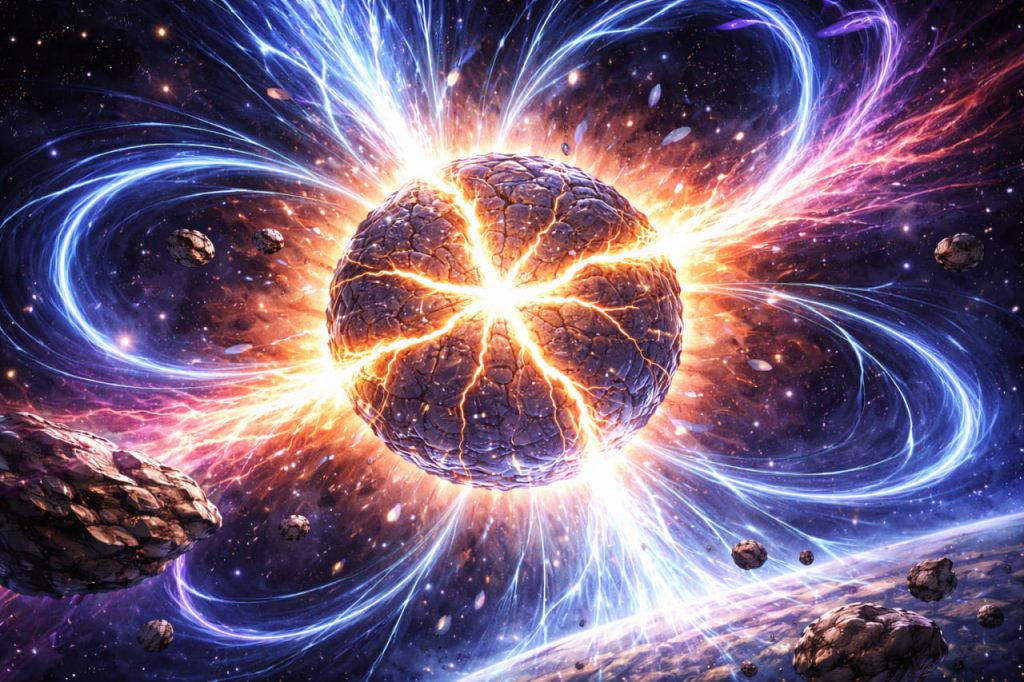
A starquake is one of the most extreme seismic events known in astrophysics. Unlike earthquakes on Earth, starquakes occur on neutron stars, where gravity, density, and magnetic forces reach extraordinary levels. These events involve sudden fractures in a star’s rigid outer crust, releasing vast amounts of energy in a fraction of a second. Although starquakes happen far beyond our solar system, their effects can be detected across the galaxy. Studying starquakes helps scientists understand matter under conditions impossible to replicate on Earth.
What Causes a Starquake
Starquakes are driven primarily by magnetic and rotational stress. In neutron stars—especially magnetars—immense magnetic fields slowly twist and deform the star’s crust. Over time, stress builds up as the crust resists this distortion. When the stress exceeds the crust’s structural limits, it suddenly cracks. This rapid release of energy is what astronomers call a starquake.
The Crust of a Neutron Star
The crust of a neutron star is the strongest known solid material in the universe. It consists of tightly packed atomic nuclei arranged in an exotic lattice, supported by immense pressure. Despite its strength, the crust is still brittle under extreme stress. When it fractures, the resulting vibrations propagate through the star, coupling with its magnetic field. These vibrations are key to understanding the signals astronomers observe.
Energy Release and Radiation
When a starquake occurs, energy is released in the form of X-rays and gamma rays. In magnetars, this energy release can be so intense that it briefly outshines all other sources in the galaxy at those wavelengths. The radiation is not caused by nuclear reactions, but by magnetic reconfiguration and crustal motion. Some starquakes produce repeating oscillations in brightness, known as quasi-periodic oscillations, which offer clues about the star’s internal structure.
How Starquakes Are Detected
Starquakes cannot be observed directly as physical cracks, but their effects are detectable through space-based observatories. Sudden spikes in high-energy radiation signal that a violent event has occurred. By analyzing the timing and frequency of these signals, scientists infer the properties of the neutron star’s crust and magnetic field. Each detected starquake provides rare data about extreme states of matter.
Why Starquakes Matter
Starquakes are not just dramatic cosmic events—they are natural experiments in fundamental physics. They help test theories about nuclear matter, magnetism, and the behavior of solids under immense pressure. According to astrophysicist Dr. Victoria Kaspi:
“Starquakes allow us to probe
the internal structure of neutron stars indirectly.”
Through these events, neutron stars reveal information that would otherwise remain inaccessible.
Interesting Facts
- Starquakes occur on neutron stars, not ordinary stars.
- The neutron star crust is the strongest known solid material.
- Some starquakes release more energy in seconds than the Sun emits in years.
- Magnetars experience starquakes more frequently than other neutron stars.
- Starquake signals can travel across the galaxy.
Glossary
- Starquake — a sudden fracture of a neutron star’s crust.
- Neutron Star — an ultra-dense remnant formed after a supernova.
- Magnetar — a neutron star with an extremely strong magnetic field.
- Gamma Rays — the highest-energy electromagnetic radiation.
- Crust — the solid outer layer of a neutron star.