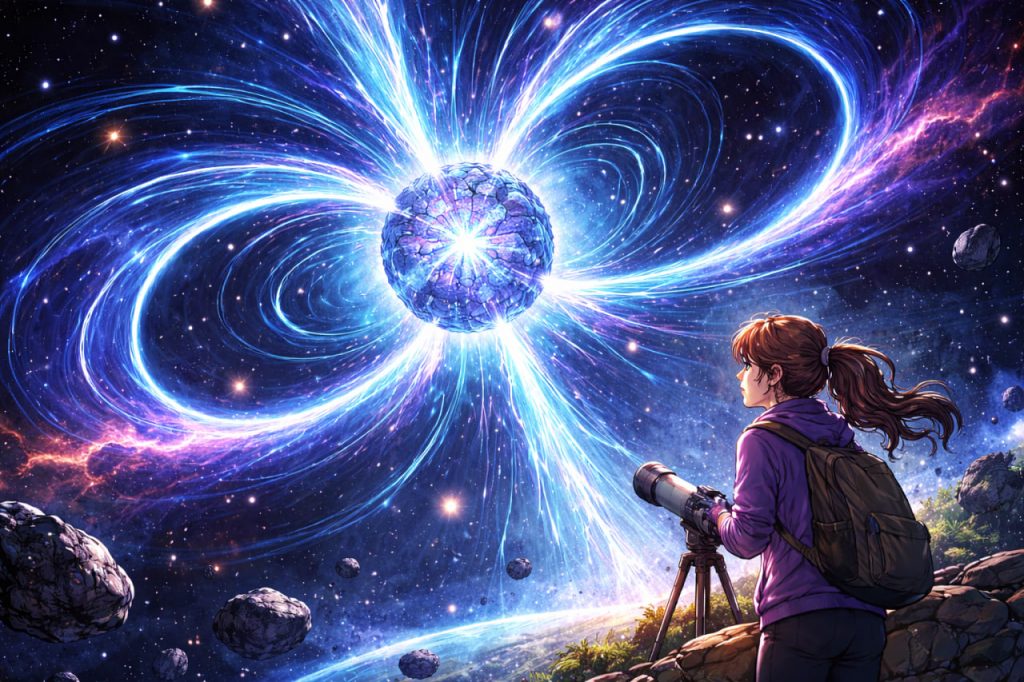
Magnetars are among the most extreme and mysterious objects known in astrophysics. They are a rare type of neutron star distinguished not by their mass or size, but by their extraordinary magnetic fields, the strongest ever observed in the universe. These magnetic fields are so intense that they reshape matter, distort atomic structures, and release enormous bursts of energy. Although magnetars are relatively small on cosmic scales, their influence can be felt across vast distances. Studying magnetars provides insight into physics under conditions impossible to recreate on Earth.
What Is a Magnetar
A magnetar is a type of neutron star formed after the collapse of a massive star during a supernova. Like all neutron stars, magnetars are incredibly dense, packing more mass than the Sun into a sphere roughly 20 kilometers wide. What sets magnetars apart is their magnetic field strength, which can be trillions of times stronger than Earth’s magnetic field. This extreme magnetism dominates every physical process occurring on and around the star.
How Magnetars Get Their Extreme Magnetic Fields
The origin of a magnetar’s magnetic field lies in the conditions present at its birth. When the core of a massive star collapses, it can rotate rapidly and compress magnetic field lines into an ultra-dense configuration. This process amplifies the magnetic field to extraordinary levels. Over time, the magnetic field slowly decays, releasing vast amounts of energy. This decay is the primary power source behind magnetar activity, rather than rotation or nuclear reactions.
Violent Outbursts and Starquakes
Magnetars are known for producing sudden, intense bursts of X-rays and gamma rays. These events occur when stresses caused by magnetic forces crack the star’s rigid outer crust in events known as starquakes. The released energy can briefly outshine entire galaxies in high-energy radiation. Even from great distances, such bursts can affect Earth’s upper atmosphere. These violent episodes make magnetars some of the most energetic transient sources in the universe.
Effects of Extreme Magnetism
The magnetic field near a magnetar is so strong that it alters the behavior of matter itself. At close range, magnetic forces can distort atomic shapes and affect how light propagates through space. The vacuum around a magnetar behaves differently than empty space elsewhere, exhibiting quantum effects normally too weak to observe. These conditions allow scientists to test theories of physics in regimes far beyond laboratory capabilities.
Why Magnetars Matter
Magnetars help bridge astrophysics, nuclear physics, and quantum theory. They offer a natural laboratory for studying matter at extreme density and magnetism. Understanding magnetars also improves knowledge of neutron stars as a whole and sheds light on the aftermath of stellar death. According to astrophysicist Dr. Chryssa Kouveliotou:
“Magnetars show us what nature can do
when gravity and magnetism reach their limits.”
Their study continues to challenge and refine modern physics.
Interesting Facts
- A magnetar’s magnetic field could erase data on a credit card from thousands of kilometers away.
- Magnetars are a rare subset of neutron stars.
- Some gamma-ray bursts may be linked to magnetar activity.
- Magnetar flares are among the brightest events in the high-energy universe.
- Their magnetic fields slowly decay over time, powering their emissions.
Glossary
- Magnetar — a neutron star with an extremely strong magnetic field.
- Neutron Star — a dense stellar remnant formed after a supernova.
- Starquake — a fracture of a neutron star’s crust caused by magnetic stress.
- Gamma Rays — the highest-energy form of electromagnetic radiation.
- Magnetic Field — a region where magnetic forces influence matter and energy.