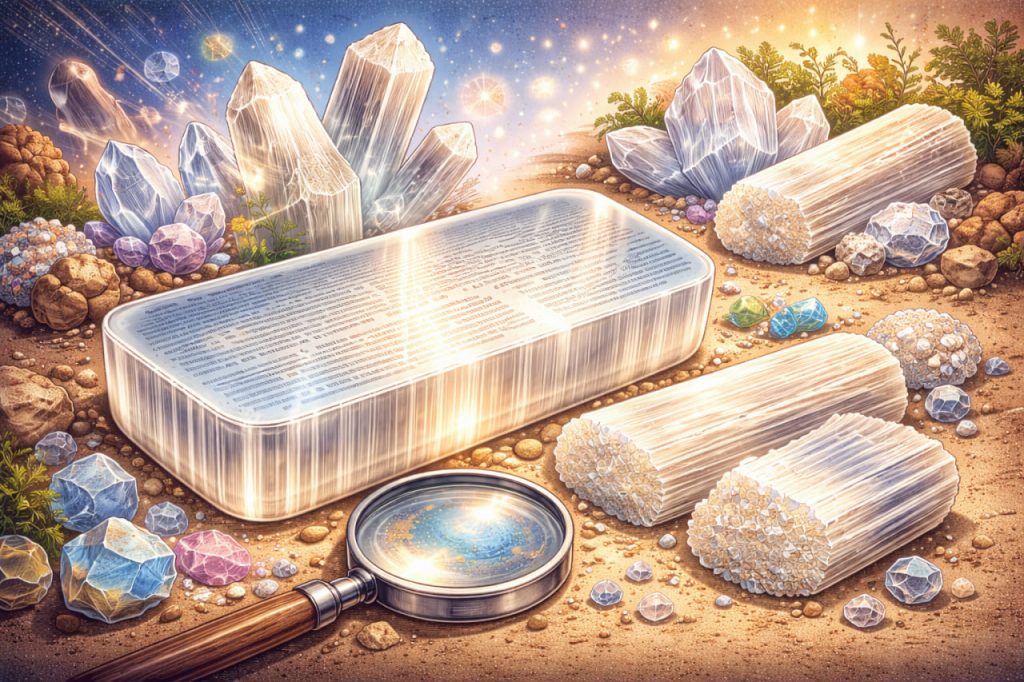
Ulexite is a rare and visually striking mineral that has fascinated scientists and collectors for over a century. Often referred to as the “television stone,” ulexite possesses unusual optical properties that allow it to transmit images from one surface to another. At first glance, it may look like a bundle of silky white fibers or soft crystalline strands, but its internal structure hides remarkable physical behavior. Ulexite forms in arid environments where evaporation concentrates mineral-rich waters, making it a product of very specific geological conditions. Beyond its visual appeal, ulexite plays an important role in industrial processes due to its high boron content. Understanding ulexite means exploring the intersection of geology, physics, and applied materials science.
What Ulexite Is and How It Forms
Ulexite is a borate mineral composed primarily of sodium, calcium, boron, oxygen, and water. It forms in evaporite deposits, typically in dry regions where ancient lakes or seas once existed. As water evaporates, dissolved minerals crystallize, and under the right chemical conditions, ulexite fibers begin to grow. These fibers align in parallel bundles, creating the mineral’s characteristic internal structure. Over time, repeated cycles of evaporation and crystallization allow ulexite deposits to expand. This formation process explains why ulexite is commonly found in deserts such as those in South America and parts of the western United States.
The Optical Phenomenon Behind the “Television Stone”
What makes ulexite truly unique is its ability to transmit light through its fibrous structure. Each fiber acts like a natural optical channel, guiding light from one end of the crystal to the other. When a polished piece of ulexite is placed on printed text, the image appears projected onto the top surface of the stone. This effect resembles the way fiber-optic cables transmit information. According to mineral physicist Dr. Alan Pierce:
“Ulexite is a natural example of fiber optics,
demonstrating how structure alone can control light behavior.”
This phenomenon is purely physical and does not involve any electronic components, making ulexite a powerful teaching tool in optics.
Physical Properties and Appearance
Ulexite typically appears white to colorless and has a soft, fibrous texture. It is relatively fragile and can be scratched easily, which limits its use in jewelry. The mineral often feels lightweight due to its internal water content and fibrous arrangement. When exposed to moisture, ulexite can alter or dissolve slowly, which is why specimens must be stored carefully. Its silky luster and unusual growth patterns make it popular among mineral collectors, even though it requires delicate handling. These physical traits reflect the mineral’s high hydration and delicate crystal bonding.
Industrial Importance of Ulexite
Beyond its visual properties, ulexite is an important source of boron, an element widely used in industry. Boron compounds are essential in the production of glass, ceramics, detergents, fertilizers, and insulating materials. In these applications, ulexite is typically processed rather than used in its natural crystal form. Its boron content makes it valuable despite its softness and fragility. Industrial mining of ulexite focuses on large evaporite deposits rather than individual crystals, highlighting the difference between scientific interest and commercial use.
Scientific and Educational Value
Ulexite holds special significance in education because it provides a tangible demonstration of abstract physical concepts. Students can directly observe how light travels through aligned structures, making it easier to understand principles behind fiber optics and waveguides. In geology, ulexite serves as an example of evaporite mineral formation and borate chemistry. While it is not rare in an absolute sense, well-preserved specimens with strong optical clarity are uncommon. This combination of accessibility and uniqueness ensures ulexite’s continued relevance in both classrooms and research discussions.
Interesting Facts
- Ulexite can project images without electricity or lenses.
- It is sometimes called the “TV stone” because of its image-transmitting ability.
- The mineral contains a high percentage of boron, an industrially important element.
- Ulexite fibers function similarly to modern fiber-optic cables.
- Well-polished specimens show the optical effect most clearly.
Glossary
- Ulexite — a hydrated borate mineral with fibrous crystal structure.
- Borate Mineral — a mineral containing boron and oxygen.
- Evaporite Deposit — a mineral deposit formed by the evaporation of water.
- Fiber Optics — technology that transmits light through thin fibers.
- Hydrated Mineral — a mineral that contains water within its crystal structure.