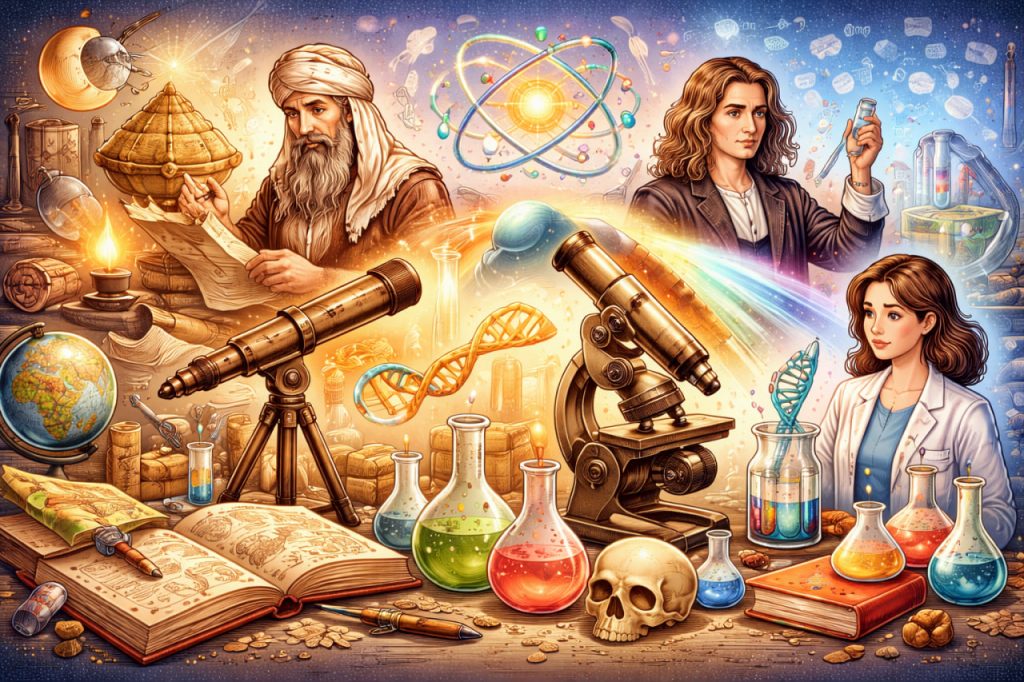
The history of science is the story of how humanity gradually learned to understand the world through observation, experimentation, and reasoning. Long before modern laboratories and advanced instruments existed, people sought patterns in nature, the sky, and living organisms. Over centuries, curiosity transformed into systematic knowledge, laying the foundations of modern civilization. Scientific progress did not follow a straight path; it advanced through trial and error, debates, breakthroughs, and sometimes resistance. Each era added new tools, methods, and perspectives that reshaped how reality was interpreted. Studying the history of science helps us understand not only scientific discoveries, but also how human thinking itself evolved.
Early Knowledge and Ancient Civilizations
The roots of science can be traced back to ancient civilizations, where practical needs drove early discoveries. In Mesopotamia and Egypt, people developed mathematics, astronomy, and medicine to support agriculture, construction, and navigation. Ancient scholars observed celestial movements to create calendars and predict seasonal changes. In Greece, thinkers such as Aristotle and Archimedes emphasized logic, geometry, and systematic inquiry, shaping early scientific philosophy. Knowledge was often intertwined with religion and mythology, yet careful observation still played a central role. According to historian of science Dr. Helen Crawford:
“Early science was born from necessity,
but it survived because humans learned to question their own explanations.”
These early contributions formed the intellectual groundwork for later scientific revolutions.
The Scientific Revolution
The Scientific Revolution of the 16th and 17th centuries marked a turning point in human understanding of nature. During this period, observation and experimentation replaced reliance on ancient authority. Figures such as Galileo Galilei, Johannes Kepler, and Isaac Newton introduced mathematical laws to describe motion, gravity, and planetary behavior. The invention of new instruments, including the telescope and microscope, revealed worlds previously invisible to the human eye. Science became a method rather than a collection of beliefs. This shift established principles such as reproducibility, evidence-based reasoning, and skepticism, which remain central to science today.
Expansion of Knowledge in the Modern Era
From the 18th to the 20th century, science expanded rapidly across multiple disciplines. Chemistry uncovered the structure of matter, biology explained evolution and heredity, and physics revealed the nature of energy and atomic structure. Advances in technology allowed experiments at scales ranging from subatomic particles to distant galaxies. Scientific institutions, journals, and universities formalized research and collaboration. At the same time, science became increasingly specialized, with experts focusing on narrow fields while contributing to a larger body of shared knowledge. This era demonstrated how cumulative discovery accelerates progress.
Science, Society, and Ethics
Science has always interacted closely with society, influencing and being influenced by cultural, political, and economic forces. Scientific discoveries have improved health, communication, and living standards, but they have also raised ethical questions. Technologies such as nuclear energy, genetic engineering, and artificial intelligence highlight the responsibility that comes with scientific power. Public trust in science depends not only on accuracy, but also on transparency and ethical conduct. Understanding the historical context of scientific advances helps society navigate these challenges more thoughtfully.
Why the History of Science Matters Today
The history of science reminds us that knowledge is not fixed, but constantly evolving. Ideas once considered absolute truths have been revised or replaced as new evidence emerged. This perspective encourages humility, critical thinking, and openness to change. By studying past successes and mistakes, scientists and citizens alike can better evaluate modern claims and future innovations. The story of science is ultimately a story of human curiosity—our ongoing effort to understand the universe and our place within it.
Interesting Facts
- Early scientific knowledge often developed from agriculture, navigation, and medicine.
- The Scientific Revolution introduced the idea that experiments must be repeatable.
- Many major discoveries occurred after challenging long-held beliefs.
- Scientific progress often accelerates with new tools and technologies.
- Some theories once rejected later became foundations of modern science.
Glossary
- Scientific Method — a systematic approach to investigation based on observation and experimentation.
- Scientific Revolution — a period of major transformation in scientific thinking during the 16th–17th centuries.
- Empirical Evidence — information gained through observation or experiment.
- Theory — a well-supported explanation of natural phenomena.
- Ethics in Science — principles guiding responsible research and application of knowledge.