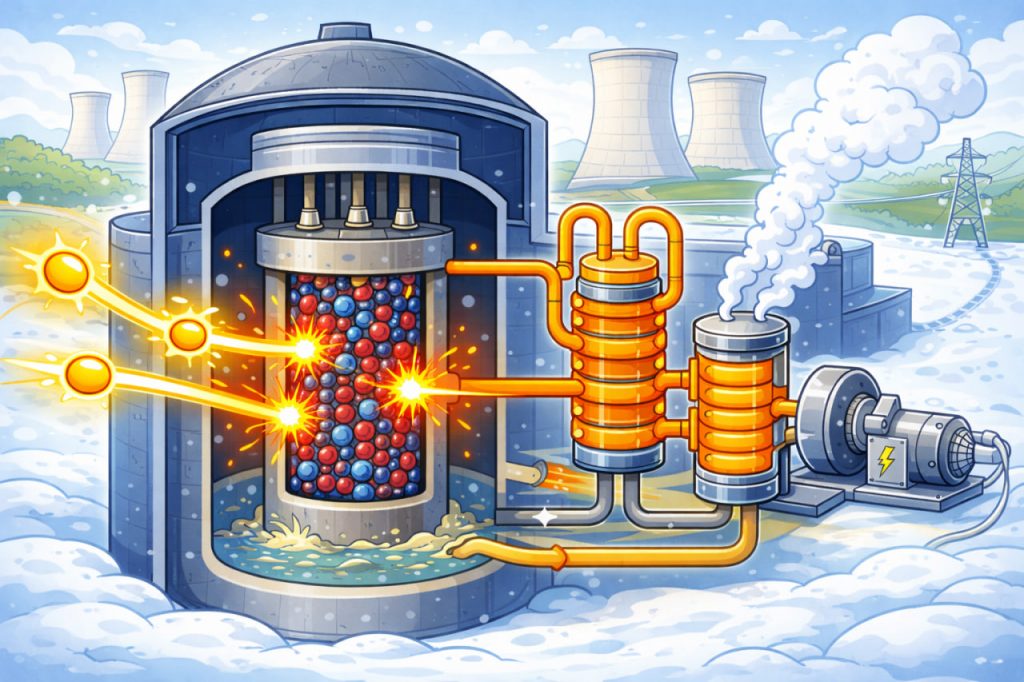
Fast neutron reactors are one of the most advanced and conceptually important technologies in nuclear energy. Unlike conventional nuclear reactors, they operate using fast (high-energy) neutrons rather than slowed, or thermal, neutrons. This fundamental difference allows them to use nuclear fuel more efficiently and opens possibilities that traditional reactors cannot achieve. Fast reactors are often discussed in the context of long-term energy sustainability, nuclear waste reduction, and advanced fuel cycles. Although technologically complex, they represent a significant step in the evolution of nuclear power. Understanding how fast neutron reactors work helps explain why they attract both scientific interest and public debate.
How Fast Neutron Reactors Work
In a fast neutron reactor, the chain reaction is maintained by neutrons that retain their high energy after fission. Unlike thermal reactors, these systems do not use moderators such as water or graphite to slow neutrons down. The reactor core is designed so that fast neutrons can efficiently induce further fission events. Because fast neutrons interact differently with nuclear materials, the reactor can operate with a broader range of fuels. This design requires precise engineering and careful control of neutron behavior. The absence of moderation fundamentally changes the physics of the reactor and its fuel dynamics.
Fuel Efficiency and Closed Fuel Cycles
One of the key advantages of fast neutron reactors is their ability to use fuel more efficiently. They can operate on mixed oxide fuels and can even utilize materials that are considered waste in conventional reactors. In some configurations, fast reactors are capable of breeding, meaning they produce more fissile material than they consume. This feature significantly extends the usable energy extracted from nuclear fuel. As a result, fast reactors are often linked to the concept of a closed nuclear fuel cycle. According to nuclear engineer Dr. Victor Hansen:
“Fast reactors transform nuclear energy from a short-term resource
into a long-term strategic option.”
This potential makes them attractive for future energy planning.
Coolants and Reactor Design
Because water would slow neutrons, fast reactors rely on alternative coolants. Common choices include liquid sodium, lead, or lead–bismuth alloys, which efficiently transfer heat without moderating neutrons. These coolants allow high operating temperatures and improved thermal efficiency. However, they also introduce engineering challenges, such as chemical reactivity or material corrosion. Reactor design must balance safety, heat removal, and structural integrity. Advanced monitoring and passive safety features are critical components of modern fast reactor concepts.
Safety Considerations
Safety in fast neutron reactors is addressed through multiple layers of design and control. While their physics differs from thermal reactors, modern designs emphasize passive safety mechanisms that respond automatically to abnormal conditions. Fuel composition, core geometry, and coolant behavior are carefully engineered to stabilize reactions. As with all nuclear technologies, rigorous regulation and oversight are essential. Researchers continue to study how fast reactors behave under various scenarios to further improve safety margins.
Role in the Future of Nuclear Energy
Fast neutron reactors are often viewed as a key technology for the future of nuclear power. They offer solutions to long-standing challenges such as fuel scarcity and long-lived radioactive waste. Several countries invest in research and demonstration projects to refine these systems. While they are not yet widely deployed, their development represents a strategic effort to make nuclear energy more sustainable and efficient. The future role of fast reactors will depend on technological progress, economic factors, and societal acceptance.
Interesting Facts
- Fast neutron reactors operate without slowing neutrons down.
- They can use fuel considered waste in conventional reactors.
- Some designs are capable of producing more fuel than they consume.
- Liquid metals are commonly used as coolants.
- Fast reactors support the concept of a closed nuclear fuel cycle.
Glossary
- Fast Neutron — a high-energy neutron produced during nuclear fission.
- Moderator — a material used to slow neutrons in conventional reactors.
- Breeder Reactor — a reactor that generates more fissile material than it uses.
- Closed Fuel Cycle — a system where nuclear fuel is reused after processing.
- Coolant — a substance used to remove heat from a reactor core.