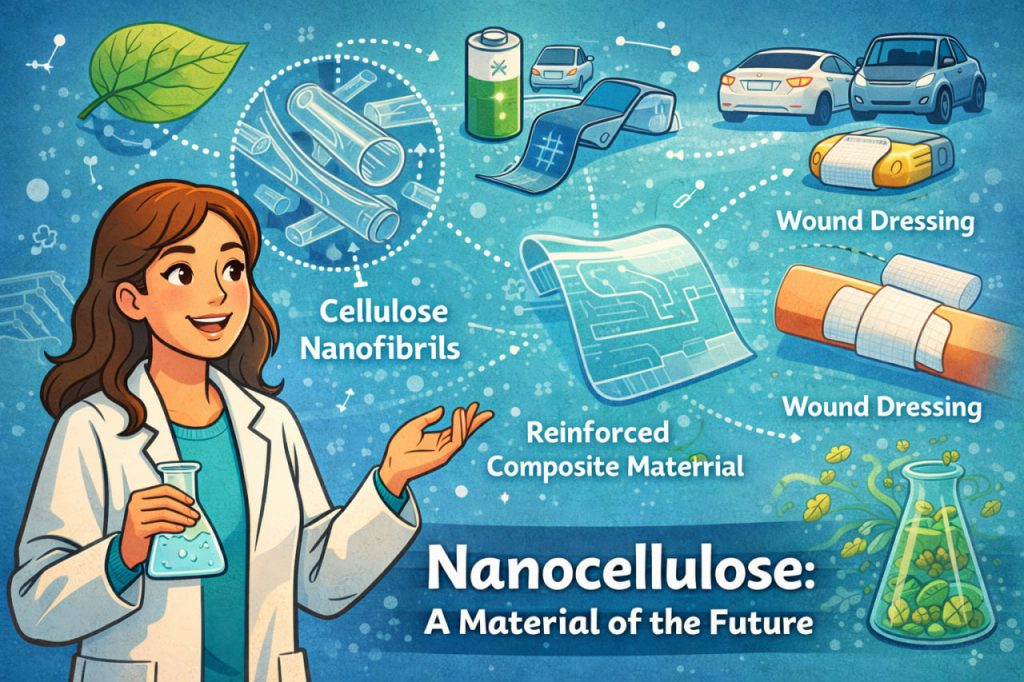
Nanocellulose is an advanced material derived from one of the most common natural substances on Earth — cellulose. Despite its natural origin, nanocellulose exhibits exceptional mechanical strength, low weight, and remarkable versatility at the nanoscale. These properties make it a promising solution for challenges in materials science, medicine, energy, and sustainability. As industries seek alternatives to plastics and carbon-intensive materials, nanocellulose has emerged as a strong candidate due to its renewable nature and low environmental footprint. Scientists continue to explore how manipulating cellulose fibers at the nanometer level unlocks entirely new behaviors not seen in bulk materials. Understanding nanocellulose is key to understanding the future of sustainable high-performance materials.
What Is Nanocellulose and How It Is Produced
Nanocellulose consists of cellulose fibers broken down to nanometer-scale dimensions, typically extracted from wood, plants, algae, or even bacteria. At this scale, cellulose fibers become extremely strong, flexible, and highly reactive due to their large surface area. There are several main types of nanocellulose, including cellulose nanofibrils (CNF), cellulose nanocrystals (CNC), and bacterial nanocellulose. Each type is produced using different mechanical, chemical, or biological processes, such as high-pressure homogenization or acid hydrolysis. According to materials scientist Dr. Elena Morozova:
“When cellulose is reduced to the nanoscale, it stops behaving like ordinary plant matter
and starts acting like an advanced engineering material.”
This transformation explains why nanocellulose can rival metals and synthetic polymers in performance.
Unique Properties at the Nanoscale
The most striking feature of nanocellulose is its exceptional strength-to-weight ratio. In some forms, it can be stronger than steel while remaining lightweight and flexible. Nanocellulose is also biodegradable, non-toxic, and capable of forming transparent films and strong composites. Its surface chemistry allows it to bond easily with other materials, making it highly adaptable. Additionally, nanocellulose can retain large amounts of water, which is useful in biomedical and filtration applications. These combined properties position nanocellulose as a bridge between natural materials and cutting-edge nanotechnology.
Applications in Industry and Technology
Nanocellulose is already being tested and applied across multiple industries. In packaging, it improves strength and barrier properties while reducing plastic use. In construction and automotive manufacturing, nanocellulose-reinforced composites lower weight without sacrificing durability. The electronics industry explores nanocellulose as a flexible, transparent substrate for displays and sensors. Energy researchers investigate its use in battery separators and supercapacitors, where its structure enhances ion transport. As production methods scale up, nanocellulose is moving steadily from laboratory research into commercial products.
Biomedical and Environmental Uses
One of the most promising areas for nanocellulose lies in biomedicine. Its biocompatibility allows it to be used in wound dressings, tissue scaffolds, and drug delivery systems. Nanocellulose-based hydrogels can mimic human tissue, supporting cell growth and healing. Environmentally, nanocellulose plays a role in water purification, where it helps filter heavy metals, bacteria, and microplastics. Environmental engineer Dr. Samuel Reed notes:
“Nanocellulose offers a rare combination —
high performance without sacrificing environmental responsibility.”
This balance makes it especially attractive for sustainable innovation.
Challenges and Future Development
Despite its promise, nanocellulose still faces challenges related to cost, large-scale production, and standardization. Producing consistent material quality at industrial scale remains complex. Researchers are also studying long-term durability and behavior in different environments. However, advances in green chemistry and processing technologies are rapidly improving efficiency. As investment and research continue, nanocellulose is expected to play a significant role in the transition toward a bio-based economy.
Interesting Facts
- Nanocellulose fibers can be thousands of times thinner than a human hair.
- Some forms of nanocellulose are stronger than steel by weight.
- Bacterial nanocellulose can be grown in laboratories using living microorganisms.
- Nanocellulose films can be transparent and flexible, suitable for electronics.
- Cellulose is the most abundant organic polymer on Earth, making nanocellulose highly scalable.
Glossary
- Nanocellulose — cellulose material engineered at the nanometer scale with enhanced properties.
- Cellulose Nanofibrils (CNF) — long, flexible nanofibers derived from plant cellulose.
- Cellulose Nanocrystals (CNC) — rigid, rod-like nanoparticles extracted from cellulose.
- Biocompatibility — the ability of a material to function safely within biological systems.
- Composite Material — a material made by combining two or more substances to enhance performance.