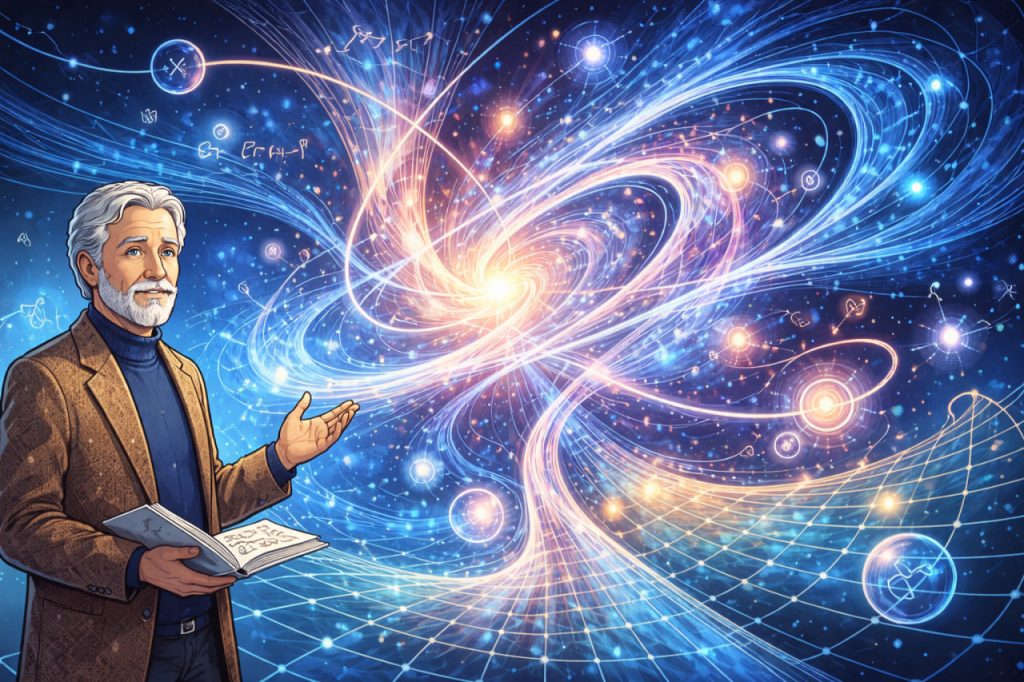
The theory of the physical vacuum proposed by Georgy Shipov represents one of the most controversial and unconventional concepts in modern theoretical physics. Unlike standard models that describe vacuum as a quantum field with fluctuating energy, Shipov’s approach treats the vacuum as a structured, dynamic medium with its own geometry and physical properties. This theory attempts to go beyond classical general relativity and quantum field theory by introducing additional degrees of freedom linked to space-time itself. Although not accepted within mainstream physics, the theory has attracted attention for its ambition to unify gravity, inertia, and fundamental interactions. Understanding Shipov’s ideas requires distinguishing between established physics and speculative theoretical frameworks. For this reason, the theory is best approached as a philosophical and mathematical hypothesis rather than an experimentally confirmed model.
What Is the Physical Vacuum in Shipov’s View
In conventional physics, the vacuum is often described as empty space permeated by quantum fluctuations. In contrast, Shipov defines the physical vacuum as a non-material yet geometrically active medium that underlies all physical reality. According to this view, space itself possesses internal structure, capable of deformation, rotation, and torsion. These properties are not directly observable but are proposed to influence matter, energy, and motion. Shipov’s vacuum is therefore not passive emptiness, but an active foundation from which physical phenomena emerge. This interpretation challenges traditional assumptions about space and introduces new mathematical objects to describe its behavior.
Torsion, Spin, and Absolute Space
A central element of Shipov’s theory is the concept of torsion, a geometric property related to rotational deformation of space-time. While general relativity describes gravity through curvature, Shipov argues that curvature alone is insufficient to describe all physical interactions. He introduces torsion as an independent degree of freedom associated with spin and rotational motion. In this framework, inertia and gravity arise not only from mass-energy, but also from interactions with the structured vacuum. Shipov further proposes the existence of an absolute reference frame, embedded within the vacuum itself, a concept that sharply contradicts Einstein’s principle of relativity. According to theoretical physicist Dr. Viktor Kolesnikov:
“Shipov’s model replaces the idea of empty space
with a geometrical medium capable of transmitting physical influence.”
This claim is one of the main reasons the theory remains outside accepted physics.
Mathematical Foundations and Extensions
The theory of physical vacuum is built upon extended geometric formalisms, including generalizations of Einstein–Cartan theory and affine geometry. Shipov introduces equations that describe vacuum dynamics independently of matter, suggesting that space-time geometry can exist and evolve even in the absence of particles or fields. These equations aim to explain gravity, inertia, and electromagnetic phenomena within a single mathematical framework. However, critics argue that the theory lacks empirical validation and does not produce testable predictions distinguishable from established models. Without experimental support, such mathematical constructions remain speculative despite their internal consistency.
Scientific Criticism and Mainstream Perspective
From the standpoint of mainstream physics, Shipov’s theory faces significant challenges. Most physicists reject the idea of an absolute reference frame and independent vacuum dynamics because these concepts conflict with well-tested principles of relativity and quantum mechanics. Additionally, the theory has not been confirmed by reproducible experiments or observations. While some supporters claim indirect evidence, these claims have not been accepted by the broader scientific community. Physicist Dr. Elena Markova summarizes the consensus view:
“Without experimental verification, even elegant theories
remain mathematical speculation rather than physical law.”
As a result, Shipov’s theory is typically classified as non-mainstream or alternative physics.
Why the Theory Still Attracts Interest
Despite widespread criticism, the theory of physical vacuum continues to attract interest among researchers exploring foundational questions about space, time, and the origin of physical laws. Its appeal lies in its attempt to describe reality as emerging from geometry itself, rather than from particles alone. Philosophically, it resonates with historical ideas about the ether and modern discussions about the nature of space-time. While it does not currently influence practical physics or technology, the theory serves as an example of how far theoretical speculation can go when attempting to unify fundamental concepts. Studying such ideas can be useful for understanding the boundaries between established science and speculative thought.
P.S. Unfortunately, modern science has a number of unresolved problems, and in particular, due to the generally accepted theories that form the basis of modern science. For those who want to take science out of its current confines and into a new direction, I recommend that you study the theory of the physical vacuum in more detail, as well as the available information about torsion fields, and remember the discarded theory of the aether, which was the primary theory before Einstein’s theory of relativity.
Interesting Facts
- Shipov’s theory introduces vacuum equations without matter, unlike general relativity.
- The concept of torsion existed before Shipov, but he elevated it to a central role.
- The theory allows for a form of absolute space, rejected by modern relativity.
- No confirmed experiments currently support the physical vacuum model.
- The theory is often discussed in the context of philosophy of science, not applied physics.
Glossary
- Physical Vacuum — a hypothetical structured medium underlying space-time.
- Torsion — a geometric property describing rotational deformation of space-time.
- General Relativity — Einstein’s theory describing gravity as curvature of space-time.
- Absolute Reference Frame — a proposed universal frame of rest, not accepted in modern physics.
- Speculative Theory — a theoretical model lacking experimental confirmation.