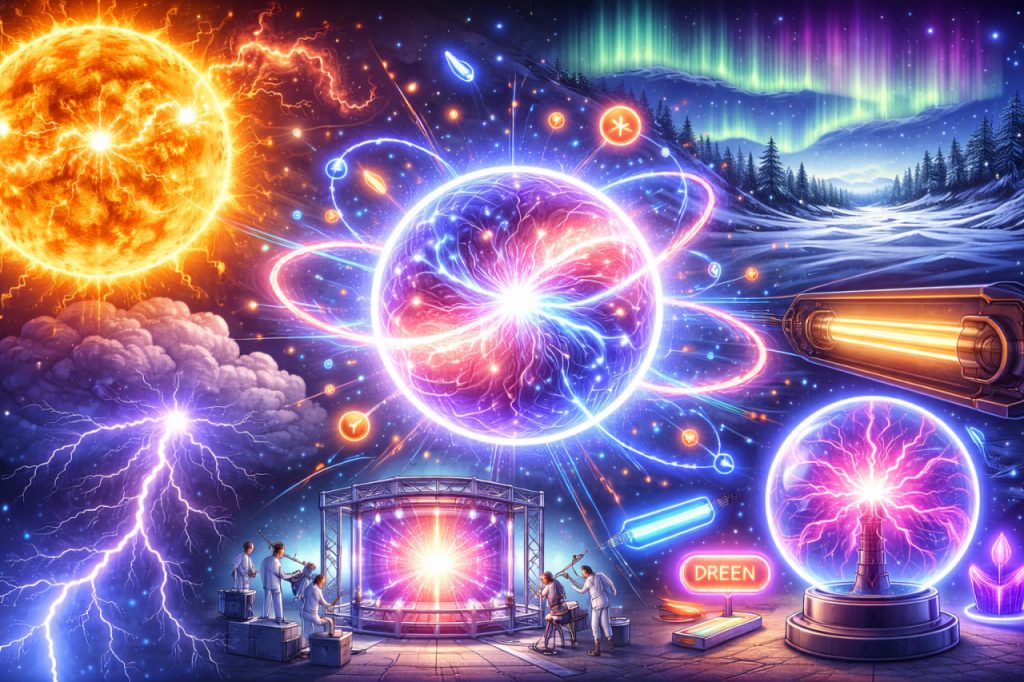
Plasma is often described as the fourth state of matter, yet this definition barely captures its true significance. While solids, liquids, and gases dominate everyday experience, plasma governs the behavior of stars, cosmic space, and many high-energy processes on Earth. It forms when matter becomes so energized that electrons separate from atoms, creating a dynamic mixture of charged particles. Unlike ordinary gases, plasma responds strongly to electric and magnetic fields, leading to complex collective behavior. This makes plasma both extraordinarily powerful and challenging to control. Understanding plasma is essential for explaining how the universe works at its most fundamental level.
How Plasma Forms
Plasma forms when sufficient energy is supplied to a gas to cause ionization, the process by which electrons are stripped from atoms. This energy can come from extreme heat, strong electric fields, or intense radiation. As electrons become free, the gas transforms into a conductive medium filled with ions and electrons. These charged particles interact not only through collisions, but also through long-range electromagnetic forces. As a result, plasma behaves very differently from neutral gases, often forming waves, filaments, and self-organized structures. Plasma physicist Dr. Michael Brown explains:
“Plasma is not just a hot gas —
it is a collective state where particles move together under electromagnetic forces.”
This collective nature is what makes plasma unique among all states of matter.
Key Properties of Plasma
One of plasma’s defining characteristics is its electrical conductivity. Because it contains free charges, plasma can carry electric currents and generate magnetic fields. It also supports wave phenomena, such as oscillations and instabilities, that cannot exist in solids or liquids. Plasma can glow, twist, and reorganize itself in response to changing conditions. These properties allow plasma to transfer energy efficiently across large distances. At the same time, they introduce instability, making plasma difficult to confine and predict. These features place plasma at the intersection of electromagnetism, fluid dynamics, and statistical physics.
Plasma in Nature
Plasma dominates the visible universe. All stars, including the Sun, are massive spheres of plasma where nuclear fusion occurs. Lightning represents a brief but intense plasma discharge in Earth’s atmosphere. Auroras form when charged particles from the solar wind collide with atmospheric gases, creating glowing plasma structures near the poles. Even space between stars contains diffuse plasma shaped by magnetic fields. Astrophysicist Dr. Elena Markov notes:
“If you want to understand the universe,
you must understand plasma — because that is what the universe is made of.”
These natural examples show that plasma is not exotic, but fundamental.
Plasma in Technology and Research
Plasma plays an essential role in modern technology. It is used in fluorescent lamps, plasma displays, semiconductor manufacturing, and surface treatment. In medicine, low-temperature plasma is explored for sterilization and tissue interaction. Plasma research is especially important in the pursuit of nuclear fusion, where controlled plasma could provide a nearly limitless energy source. Engineers must carefully manage temperature, magnetic confinement, and instability to keep plasma under control. Advances in plasma technology continue to shape electronics, energy systems, and materials science.
Why Plasma Is Scientifically Unique
Plasma challenges traditional ideas about matter because its behavior is governed more by fields than by direct contact between particles. This makes it capable of forming large-scale structures from microscopic interactions. Scientists describe plasma using complex mathematical models that combine multiple branches of physics. Its study connects laboratory experiments with space weather, astrophysics, and future energy technologies. Plasma is not simply another state of matter — it is a framework for understanding energetic systems across the universe.
Interesting Facts
- More than 99% of visible matter in the universe exists in a plasma state.
- Plasma can generate its own magnetic fields.
- Lightning is a short-lived but extremely hot plasma.
- The Sun’s energy is produced inside a plasma core.
- Plasma can exist at both extremely high and surprisingly low temperatures.
Glossary
- Plasma — an ionized state of matter consisting of free electrons and ions.
- Ionization — the process of removing electrons from atoms.
- Electromagnetic Force — interaction between charged particles and fields.
- Collective Behavior — motion governed by group interactions rather than individual collisions.
- Nuclear Fusion — an energy-producing process occurring in plasma under extreme conditions.