Alfvén waves are one of the most important phenomena in plasma physics and astrophysics, revealing how energy and information travel through magnetized space. They describe oscillations that occur when charged particles interact with magnetic fields, producing wave-like motions that can propagate over vast distances. These waves play a key role in shaping the behavior of plasmas found in stars, the solar wind, and planetary magnetospheres. Although invisible to the human eye, Alfvén waves influence processes ranging from space weather to energy transport in the universe. Their discovery helped bridge the gap between electromagnetism and fluid dynamics. Understanding Alfvén waves is essential for explaining how cosmic plasmas remain dynamic and structured.
Origin and Discovery
Alfvén waves were first described by Hannes Alfvén, who introduced the concept in the mid-20th century while studying the behavior of ionized gases in magnetic fields. At the time, the idea that magnetic fields could support wave motion in plasma was revolutionary. Alfvén showed that when plasma is threaded by a magnetic field, disturbances can travel along magnetic field lines rather than spreading randomly. This insight transformed plasma physics and later earned him the Nobel Prize. His work laid the foundation for modern space and astrophysical plasma research.
How Alfvén Waves Work
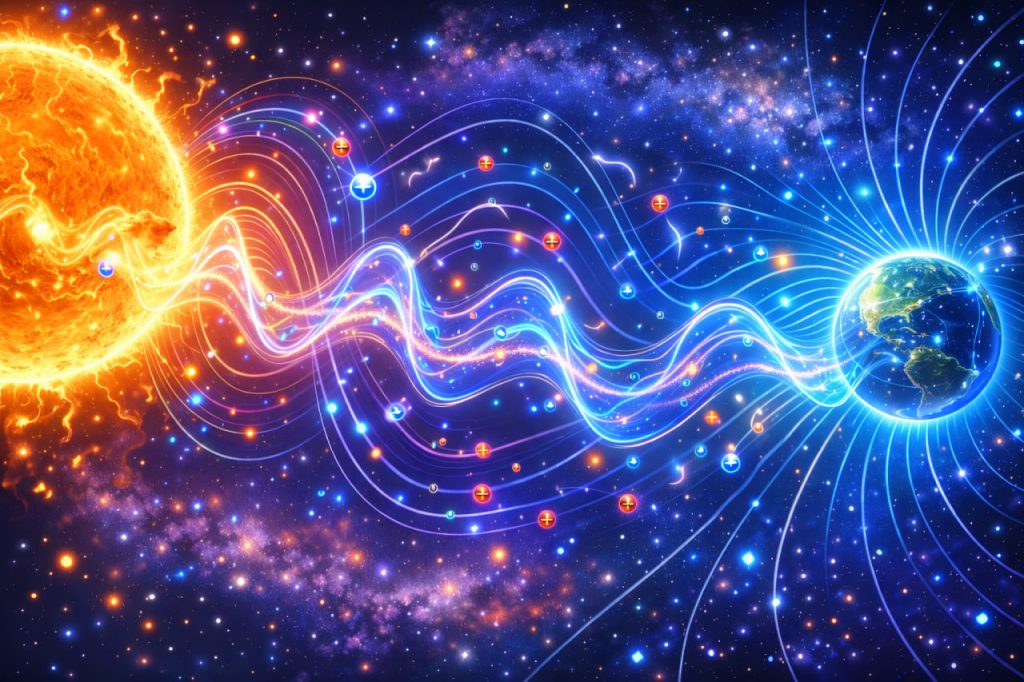
Alfvén waves arise when a magnetic field line embedded in plasma is disturbed and begins to oscillate. Because plasma consists of charged particles, it is strongly coupled to magnetic fields. When the field is displaced, magnetic tension acts like a restoring force, similar to how tension works in a stretched string. The oscillation then travels along the magnetic field line as a wave. Importantly, these waves move energy without transporting matter over long distances. This makes them highly efficient carriers of momentum and energy in space plasmas.
Alfvén Waves in Space and Astrophysics
In space, Alfvén waves are found almost everywhere plasma and magnetic fields coexist. They propagate through the solar wind, influence auroras, and contribute to the heating of the Sun’s corona. Observations suggest that these waves help transfer energy from the Sun’s surface into its outer atmosphere, explaining why the corona is much hotter than expected. In planetary magnetospheres, Alfvén waves connect solar activity with atmospheric effects, including geomagnetic storms. Astrophysicists also study Alfvén waves in interstellar clouds and accretion disks, where they affect turbulence and star formation.
Laboratory and Technological Relevance
Alfvén waves are not limited to space; they can also be generated and studied in laboratory plasmas. Controlled experiments help scientists test theoretical models and understand plasma stability. In fusion research, Alfvén waves are important because they interact with energetic particles inside reactors, influencing confinement and efficiency. Engineers must account for these interactions when designing advanced plasma systems. As plasma-based technologies expand, knowledge of Alfvén wave behavior becomes increasingly practical rather than purely theoretical.
Why Alfvén Waves Matter
Alfvén waves demonstrate that magnetic fields are not static structures but dynamic systems capable of carrying energy across enormous distances. They help explain how distant regions of space remain connected and responsive to changes. Beyond their physical significance, Alfvén waves represent a unifying concept linking laboratory physics with cosmic-scale phenomena. Their study continues to improve predictions of space weather and deepen understanding of the universe’s energetic processes. In this sense, Alfvén waves are a fundamental language of magnetized plasma.
Interesting Facts
- Alfvén waves travel along magnetic field lines, not across them.
- They can move energy without transporting plasma over long distances.
- These waves play a role in heating the solar corona.
- Alfvén waves exist both in space and laboratory plasmas.
- They were once controversial before becoming a core concept in plasma physics.
Glossary
- Plasma — an ionized state of matter consisting of charged particles.
- Magnetic Field Line — an imaginary line representing magnetic field direction.
- Magnetosphere — the region around a planet dominated by its magnetic field.
- Solar Wind — a stream of charged particles flowing from the Sun.
- Plasma Oscillation — collective wave-like motion of charged particles.