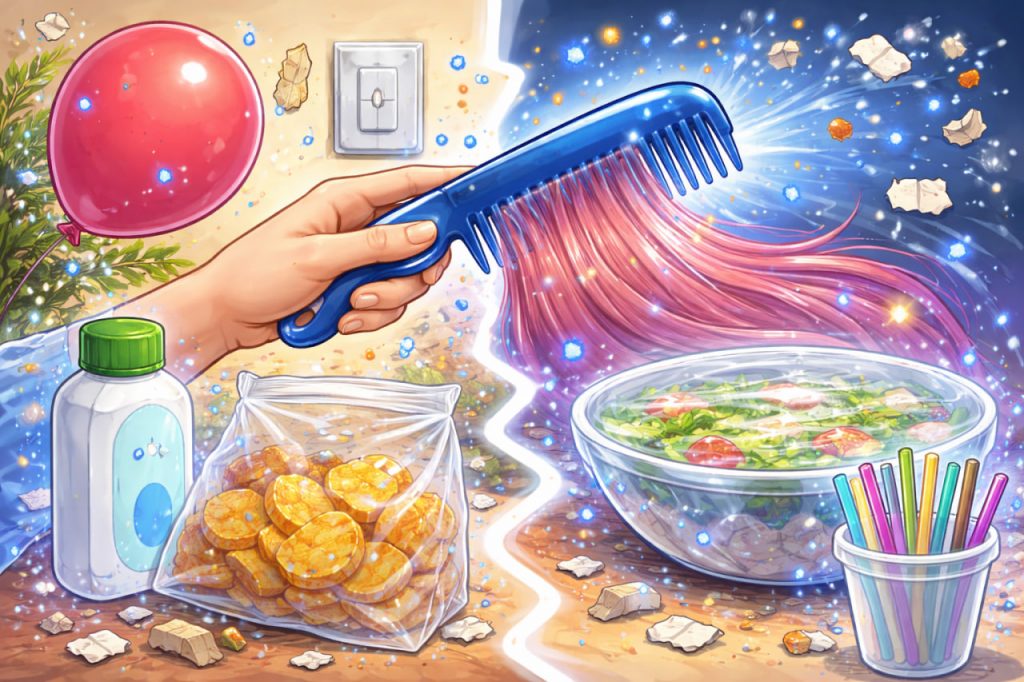
Plastic is one of the materials most strongly associated with electrostatic charge in everyday life. From crackling sounds when removing synthetic clothing to small shocks after touching metal, plastic often plays a central role in static electricity. These effects are not random; they arise from the physical properties of plastics and how they interact with other materials. Electrostatic charge in plastics is a well-studied phenomenon in physics, with implications for industry, technology, and safety. Understanding why plastic accumulates charge helps explain many common observations and highlights how invisible forces shape our daily environment. This topic connects fundamental physics with practical consequences.
What Electrostatic Charge Is
Electrostatic charge results from an imbalance of electric charges on the surface of an object. Atoms contain positively charged protons and negatively charged electrons, which normally balance each other. When materials come into contact and then separate, electrons can transfer from one surface to another. If electrons are gained or lost, the object becomes electrically charged. This charge remains localized until it is neutralized by contact with another object or the surrounding air. Electrostatic effects are most noticeable in dry conditions, where charge dissipates more slowly.
Why Plastic Accumulates Static Electricity
Plastics are excellent electrical insulators, meaning they do not allow electric charges to move freely. When plastic rubs against another material—such as fabric, hair, or paper—it can easily gain or lose electrons through triboelectric charging. Because plastic does not conduct electricity well, the charge remains trapped on its surface. This is why plastic objects often attract dust, cling to other materials, or produce sparks. Compared to metals, which quickly redistribute charge, plastic holds static electricity for much longer periods.
The Triboelectric Effect in Everyday Life
The triboelectric effect describes how different materials exchange electrons when they touch and separate. Materials are ranked in a triboelectric series, which predicts whether they tend to gain or lose electrons. Plastics such as polyethylene, polystyrene, and PVC tend to gain electrons and become negatively charged. This explains why plastic wrap sticks to containers or why balloons cling to walls after being rubbed. These everyday effects are simple demonstrations of surface-level electrical interactions governed by material chemistry and structure.
Environmental Factors and Charge Behavior
Humidity plays a critical role in electrostatic behavior. Moist air contains water molecules that help dissipate excess charge, reducing static buildup. In dry environments, especially during winter, plastic objects accumulate more charge and release it suddenly. Temperature, surface roughness, and contact area also influence how much charge is transferred. Industrial environments must carefully control these factors to prevent unwanted electrostatic discharge. These environmental dependencies show that static electricity is not just a material property, but a system-level interaction.
Practical Implications and Applications
Electrostatic charge in plastics has both useful and problematic consequences. In manufacturing, static charge can cause dust contamination, material sticking, or even sparks that pose fire risks. At the same time, controlled electrostatic charging is used in powder coating, printing, air filtration, and electronics manufacturing. Engineers design antistatic additives and surface treatments to manage charge behavior. Understanding plastic electrostatics is therefore essential for safety, efficiency, and technological innovation.
Interesting Facts
- Plastic is one of the strongest static charge holders among common materials.
- Dry air significantly increases electrostatic buildup.
- Rubbing materials together transfers electrons, not protons.
- Static electricity can produce sparks reaching thousands of volts at low current.
- Antistatic plastics are engineered to dissipate charge safely.
Glossary
- Electrostatic Charge — an imbalance of electric charge on a surface.
- Insulator — a material that resists the flow of electric current.
- Triboelectric Effect — charge transfer caused by contact and separation of materials.
- Triboelectric Series — a ranking of materials by electron transfer tendency.
- Electrostatic Discharge — sudden release of accumulated electric charge.