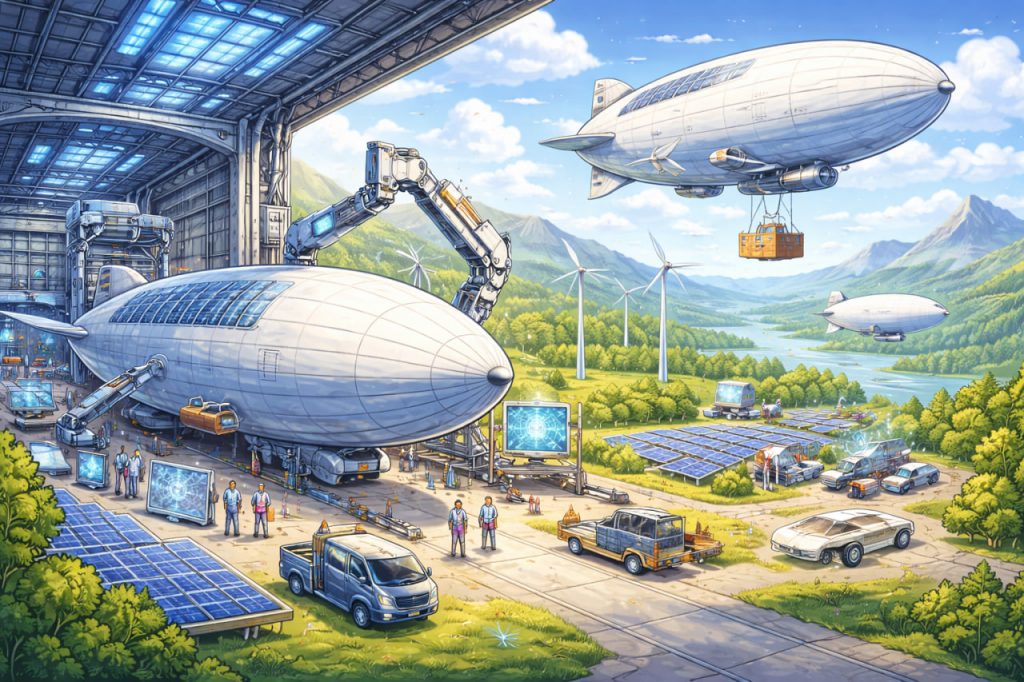
The future of airship construction is increasingly discussed as the world searches for sustainable, efficient, and flexible transportation solutions. Once considered a relic of early aviation, airships are now being re-evaluated through the lens of modern materials, digital control systems, and environmental priorities. Unlike conventional aircraft, airships offer unique advantages such as long endurance, low fuel consumption, and the ability to operate without extensive infrastructure. These qualities position them as a promising complement to existing transport technologies rather than a replacement. Advances in engineering have fundamentally changed what airships can be, opening possibilities that were unattainable in the past. The future of airship construction reflects a broader trend of revisiting historical concepts with modern scientific understanding.
New Materials and Structural Design
One of the most important drivers of modern airship development is the use of advanced materials. Lightweight composites, high-strength fabrics, and improved gas containment membranes significantly enhance durability and safety. Modern structural designs reduce weight while increasing resistance to weather, UV radiation, and mechanical stress. Unlike early rigid frameworks made of metal, contemporary airships often rely on hybrid or semi-rigid structures that adapt to pressure changes. These innovations allow for larger payloads and longer service life. Material science has transformed airships from fragile giants into robust aerospace platforms.
Hybrid Lift and Improved Control
Future airships increasingly rely on hybrid lift systems, combining buoyant lift from helium with aerodynamic lift generated during forward motion. This approach improves maneuverability and allows precise control during takeoff, landing, and hovering. Advanced propulsion systems enable vertical or near-vertical operations in confined areas. Computer-assisted flight control stabilizes the airship in changing wind conditions, addressing one of the classic limitations of lighter-than-air craft. These improvements make airships more practical for real-world operations in diverse environments.
Sustainability and Energy Efficiency
Airship construction aligns naturally with sustainability goals. Because buoyancy provides most of the lift, airships consume significantly less energy than airplanes for comparable payloads. Future designs increasingly integrate electric propulsion, solar panels, and energy recovery systems. Reduced fuel requirements mean lower emissions and quieter operation, which is especially valuable for environmental monitoring and urban-adjacent missions. In an era of climate awareness, airships offer a rare combination of scale and efficiency that few other aircraft can match.
Applications Driving Future Development
The future of airship construction is shaped by practical use cases rather than luxury travel. Cargo delivery to remote regions, disaster relief, infrastructure inspection, and scientific observation are among the most promising applications. Airships can transport heavy or oversized loads to areas without roads, ports, or runways. Their ability to remain airborne for extended periods makes them ideal for surveillance and communication platforms. As global logistics face increasing complexity, airships provide flexible solutions where traditional transport struggles.
Challenges and Long-Term Outlook
Despite their potential, airships still face technical and economic challenges. Weather sensitivity, high initial development costs, and regulatory frameworks require continued refinement. Public perception, shaped by historical accidents, also plays a role in acceptance. However, modern engineering has addressed many of the safety issues that defined earlier eras. Experts emphasize that the future of airships depends on realistic expectations and targeted deployment rather than mass adoption. As aerospace engineer Dr. Laura Mitchell notes:
“The future of airships lies in solving specific problems
where efficiency and endurance matter more than speed.”
This pragmatic approach defines the next chapter of airship construction.
Interesting Facts
- Modern airships can operate with minimal ground infrastructure.
- Hybrid lift designs improve payload capacity and stability.
- Airships consume far less energy than airplanes for heavy loads.
- New materials significantly reduce maintenance requirements.
- Future airships are designed for utility, not luxury.
Glossary
- Hybrid Lift — lift generated from both buoyancy and aerodynamic forces.
- Composite Materials — lightweight materials made from multiple components.
- Buoyancy — the upward force exerted by displaced air.
- Electric Propulsion — movement powered by electric motors instead of combustion.
- Endurance Platform — an aircraft designed for long-duration flight.