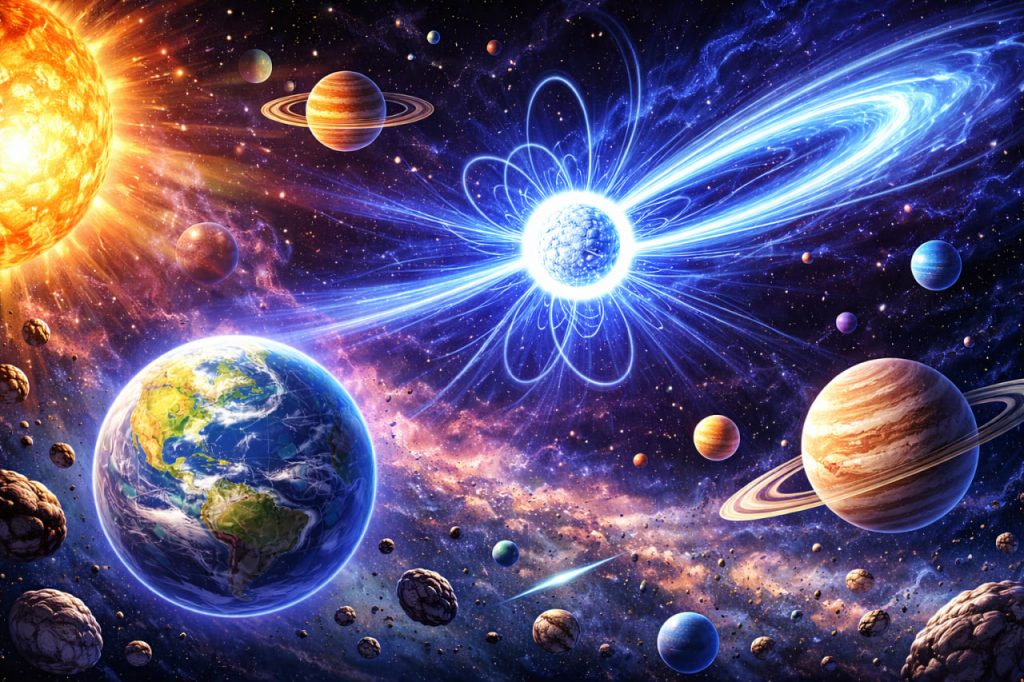
A neutron star passing close to the Solar System would be one of the most extreme astrophysical encounters imaginable. Neutron stars are remnants of massive stars that collapsed after supernova explosions, concentrating enormous mass into an incredibly small volume. Despite their compact size, their gravitational and electromagnetic influence is immense. Such an event is extraordinarily unlikely, but examining it allows scientists to understand how fragile—or resilient—planetary systems are in a dynamic galaxy. This scenario highlights the balance between cosmic forces and the stability of our Solar System.
The Nature of a Neutron Star
A neutron star forms when the core of a massive star collapses so intensely that protons and electrons merge into neutrons. The resulting object typically has a radius of about 10–12 kilometers while containing more mass than the Sun. Its density is so extreme that ordinary matter behaves in unfamiliar ways. Many neutron stars rotate rapidly and possess magnetic fields trillions of times stronger than Earth’s. These characteristics make neutron stars key objects for testing fundamental physics.
Gravitational Influence on Planetary Orbits
The most significant effect of a passing neutron star would be gravitational. At large distances, its influence would be minimal, comparable to other stellar flybys that the Solar System has experienced in its history. However, a closer passage could disturb the orbits of distant objects, especially in the outer Solar System. Comets and icy bodies could be nudged onto new trajectories.
According to astrophysicist Dr. Elena Markovic:
“A neutron star would need to pass extraordinarily close to disrupt the inner planets.
At realistic distances, the main effects would be subtle and long-term rather than catastrophic.”
This means dramatic planetary rearrangement is not expected under plausible conditions.
Effects on the Oort Cloud
The most sensitive region to a stellar flyby is the Oort Cloud, a vast, distant shell of icy bodies surrounding the Solar System. A neutron star passing nearby could gravitationally disturb this region, sending comets toward the inner Solar System over long periods. These effects would unfold over tens of thousands or even millions of years. Such a delayed increase in comet activity would represent a long-term consequence rather than an immediate disaster. This mechanism is already considered for ordinary stellar encounters.
Radiation and Magnetic Fields
Some neutron stars emit powerful radiation, including X-rays and gamma rays, and possess intense magnetic fields. If such emissions were directed toward the Solar System, they could interact with the heliosphere and affect space-based technology. Earth’s atmosphere would provide substantial protection for life at the surface.
As noted by space physicist Dr. Jonathan Reed:
“Even strong radiation from compact objects is largely mitigated by distance and planetary atmospheres.
Technological systems would be far more vulnerable than biological life.”
This highlights the difference between technological risk and existential threat.
Potential Impact on Earth
For Earth to face serious danger, the neutron star would need to pass extremely close and emit intense radiation in our direction. Such a scenario is considered exceptionally improbable. While increased radiation could affect satellites or the upper atmosphere, surface conditions would remain largely stable. Geological or orbital catastrophes would require distances far smaller than those expected in natural stellar motion. Earth’s position within the Solar System offers additional shielding.
How Likely Is This Scenario
Neutron stars are relatively rare compared to ordinary stars, and close stellar flybys are already uncommon. Astronomical surveys track nearby stellar objects with high precision, reducing uncertainty about future encounters. No known neutron star poses a threat to the Solar System. Statistical models suggest that such an event is far less likely than other cosmic hazards. The scenario remains primarily a theoretical exercise.
Why Scientists Study Extreme Flybys
Studying hypothetical neutron star flybys helps scientists test models of gravity, orbital stability, and radiation effects. These investigations improve understanding of how planetary systems evolve in crowded stellar environments. They also provide insight into the long-term history of our own Solar System. Extreme scenarios sharpen scientific models even when the probability is low. This approach strengthens confidence in predictions about planetary safety.
Interesting Facts
- Neutron stars can contain more mass than the Sun in a city-sized volume.
- Stellar flybys mainly affect the outer regions of planetary systems.
- Disturbances from a flyby can unfold over millions of years.
- Earth’s atmosphere shields life from most high-energy radiation.
- No known neutron star is on a dangerous trajectory toward the Solar System.
Glossary
- Neutron Star — an ultra-dense remnant of a massive star after a supernova.
- Oort Cloud — a distant region of icy bodies surrounding the Solar System.
- Heliosphere — the bubble of solar wind protecting the Solar System.
- Gamma Radiation — extremely high-energy electromagnetic radiation.
- Stellar Flyby — a close passage of one star near another stellar system.