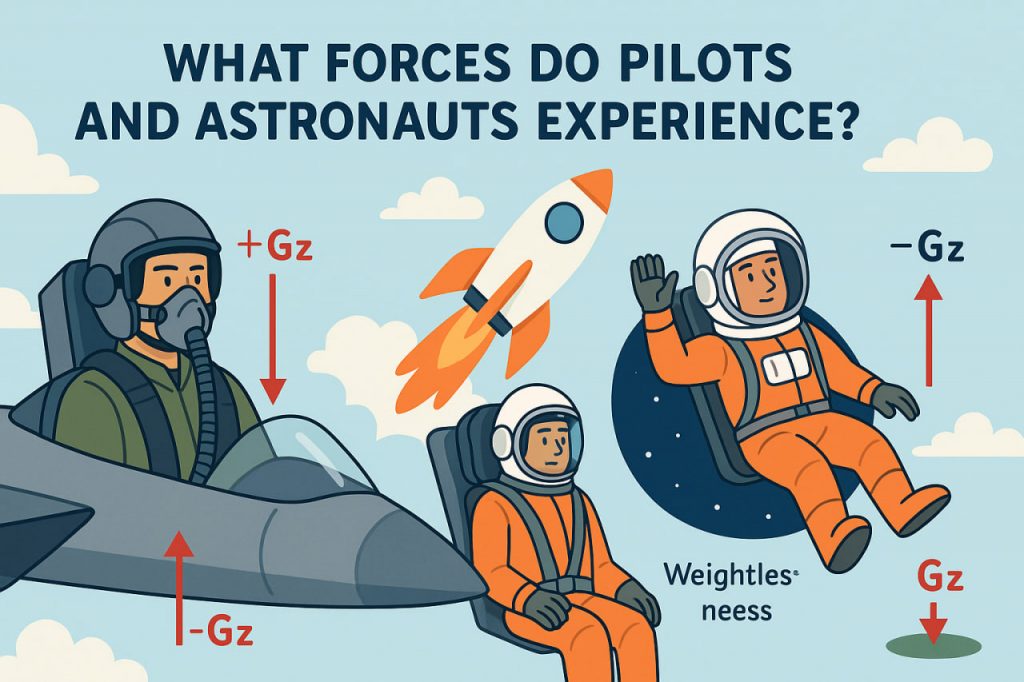
When airplanes soar through the sky or rockets launch into space, the people inside are subjected to incredible forces known as G-forces (gravitational loads). These forces push, pull, and compress the body in ways most of us can only imagine. For pilots and astronauts, managing these extreme conditions is not just about comfort — it’s about survival.
What Are G-Forces?
A G-force measures the effect of acceleration or gravity on the human body. On Earth, we constantly experience 1G, which equals the normal pull of gravity. When an aircraft speeds up, turns sharply, or descends rapidly, the body feels a change in force — either heavier or lighter than normal.
For example:
- +Gz — force pushing blood toward the feet (feeling “heavier”).
- –Gz — force pushing blood toward the head (feeling “lighter”).
Aeromedical expert Dr. Pavel Stepanov explains:
“At high G-forces, blood is pulled away from the brain, vision darkens, and the body feels as though it weighs several times its normal mass.”
Forces Experienced by Pilots
During fast maneuvers in fighter jets, pilots can experience up to 9G — meaning their body feels nine times heavier than normal. A 75 kg pilot would effectively “weigh” 675 kg for a few seconds.
Effects of high G-forces include:
- Greyout — loss of color vision.
- Blackout — temporary blindness due to lack of blood flow to the brain.
- G-LOC (G-induced Loss of Consciousness) — fainting caused by extreme G-loads.
To counter this, pilots wear anti-G suits that apply pressure to the legs and abdomen, preventing blood from pooling in the lower body. They also use special breathing techniques to maintain consciousness under high stress.
The Challenge for Astronauts
Astronauts face G-forces that are just as intense — but in different directions.
- During launch, they experience up to 3–4G as the rocket accelerates upward.
- During re-entry, G-forces can reach 5–7G as the spacecraft slows down rapidly in Earth’s atmosphere.
These forces press the body firmly into the seat, making movement and breathing difficult. Training programs help astronauts strengthen neck and core muscles to withstand these stresses safely.
According to astronaut Dr. Karen Blake:
“The launch feels like a giant hand pushing you into your seat. Every breath takes effort — but it’s the most thrilling pressure you’ll ever feel.”
Microgravity and Weightlessness
Once in orbit, astronauts experience microgravity, or near weightlessness. While this may seem relaxing, it brings new challenges:
- Muscle and bone loss, since the body no longer supports its own weight.
- Fluid shift toward the head, causing facial puffiness and pressure in the eyes.
- Disorientation, as the inner ear loses its sense of up and down.
That’s why astronauts exercise for two hours daily on treadmills and resistance machines aboard the International Space Station (ISS).
Training for Extreme Conditions
Pilots and astronauts undergo rigorous training to prepare their bodies and minds:
- Centrifuge training — simulates high G-forces by spinning participants at increasing speeds.
- Parabolic flights (“vomit comet”) — simulate short periods of weightlessness.
- Physical conditioning — strengthens the cardiovascular system and muscles to handle extreme stress.
Interesting Facts
- Fighter jet pilots can lose up to 20% of their height temporarily under 9G pressure due to spinal compression.
- The G-force tolerance of a trained pilot is around 9G, while an untrained person may black out at 4–5G.
- During the Apollo missions, astronauts experienced about 6G during re-entry to Earth.
- Roller coasters typically generate only 3–4G, much less than military aircraft.
Glossary
- G-force — a measure of acceleration felt as weight.
- Microgravity — a state of near weightlessness experienced in space.
- Anti-G suit — a garment that helps pilots resist blood pooling under high G-forces.
- Centrifuge — a rotating machine used for G-force training.

