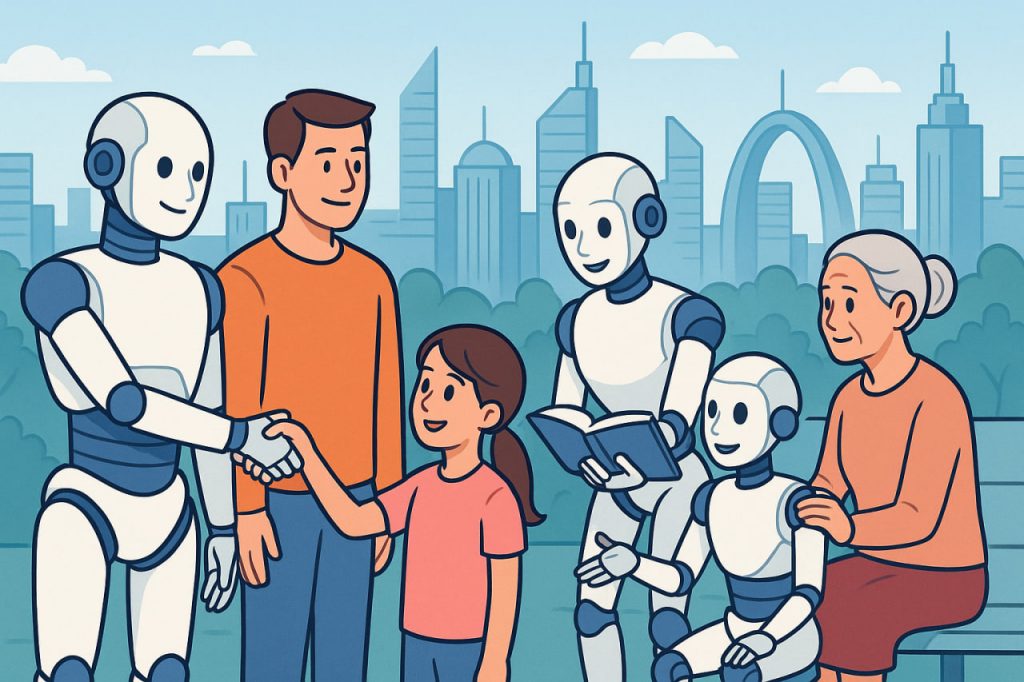
From science fiction dreams to real-world innovation, humanoid robots have evolved into some of the most advanced technologies of the modern era. Designed to look and move like humans, these robots are not only reshaping industries but also redefining how we think about work, companionship, and the boundaries between humans and machines.
What Are Humanoid Robots?
A humanoid robot is a machine built to resemble the human body, typically with a head, torso, arms, and legs. Some are built for research, others for industry, healthcare, or customer service. They may walk, talk, and even mimic facial expressions — bridging the gap between robotics and artificial intelligence.
Robotics expert Dr. Elena Park explains:
“Humanoid robots are not just mechanical tools — they are social technologies. Their design helps people feel comfortable interacting with machines.”
How Humanoid Robots Work
These robots integrate multiple cutting-edge systems:
- Sensors — to detect movement, sound, and touch.
- Cameras and LiDAR — for vision and spatial awareness.
- Actuators and motors — to mimic muscles and enable smooth movement.
- Artificial Intelligence (AI) — to understand language, emotions, and perform complex tasks.
They rely on machine learning to improve over time — learning from human behavior, speech, and even gestures.
Famous Examples of Humanoid Robots
- ASIMO (Honda, Japan) — One of the first walking robots, able to climb stairs and carry objects.
- Atlas (Boston Dynamics, USA) — Known for acrobatic movements, parkour, and balancing in challenging environments.
- Sophia (Hanson Robotics, Hong Kong) — A social humanoid robot capable of facial expressions and conversations, even recognized as a “citizen” by Saudi Arabia.
- Ameca (Engineered Arts, UK) — Features realistic facial movements and emotional interactions powered by AI.
Uses of Humanoid Robots
Humanoid robots are being integrated into multiple fields:
- Healthcare — assisting elderly patients or performing precise surgical tasks.
- Education — teaching languages and STEM subjects interactively.
- Research — studying human motion, behavior, and ergonomics.
- Emergency response — entering dangerous areas where humans cannot go.
- Entertainment and hospitality — greeting guests, performing, or serving as guides.
The Advantages
- Adaptability — They can operate in environments designed for humans.
- Emotional engagement — Their human-like appearance encourages trust and communication.
- Efficiency and precision — They perform repetitive or dangerous tasks without fatigue.
The Challenges
Despite their promise, humanoid robots face major hurdles:
- High cost — Developing realistic humanoid robots remains extremely expensive.
- Energy consumption — Battery life and mobility are still limited.
- Ethical concerns — Questions arise about replacing human jobs and defining robot rights.
AI researcher Dr. Marco Stein notes:
“As humanoids become more lifelike, society must decide not just how to use them — but how to coexist with them responsibly.”
The Future of Humanoid Robotics
In the next decade, advances in AI, biomechanics, and nanotechnology will make humanoid robots more autonomous and affordable. They may soon assist in disaster relief, space exploration, and personal care — blending seamlessly into daily life.
Interesting Facts
- Japan has more humanoid robots per capita than any other country.
- NASA’s Robonaut 2 was designed to assist astronauts on the International Space Station.
- Some humanoid robots are now equipped with empathy algorithms to recognize human emotions.
- The first recorded humanoid automaton dates back to the 15th century, built by Leonardo da Vinci.
Glossary
- Actuator — a device that converts energy into movement, similar to a human muscle.
- LiDAR — a technology that uses laser light to measure distance and create 3D maps.
- Machine learning — a process that enables computers to learn and improve from experience.
- Empathy algorithm — AI software designed to detect and respond to human emotions.