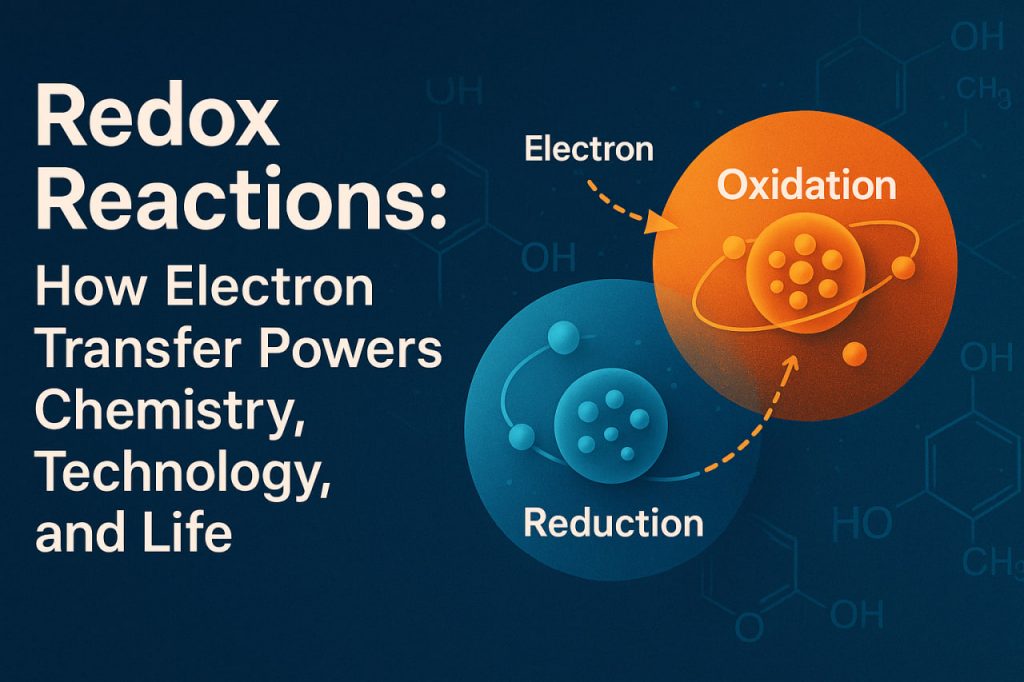
Redox reactions — short for reduction–oxidation reactions — are fundamental chemical processes that drive many of the transformations occurring in nature, technology, and even inside the human body. These reactions involve the transfer of electrons between substances, causing one material to be oxidized (lose electrons) while another is reduced (gain electrons). Although the concept seems simple, redox reactions power some of the most essential processes in the universe, including cellular respiration, photosynthesis, metal corrosion, energy storage, combustion, and industrial synthesis. Understanding how they work provides insight into chemistry’s hidden mechanisms and reveals how electron flow fuels the world around us.
Redox principles are foundational across scientific disciplines. In biology, they allow living cells to extract energy from nutrients. In engineering, they help create batteries, fuel cells, and industrial catalysts. In geology, they determine how minerals form and transform over millions of years. Every spark, flame, and electrical current involves redox chemistry at its core.
What Is a Redox Reaction?
A redox reaction always involves two simultaneous processes:
- Oxidation — a substance loses electrons
- Reduction — a substance gains electrons
Electrons do not disappear or appear spontaneously — they simply move from one species to another. These electron transfers create differences in energy, which can be used to power chemical or electrical work.
According to physical chemist Dr. Eleanor Hayes:
“Redox reactions are the molecular engines of the universe —
they move electrons, and electrons move energy.”
This elegant mechanism makes redox chemistry one of the most important concepts in science.
How Redox Reactions Work
Redox processes can occur in many ways:
- direct electron transfer between molecules
- ionic exchange in solutions
- electron flow through external circuits (batteries)
- oxidation by oxygen during burning
- reduction using chemical agents in industrial synthesis
Each reaction includes two half-reactions:
- oxidation half-reaction
- reduction half-reaction
Chemists often write these separately to analyze electron movement more clearly.
Common Examples of Redox Reactions
1. Combustion
Burning fuels (wood, coal, gasoline) is a redox process where carbon and hydrogen atoms are oxidized by oxygen, releasing heat and light.
2. Corrosion
Iron rusting is a slow redox reaction where iron loses electrons and forms iron oxide.
3. Respiration
Cells extract energy by oxidizing glucose and reducing oxygen — a controlled redox process essential for life.
4. Photosynthesis
Plants use sunlight to drive redox reactions that convert CO₂ and water into glucose and oxygen.
5. Batteries
All batteries work through redox chemistry: electrons move from the anode (oxidation) to the cathode (reduction), generating electric current.
Why Redox Reactions Matter
Redox reactions:
- power biological life
- generate electricity
- drive metabolic pathways
- enable industrial production
- create environmental changes
- support technological innovation
From metabolism to metallurgy, redox reactions determine how matter changes, interacts, and stores energy.
Oxidation Numbers and Tracking Electrons
To analyze redox reactions, chemists assign oxidation numbers — bookkeeping tools that indicate how many electrons an atom has gained or lost relative to its neutral state. Changes in oxidation numbers reveal whether oxidation or reduction has occurred.
Applications of Redox Chemistry
- battery technology (lithium-ion, zinc-air, flow batteries)
- water purification (oxidative disinfection)
- industrial synthesis (ammonia production, metal refining)
- environmental remediation
- fuel cells and clean energy systems
Advances in redox technology will play a major role in building sustainable energy systems for the future.
Interesting Facts
- Rusting is one of the slowest yet most widespread redox reactions on Earth.
- In the human body, mitochondria perform thousands of redox reactions every second to generate energy.
- Lithium-ion batteries rely on reversible redox processes to store and release charge.
- Photosynthesis is the largest redox process on the planet, sustaining nearly all life.
- The word “oxidation” originally meant “reaction with oxygen,” but now refers to any electron loss.
Glossary
- Oxidation — loss of electrons during a chemical reaction.
- Reduction — gain of electrons by a molecule, ion, or atom.
- Oxidation Number — value indicating electron gain or loss.
- Half-Reaction — part of a redox process showing either oxidation or reduction.
- Electron Transfer — movement of electrons from one species to another.