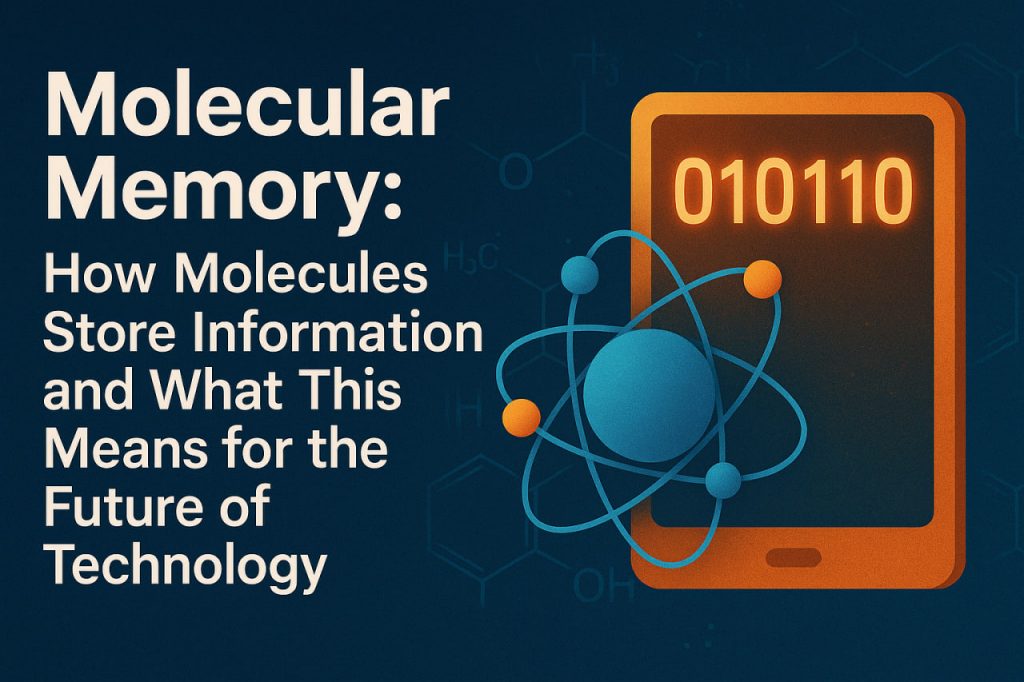
Molecular memory is an emerging scientific field that explores how information can be encoded, stored, and retrieved at the molecular level. Instead of relying on traditional electronic circuits, molecular memory systems use the physical or chemical states of molecules — such as shape, charge, or bonding arrangement — to hold data. This radically different approach offers the potential for ultra-dense, energy-efficient, and long-lasting data storage technologies. As digital information grows exponentially, scientists are searching for ways to surpass the physical limits of conventional semiconductor memory. Molecular memory could become a key solution.
The idea is inspired partly by biological systems. DNA, for example, stores vast amounts of information in molecular form with extraordinary stability and density. By understanding such natural mechanisms and developing synthetic equivalents, researchers hope to create programmable materials capable of storing data far beyond the capacity of existing technologies.
What Is Molecular Memory?
Molecular memory refers to any system in which:
- individual molecules act as data units
- chemical states represent bits of information
- the system can be written, read, and erased
- data remains stable over time
Scientists use molecules whose properties change predictably in response to external stimuli such as:
- electrical charge
- light
- temperature
- magnetic fields
- chemical reactions
According to nanotechnology expert Dr. Isabelle Carter:
“Molecular memory could shrink entire data centers
into the size of a single bookshelf if perfected.”
This illustrates the enormous potential of molecular-scale storage.
How Molecular Memory Works
There are several approaches currently being explored:
1. Redox-Based Memory
Some molecules switch between oxidation states, representing binary values (0/1).
This method is stable and highly energy efficient.
2. Photochromic Memory
Specific molecules change shape or color when exposed to certain wavelengths of light.
These changes can be reversed, allowing data to be written and erased.
3. DNA-Based Memory
DNA stores data using sequences of A, T, C, and G.
This method already shows remarkable density — 1 gram of DNA can store over 200 million gigabytes.
4. Molecular Spin Memory
Some molecules store information using the orientation of electron spins, similar to quantum memory concepts.
Each method has advantages and challenges, and research is ongoing to find scalable solutions.
Why Molecular Memory Is Important
Modern data storage faces several limitations:
- physical limits of transistor miniaturization
- enormous energy consumption of data centers
- heat generation in electronic systems
- limited lifetime of flash memory
- need for stable long-term archival storage
Molecular systems could solve many of these issues by enabling:
- extreme data density (thousands of times higher than current storage)
- near-zero energy consumption for long-term storage
- very small device size
- chemical stability over centuries
- reduced environmental footprint
In essence, molecular memory could transform the entire digital ecosystem.
Potential Applications
If perfected, molecular memory could be used in:
- ultra-compact smartphones and laptops
- long-term archives for museums and governments
- low-energy, high-capacity servers
- autonomous systems requiring durable memory
- biomedical devices storing data within tissues
- advanced sensors and smart materials
Because molecules can respond to environmental cues, they may also enable programmable materials that adapt or “learn” from their surroundings.
Challenges and Limitations
Despite its promise, molecular memory is still in early research stages. Challenges include:
- difficulty integrating molecules with existing electronics
- stability issues during repeated read/write cycles
- susceptibility to chemical degradation
- slow data access speeds in some systems
- manufacturing complexity at large scales
Scientists continue to refine molecular structures to improve durability and compatibility.
The Future of Molecular Memory
The field is advancing rapidly. Hybrid systems combining molecular components with nanotechnology may appear first. Long-term, molecular memory could become central to next-generation computing, artificial intelligence, and energy-efficient data centers. The combination of biological inspiration and advanced chemistry gives this technology a strong foundation for future breakthroughs.
Interesting Facts
- DNA is one of the world’s most dense data-storage molecules — one teaspoon could hold all human knowledge.
- Some molecular switches can flip between states billions of times without breaking down.
- Molecular memory could reduce global data-center energy use by up to 90%.
- A single molecular layer could theoretically store hundreds of terabytes.
- Nature has used molecular memory systems for 3.8 billion years, long before computers existed.
Glossary
- Redox Reaction — a process where molecules gain or lose electrons, changing their chemical state.
- Photochromic Molecule — a molecule that changes structure when exposed to light.
- DNA Encoding — method of storing digital data using DNA base sequences.
- Electron Spin — a quantum property used to represent information.
- Nanotechnology — the science of manipulating matter at atomic and molecular scales.