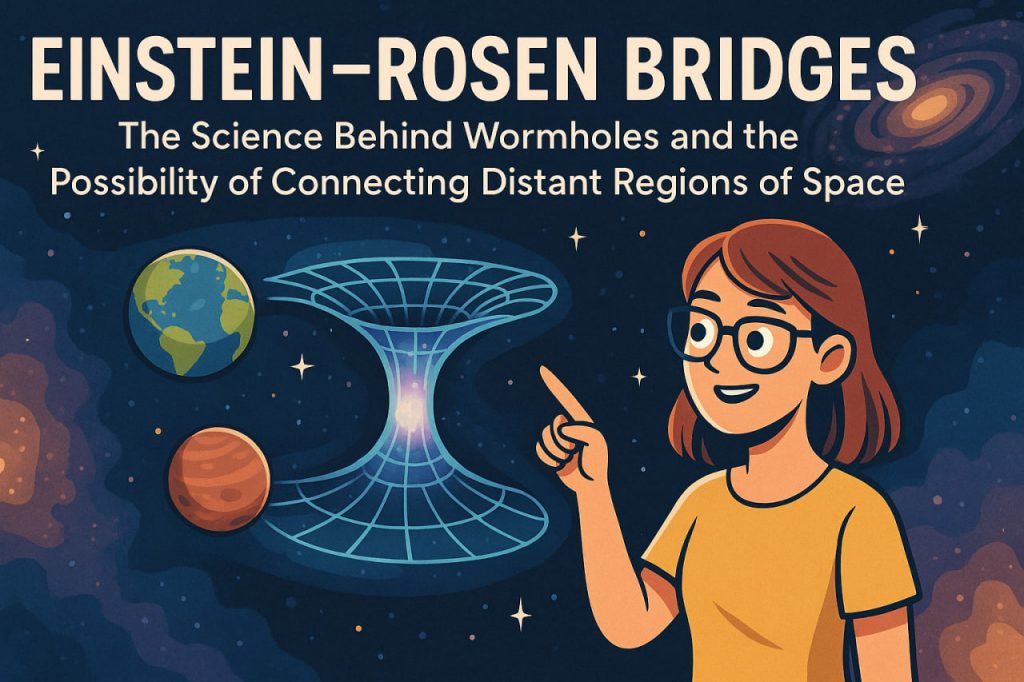
Einstein–Rosen bridges, more commonly known as wormholes, are hypothetical structures predicted by the equations of general relativity. They represent tunnels through spacetime that could, in theory, connect distant regions of the universe — or even different universes entirely. While no wormhole has ever been observed, the mathematics behind them is grounded in legitimate physics, and scientists continue to explore whether such phenomena could exist in reality. Wormholes embody some of the most fascinating ideas in modern theoretical research, blending gravity, quantum mechanics, and geometry into a single, exotic concept.
The possibility of wormholes was first proposed in 1935 by Albert Einstein and physicist Nathan Rosen. Their solution to Einstein’s equations described a connection between two black holes — like a bridge through curved spacetime. Although the original Einstein–Rosen bridge would collapse instantly, later theoretical models showed that wormholes could remain open under certain extreme conditions. Understanding how these structures might work requires deep insight into general relativity, energy conditions, and the mysterious nature of spacetime itself.
What Exactly Is an Einstein–Rosen Bridge?
In its simplest form, a wormhole is a shortcut through spacetime. Instead of traveling across the universe in a straight line, a traveler could theoretically pass through a curved tunnel that drastically reduces travel time. The geometry resembles:
- an entrance (like a black hole)
- a throat (the tunnel region)
- an exit (like a white hole or another black hole)
However, classical wormholes, including the original Einstein–Rosen bridge, are unstable. They close instantly before anything can pass through.
As theoretical physicist Dr. Samuel Reyes explains:
“Wormholes are mathematically allowed by general relativity,
but nature may not permit them to stay open long enough to be useful.”
Why Wormholes Are So Difficult to Stabilize
The equations of general relativity require enormous gravitational forces to create a wormhole — forces found only near black holes or neutron stars. But to keep a wormhole open, physics demands an even stranger ingredient:
- exotic matter, a form of energy with negative pressure
- violations of classical energy conditions
- extreme curvature of spacetime
Such materials are not known to exist in usable quantities, although some quantum phenomena hint that negative energy is possible on very small scales.
Types of Wormholes Predicted by Theory
Scientists study several types of wormholes:
1. Schwarzschild Wormholes
The original Einstein–Rosen bridge. Extremely unstable — collapses instantly.
2. Traversable Wormholes
Hypothetical tunnels that could allow passage, requiring exotic matter for stabilization.
3. Kerr Wormholes
Wormholes that may appear in rotating black holes, though still unstable.
4. Quantum Wormholes (ER = EPR hypothesis)
A modern idea linking wormholes and quantum entanglement.
ER = EPR: The New Frontier
One of the most intriguing modern hypotheses suggests:
- ER (Einstein–Rosen bridges)
- EPR (quantum entangled particles)
may describe the same phenomenon.
This idea proposes that entangled particles are connected by microscopic wormholes. If true, wormholes could be an inherent part of quantum physics rather than rare cosmic structures.
Could Wormholes Allow Faster-Than-Light Travel?
General relativity does not forbid moving through a wormhole faster than light would travel around the outside path. However:
- wormholes cannot be created with known technology
- stability issues remain unsolved
- exotic matter is hypothetical
- quantum fluctuations may destroy the tunnel
So while wormholes could theoretically allow superluminal travel, nothing suggests they are physically realizable yet.
Are Einstein–Rosen Bridges Real?
At present:
- no wormholes have been detected
- no experimental evidence supports their existence
- their stability is uncertain
- but their mathematics is consistent with general relativity
They remain one of the most fascinating and plausible speculative ideas in physics — not magic, not mythology, but a genuine prediction of Einstein’s theory if certain extreme conditions exist.
Interesting Facts
- The first wormhole model was published by Einstein and Rosen in 1935.
- Some theories propose microscopic wormholes formed in the early universe.
- Black holes and wormholes share similar mathematical structures.
- The ER = EPR hypothesis suggests that entanglement itself might create tiny wormholes.
- A traversable wormhole would require negative energy, a phenomenon seen only in quantum experiments.
Glossary
- General Relativity — Einstein’s theory describing gravity as curvature of spacetime.
- Wormhole — a theoretical tunnel connecting distant points in spacetime.
- Exotic Matter — hypothetical energy with negative pressure required to stabilize wormholes.
- Singularity — region of infinite density at the center of a black hole.
- Event Horizon — boundary beyond which nothing can escape a black hole.