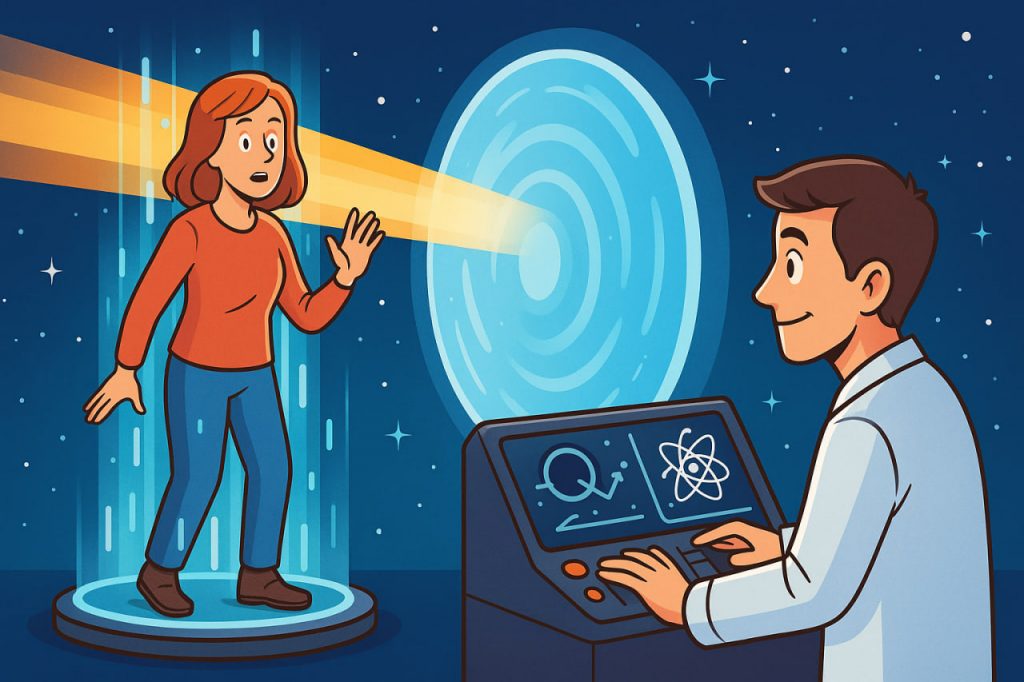
Teleportation has long fascinated humanity — from ancient myths to modern science fiction. The idea of instantly transferring objects or people from one place to another captures the imagination because it challenges our fundamental understanding of space, motion, and physical constraints. While physical teleportation of humans remains impossible with today’s science, quantum teleportation is a real and experimentally proven phenomenon that already powers breakthroughs in communication, cryptography, and fundamental physics research. Understanding what teleportation truly means in scientific terms reveals both the astonishing potential and the strict limitations of current physics.
In modern science, teleportation does not involve moving matter. Instead, it transfers information, specifically the quantum state of a particle, from one location to another without physically transporting the particle itself. This process relies on quantum entanglement — a mysterious connection between particles that remain correlated even when separated by large distances. Although this might sound supernatural, it is grounded in the mathematics of quantum mechanics and has been demonstrated in laboratories around the world.
What Is Quantum Teleportation?
Quantum teleportation is the transfer of a particle’s quantum state from one location to another using:
- quantum entanglement
- classical communication
- precise measurements
The original particle’s state is destroyed, and an identical state is recreated elsewhere.
Importantly:
- no matter travels
- no information moves faster than light
- the process is fully consistent with the laws of physics
According to quantum physicist Dr. Elena Strauss:
“Teleportation is not moving objects —
it is moving the information that defines a quantum system.”
This explanation helps distinguish scientific teleportation from fictional versions.
How Quantum Teleportation Works (Step-by-Step)
- Two particles (A and B) are entangled.
- Particle A interacts with a third particle (C) whose state we want to teleport.
- A special measurement links the state of A+C.
- The result is sent via classical communication to the receiver.
- The receiver performs operations on B, causing it to take on the state of C.
- The original state of C is destroyed — preventing duplication (no-cloning theorem).
Experiments have successfully teleported quantum states over:
- hundreds of kilometers through fiber
- over 1,000 km via satellites
This is a major milestone for future quantum networks.
Why Teleportation Matters
Quantum teleportation is essential for:
- quantum communication networks
- ultra-secure encryption
- error-resistant quantum computing
- future quantum internet infrastructure
As quantum technologies evolve, teleportation may become a backbone of global digital communication.
Can Humans Be Teleported?
With current physics, no.
Teleporting a human would require:
- scanning every atom in the body
- transmitting ~10⁴⁵ bits of data
- reconstructing a person atom-by-atom
- overcoming the no-cloning theorem
- solving philosophical questions about identity
This is far beyond technological and theoretical possibilities.
Additionally, the act of scanning would destroy the original quantum states, making it unclear whether the teleported version would be “you.”
Teleportation in Theoretical Physics
Some advanced theories explore possibilities beyond current technology:
- wormholes (Einstein–Rosen bridges)
- quantum gravity models
- holographic principles
- spacetime entanglement
These remain speculative and do not currently allow practical teleportation.
Teleportation in Sci-Fi vs Reality
Popular culture portrays teleportation as instantaneous movement of physical bodies. In reality:
- teleportation = information transfer, not matter transfer
- no violation of relativity
- no faster-than-light travel
- no duplication allowed
Even so, the scientific version is powerful and may reshape computing and communication.
Interesting Facts
- Scientists have teleported photons between Earth and satellites over 1,200 km.
- Teleportation is limited by the speed of classical communication, not quantum mechanics.
- The no-cloning theorem guarantees that teleportation destroys the original state.
- Quantum teleportation works even if the particles are light-years apart.
- Some physicists believe teleportation may help explain how spacetime itself emerges.
Glossary
- Quantum State — the complete set of information describing a quantum system.
- Entanglement — a phenomenon where particles remain correlated across distance.
- No-Cloning Theorem — a rule stating that quantum states cannot be perfectly copied.
- Quantum Internet — a future communication network based on quantum principles.
- Wormhole — a hypothetical shortcut through spacetime.