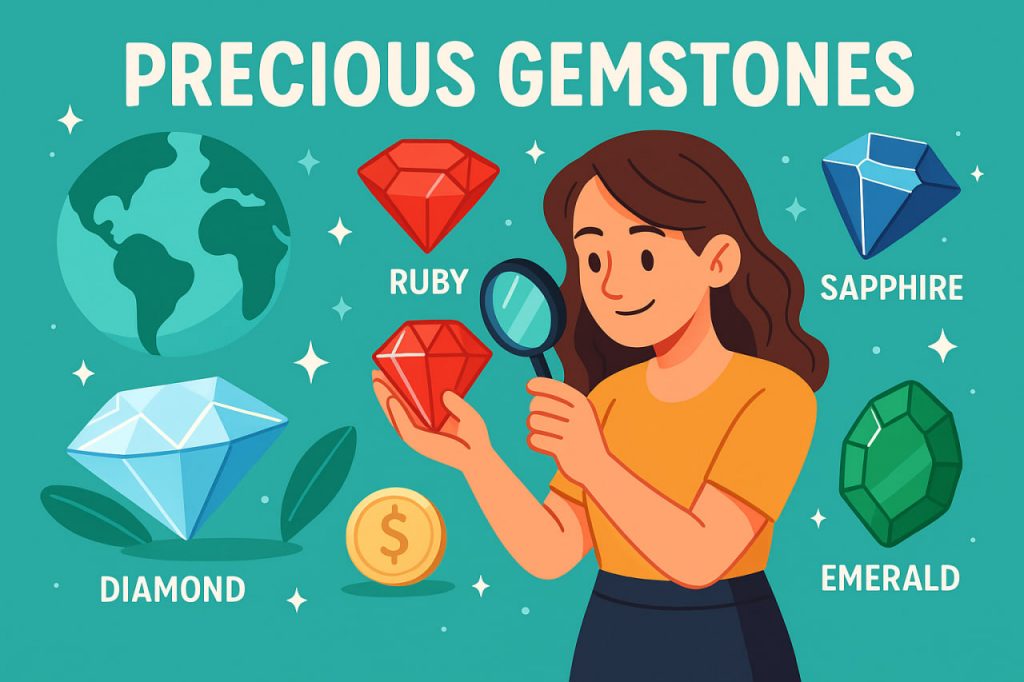
Precious gemstones have fascinated humanity for thousands of years. Their vibrant colors, rarity, and durability made them symbols of power, wealth, spirituality, and artistic expression across civilizations. Beyond their beauty, gemstones are remarkable geological materials formed under extreme conditions deep within Earth’s crust and mantle. Each gemstone carries a story of pressure, heat, time, and chemical transformation. Understanding gemstones means exploring geology, mineralogy, and human culture all at once.
Gemstones are typically classified into precious (diamond, ruby, emerald, sapphire) and semi-precious stones. Although the distinction is historical rather than scientific, precious stones are generally rarer and have exceptional clarity, brilliance, and hardness. Their value is determined by scarcity, optical qualities, and the skill of the cutter. Many gemstones take millions — sometimes billions — of years to form, making them geological treasures shaped by Earth’s deep processes.
How Gemstones Form
Gemstones originate through one of several natural processes:
- Igneous formation: Crystals develop as magma cools, forming diamonds, peridots, and quartz.
- Metamorphic formation: High pressure and temperature transform minerals into rubies, sapphires, and jade.
- Sedimentary processes: Water carries dissolved minerals that crystallize into opals, malachite, and turquoise.
- Hydrothermal activity: Mineral-rich fluids form emeralds and tourmalines in cracks and cavities.
These conditions result in unique structures, inclusions, and colors that define each gemstone.
According to mineralogist Dr. Laura Bennett:
“A gemstone is a geological archive —
its colors and imperfections tell the story of Earth’s deepest forces.”
The World’s Most Famous Precious Gemstones
1. Diamond
Composed of pure carbon, diamonds form deep in the mantle and reach the surface through volcanic eruptions.
They are the hardest known natural material and prized for their brilliance and strength.
2. Ruby
Rubies get their red color from chromium within the mineral corundum.
High-quality rubies are rarer than diamonds and often more valuable.
3. Sapphire
Also a type of corundum, sapphires come in many colors — most famously blue.
They symbolize wisdom, loyalty, and protection.
4. Emerald
Emeralds are a green variety of beryl, colored by chromium or vanadium.
They often contain natural inclusions known as “jardin,” which add character and authenticity.
Why Gemstones Are Valuable
Gemstone value depends on the “Four Cs”:
- Color: purity, hue, saturation
- Clarity: absence of internal flaws
- Cut: precision shaping for maximum brilliance
- Carat: weight and size
Other factors include origin (such as Burmese rubies or Colombian emeralds) and rarity.
Synthetic and Lab-Grown Gemstones
Modern technology can create gemstones with identical chemical structures to natural ones.
Lab-grown gems offer:
- ethical sourcing
- lower cost
- minimal environmental impact
- exceptional clarity
They are increasingly common in jewelry, though natural stones remain more collectible.
Gemstones in Culture and History
Civilizations used gemstones for:
- healing rituals
- royal crowns and armor
- religious ceremonies
- trade and currency
- art and symbolism
Egyptians prized lapis lazuli, Romans traded amber, and medieval kings wore sapphires for protection.
Gemstones as a Scientific and Economic Resource
Gemstones play roles in:
- optics (lasers, lenses)
- electronics (quartz oscillators)
- industrial tools (diamond cutting)
- nanotechnology
Their durability and optical properties make them useful beyond jewelry.
Interesting Facts
- Some diamonds are over 3 billion years old, older than most life on Earth.
- The Hope Diamond glows red under ultraviolet light due to trace boron.
- Emeralds often contain inclusions that increase their value rather than reduce it.
- Rubies larger than one carat are extremely rare; large perfect rubies are priceless.
- Opals contain microscopic silica spheres that diffract light, creating rainbow colors.
Glossary
- Inclusions — internal features within gemstones formed during crystal growth.
- Corundum — a mineral forming rubies and sapphires.
- Beryl — a mineral family including emerald and aquamarine.
- Hydrothermal Process — mineral formation from hot, pressurized fluids.
- Brilliance — light reflected from a gemstone after precise cutting.

