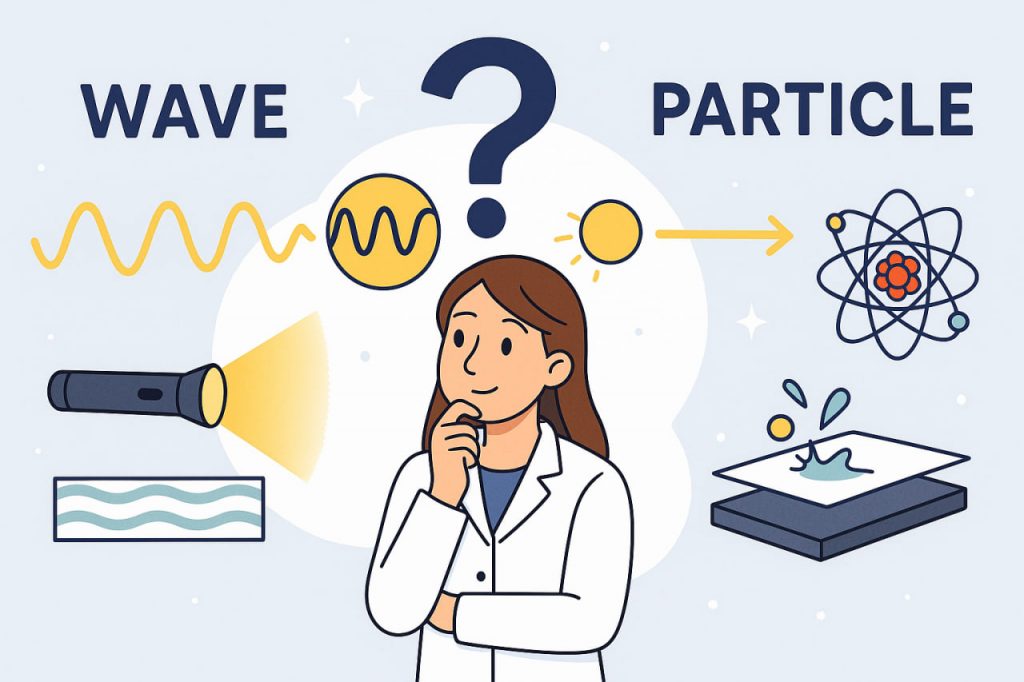
Wave–particle duality is one of the most intriguing and foundational concepts in quantum physics. It describes the surprising behavior of light and matter, which exhibit both wave-like and particle-like properties depending on how they are observed. This principle fundamentally changed our understanding of reality, revealing that classical physics cannot fully describe the microscopic world. Wave–particle duality lies at the heart of quantum mechanics and explains phenomena such as electron interference, photon behavior, and the structure of atoms. Although the idea may seem paradoxical, it reflects the complex and elegant nature of the universe. Understanding this duality helps scientists design modern technologies, from lasers and semiconductors to quantum computers and advanced communication systems.
Quantum mechanics shows that particles — photons, electrons, and even large molecules — do not behave exclusively as solid objects or waves. Instead, their behavior depends on experimental conditions and the nature of measurement. At small scales, reality becomes probabilistic rather than deterministic, and particles exist as mathematical wave functions that collapse into specific values only when measured. This perspective challenges our intuition but provides an accurate framework for predicting and controlling microscopic processes.
How Light Demonstrates Dual Behavior
Historically, scientists debated whether light was a wave or a particle. Wave behavior became evident through experiments such as diffraction and interference, where light spreads out and overlaps like ripples on water. However, the photoelectric effect revealed that light also behaves like a particle: photons strike electrons with discrete energy packets. According to quantum physicist Dr. Eleanor Hayes:
“Light does not choose to be a wave or a particle —
its behavior depends entirely on the questions we ask and the tools we use to observe it.”
This realization demonstrated that classical physics alone could not explain the full nature of electromagnetic radiation.
Matter Also Exhibits Wave–Particle Duality
Wave-like behavior is not limited to light. Louis de Broglie proposed that all matter, including electrons, atoms, and molecules, has wave properties. This was confirmed when electrons produced interference patterns — a hallmark of wave behavior — during double-slit experiments. These patterns vanish when the electrons are observed individually, showing particle-like behavior instead. This phenomenon illustrates that observation itself influences outcomes, which is a core feature of quantum systems.
The Role of Probability and Wave Functions
In quantum mechanics, particles are described by wave functions, mathematical expressions that represent probability distributions rather than fixed positions. Before measurement, a particle exists in a superposition — a combination of all possible states. When observed, the wave function collapses into a single outcome. This probabilistic nature provides accurate predictions, even though it challenges classical ideas of certainty and determinism. Wave–particle duality is therefore not a limitation but a deeper insight into how nature behaves at fundamental levels.
Technological Applications Inspired by Duality
Wave–particle duality is not only a philosophical concept — it underpins many modern technologies. Lasers rely on the particle-like emission of photons, while electron waves shape the behavior of semiconductors used in computers and smartphones. In quantum communication, the particle nature of photons ensures secure data transfer, while their wave nature allows precise manipulation in optical systems. Future technologies, such as quantum computers, depend on duality to process information in ways impossible for classical machines.
Why Wave–Particle Duality Matters Today
Understanding wave–particle duality helps scientists explore new frontiers of physics, from quantum gravity to the behavior of complex molecules. It also provides a foundation for everyday innovations and deepens our appreciation for the complexity of the universe. Wave–particle duality shows that nature is richer and more subtle than our everyday experience suggests, inviting us to rethink the boundaries between waves, particles, certainty, and uncertainty.
Interesting Facts
- The famous double-slit experiment demonstrates wave–particle duality for both light and matter.
- Electrons can behave as waves with measurable wavelengths, known as de Broglie waves.
- Photons have no mass, yet they can exert pressure on surfaces.
- Modern microscopy techniques use electron waves to achieve extremely high resolution.
- Wave functions describe probability, not physical shapes — a key idea in quantum physics.
Glossary
- Wave–Particle Duality — the concept that particles exhibit both wave-like and particle-like behavior.
- Photon — a particle of light that also behaves as an electromagnetic wave.
- Wave Function — a mathematical description of a particle’s probability distribution.
- Superposition — a state where a particle exists in multiple possible configurations simultaneously.
- Interference — a wave phenomenon where overlapping waves produce patterns of reinforcement or cancellation.