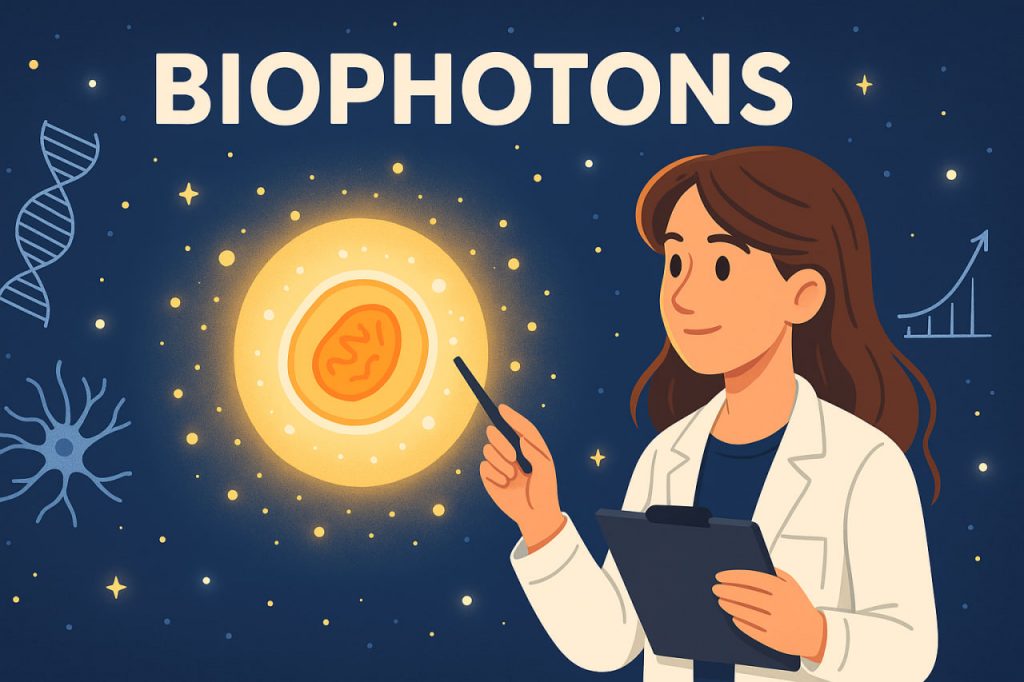
Biophotons are extremely weak light emissions produced by all living cells, including those of humans, plants, animals, and microorganisms. Although invisible to the naked eye, biophotons can be detected with highly sensitive instruments and offer a fascinating window into cellular communication and metabolic processes. These ultra-low levels of light emerge during biochemical reactions — especially those involving oxygen — and may reflect the health and functional state of cells. Scientists around the world study biophotons to understand how living organisms regulate internal processes and respond to stress, aging, and environmental conditions. While research is still ongoing, biophotons reveal that life expresses itself not only through chemistry and electricity but also through subtle light.
How Biophotons Are Generated Inside Cells
Biophotons are produced through natural metabolic processes involving reactive oxygen species, enzymes, and excited molecular states. When a molecule returns from an excited state to a stable one, it can emit a photon — a tiny particle of light. Although this emission is incredibly weak, it conveys valuable information. Biophoton intensity often increases during oxidative stress, inflammation, or cellular repair. According to biophysics researcher Dr. Maria Vogel:
“Biophotons allow us to observe cell activity in real time —
they are like whispers of light revealing how life functions at its core.”
These photons travel both within and between cells, suggesting that organisms may use light-based mechanisms alongside chemical signals for internal communication.
Biophotons as Indicators of Cellular Health
Since biophoton emission reflects metabolic activity, it can serve as a sensitive indicator of cellular well-being. Healthy cells tend to emit steady, low-level biophotons, while stressed or damaged cells may show irregular or intensified light patterns. Researchers investigate whether measuring these emissions could help assess oxidative stress, tissue vitality, or healing processes. Plants, for example, emit more biophotons when exposed to environmental stress, such as drought or toxins. In humans, variations in emission levels may correspond to immune activity or energy production. Although biophoton measurements are not yet used in clinical settings, they offer exciting possibilities for non-invasive diagnostics.
Communication Through Light: A Developing Hypothesis
One of the most intriguing theories in biophoton research is the idea that cells may use light to transmit information. The structures inside cells — including DNA — have optical properties that allow them to absorb and guide photons. Some scientists propose that biophotons may help synchronize cellular activity or coordinate complex biological responses. While this hypothesis remains under investigation, experiments show that cells can influence each other’s light emissions even when separated, suggesting a form of subtle optical communication. This emerging field connects quantum biology, biophysics, and cellular physiology.
Applications and Future Directions
Biophoton research is expanding into areas such as agriculture, environmental monitoring, and regenerative medicine. By measuring biophoton output, scientists can evaluate plant stress quickly and reduce crop losses. In medical science, monitoring biophoton patterns might one day provide information about tissue vitality or the effectiveness of treatments. Technological advancements, including ultra-sensitive photomultiplier detectors and time-resolved imaging systems, are helping researchers explore questions that were impossible to address just decades ago. As biophoton science develops, it may transform our understanding of biological regulation and energy flow in living systems.
Why Biophotons Continue to Fascinate Scientists
Biophotons challenge traditional views of biology by showing that life emits light continuously, even in total darkness. This phenomenon suggests that living cells are not merely biochemical machines but dynamic systems capable of generating coherent light. The study of biophotons bridges physics and biology, offering insights that could reshape how we understand health, consciousness, and the fundamental processes of life. Although much remains unknown, each discovery reveals a deeper connection between biological function and subtle electromagnetic phenomena.
Interesting Facts
- Human bodies emit around 10–1,000 photons per second per square centimeter, far too faint for the naked eye.
- DNA is believed to act as a biophoton waveguide, directing light inside cells.
- Plants increase biophoton emissions when experiencing environmental stress, providing early detection signals.
- Biophoton emissions show daily rhythms, reflecting metabolic cycles linked to circadian rhythms.
- Some experiments suggest biophotons could display quantum coherence, a property associated with highly ordered systems.
Glossary
- Biophoton — an ultra-weak photon of light emitted by living organisms during metabolic processes.
- Oxidative Stress — cellular imbalance caused by excess reactive oxygen species.
- Photon — a basic particle of light and electromagnetic radiation.
- Quantum Coherence — a physical phenomenon in which particles behave in a synchronized, wave-like manner.
- Waveguide — a structure that channels waves (such as light) along a specific path.

