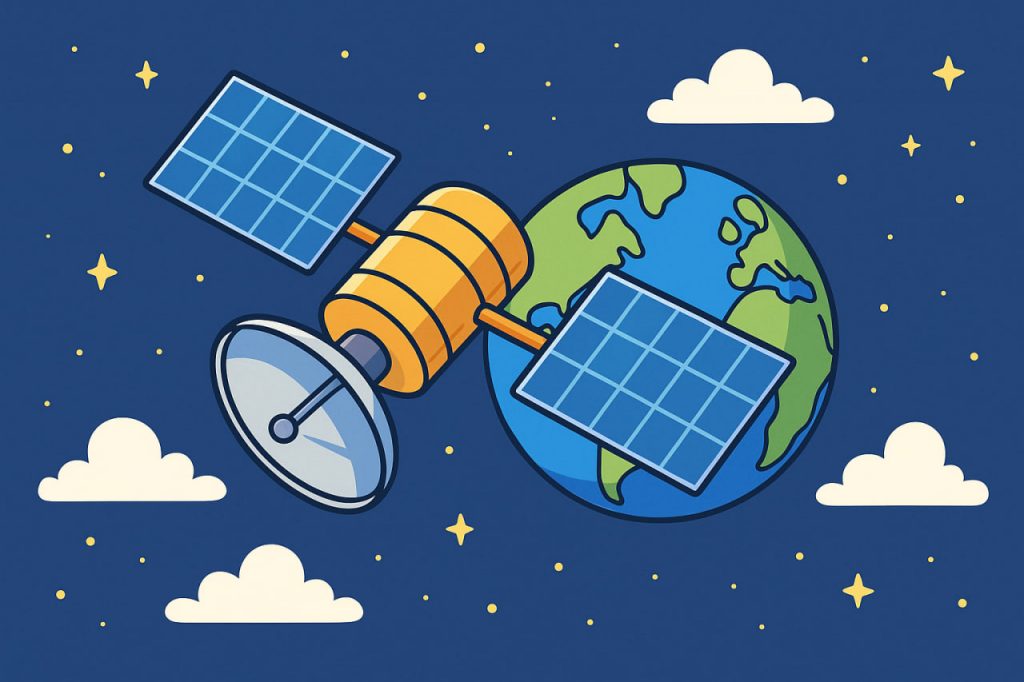
Artificial satellites are human-made objects launched into space to orbit the Earth or other celestial bodies. They have become essential tools for communication, navigation, weather forecasting, science, defense, and global connectivity. Today thousands of satellites operate above us, forming invisible networks that support everything from smartphone GPS signals to climate monitoring and international broadcasting. Although they vary widely in size and function, all satellites rely on the same basic principle: moving fast enough sideways so that they continuously fall around Earth rather than down to its surface. Understanding how satellites work and why they are so important explains much of the technology powering our modern world.
Artificial satellites can orbit at different altitudes depending on their mission. Low Earth orbit (LEO) satellites circle the planet quickly and provide high-resolution imagery. Medium Earth orbit systems enable precise navigation, such as GPS. Geostationary satellites remain fixed above a single point on Earth, making them ideal for communication and weather observation. Each orbit type expands human capabilities in unique ways, allowing satellites to collect data, transmit signals, and support critical technologies. Their design combines engineering, physics, and advanced materials to withstand harsh space environments.
How Artificial Satellites Work
Satellites are launched into space using rockets, which accelerate them to orbital speed — typically around 28,000 km/h in low Earth orbit. Once in orbit, satellites maintain their path due to the balance between gravitational pull and forward motion. Satellites carry power systems (usually solar panels), antennas, sensors, and onboard computers that allow them to perform assigned tasks. According to aerospace engineer Dr. Marcus Flemming:
“A satellite is essentially a self-contained robotic laboratory —
built to operate for years without direct human intervention.”
Thrusters help correct their trajectory, while communication systems send collected data back to Earth.
Types of Satellites and Their Purposes
Artificial satellites are classified by function, including:
- Communication satellites — transmit TV, radio, internet, and phone signals across continents.
- Navigation satellites — provide positioning services such as GPS, Galileo, and GLONASS.
- Earth-observation satellites — monitor weather, climate, forests, oceans, and natural disasters.
- Scientific satellites — study radiation, cosmic rays, space weather, and deep-space phenomena.
- Military satellites — support national security, surveillance, and encrypted communications.
These systems shape daily life, often without people realizing how dependent modern society has become on orbital technology.
How Satellites Affect Human Life
The impact of satellites reaches almost every aspect of society. Navigation systems guide airplanes, ships, emergency services, and everyday drivers. Weather satellites track storms, helping meteorologists forecast hurricanes and heatwaves. Communication satellites connect remote regions with internet access, enabling global education and economic growth. Satellites also support environmental protection by monitoring deforestation, ice melt, and ocean temperatures. Their contribution extends from personal convenience to planetary safety.
Challenges and Future Directions
Despite their benefits, satellites face challenges such as space debris, limited lifespan, and vulnerability to solar storms. Satellite constellations are increasing rapidly, raising concerns about orbital crowding and long-term sustainability. Engineers are developing technologies for debris removal, more durable designs, and autonomous collision-avoidance systems. As environmental physicist Dr. Helena Ward notes:
“The future of space depends on responsible satellite management —
our orbits must remain safe, functional, and accessible.”
Future satellites will be smaller, smarter, and more energy-efficient, supporting innovations like global 6G networks and interplanetary communication.
Interesting Facts
- The first artificial satellite, Sputnik 1, was launched in 1957 by the Soviet Union.
- GPS satellites circle Earth twice per day and require atomic clocks for precise timing.
- Weather satellites can detect storms days before they form at ground level.
- Some modern satellites are the size of a shoebox — known as CubeSats.
- There are now over 8,000 active satellites orbiting Earth.
Glossary
- Orbit — the path a satellite follows around a planet.
- Geostationary Orbit — an orbit where a satellite stays above the same spot on Earth.
- CubeSat — a small modular satellite used for education, research, and commercial missions.
- Telemetry — data sent from a satellite to Earth for monitoring and control.
- Solar Panel Array — satellite components that convert sunlight into electrical power.