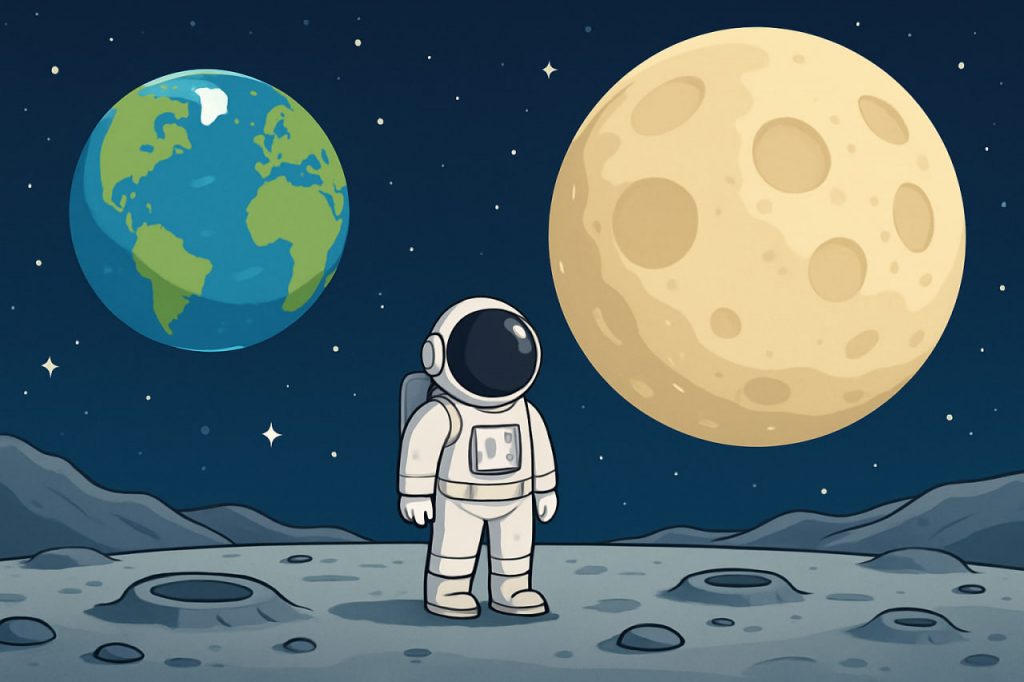
The Moon is Earth’s only natural satellite and one of the most influential celestial bodies in our solar system. For thousands of years, it has shaped human culture, guided navigation, inspired mythology, and sparked scientific curiosity. Beyond its symbolic meaning, the Moon plays a crucial physical role in stabilizing Earth’s climate, regulating ocean tides, and influencing biological rhythms. Its desolate, airless surface contains clues to the early formation of the solar system, while its gravitational pull has shaped life on Earth in profound ways. From ancient astronomers to modern space missions, the Moon remains a gateway to scientific discovery and a stepping stone toward future space exploration.
Although the Moon may appear calm and unchanging, its history is dynamic and violent. Scientists believe the Moon formed around 4.5 billion years ago after a massive collision between Earth and a Mars-sized body. The debris eventually coalesced into the Moon, gradually moving outward to its current orbit. This origin story explains its composition, internal structure, and the striking craters that cover its surface. Understanding how the Moon formed also helps researchers study planetary evolution throughout the universe.
The Moon’s Physical Characteristics
The Moon has a diameter of 3,474 km — about one-quarter the size of Earth — and a surface covered in dust, rocks, mountains, and vast plains called lunar maria. With no atmosphere, weather, or water erosion, the Moon preserves geological features for billions of years. Its low gravity, only about 17% of Earth’s, shapes how astronauts move and how dust behaves on its surface. According to lunar geologist Dr. Helena Ward:
“The Moon is a cosmic time capsule —
its surface records the history of our solar system like pages in a book.”
Its interior consists of a crust, mantle, and core, though smaller and cooler than Earth’s.
The Moon’s Influence on Earth
The Moon profoundly affects Earth’s natural systems. Its gravitational pull creates tides, which shape coastal ecosystems and influence marine life. The Moon also stabilizes Earth’s rotational tilt, helping maintain a relatively steady climate over long timescales. Without the Moon, Earth’s seasons would be far more extreme, and life might have evolved differently. The lunar cycle, lasting about 29.5 days, has historically influenced calendars, agriculture, and cultural rituals.
Phases and Eclipses
The Moon appears to change shape in the sky due to its position relative to Earth and the Sun. These phases range from new moon to full moon, creating familiar cycles visible worldwide. Lunar and solar eclipses occur when the Sun, Earth, and Moon align perfectly. A lunar eclipse happens when Earth’s shadow falls on the Moon, while a solar eclipse occurs when the Moon blocks sunlight from reaching Earth. These rare alignments have fascinated observers for centuries.
Exploration of the Moon
The Moon became the first celestial body visited by humans during NASA’s Apollo program. In 1969, Apollo 11 astronauts set foot on the lunar surface, marking a historic milestone. Since then, robotic missions have mapped its terrain, studied minerals, and searched for water ice in permanently shadowed craters. Many space agencies plan to return humans to the Moon, establish lunar bases, and use its resources to support deeper space missions. As aerospace engineer Dr. Marcus Lee explains:
“The Moon is our launching point into the solar system —
a natural platform for science, exploration, and future settlement.”
Its proximity to Earth makes it ideal for testing life-support systems and technologies for Mars and beyond.
Why the Moon Still Matters Today
Modern science views the Moon not just as a companion to Earth, but as a key to understanding planetary formation, climate stability, and the future of human space exploration. Its resources — including water ice — could support fuel production and long-term habitats. Meanwhile, its ancient surface preserves evidence of cosmic history that would otherwise be erased on Earth. The Moon remains both a scientific frontier and a symbol of humanity’s curiosity and ambition.
Interesting Facts
- The Moon is drifting away from Earth at a rate of 3.8 cm per year.
- There is no sound on the Moon because it has no atmosphere to carry vibrations.
- A day on the Moon lasts about 29.5 Earth days.
- Astronauts’ footprints remain preserved for millions of years due to lack of wind or rain.
- Scientists believe the Moon once had active volcanoes, with some lava flows only a billion years old.
Glossary
- Lunar Mare — dark basaltic plains formed by ancient volcanic eruptions.
- Tidal Forces — gravitational interactions that create tides in Earth’s oceans.
- Eclipse — an event where one celestial body blocks light from another.
- Regolith — the layer of loose dust and rock covering the Moon’s surface.
- Geological Craters — depressions formed by meteorite impacts.