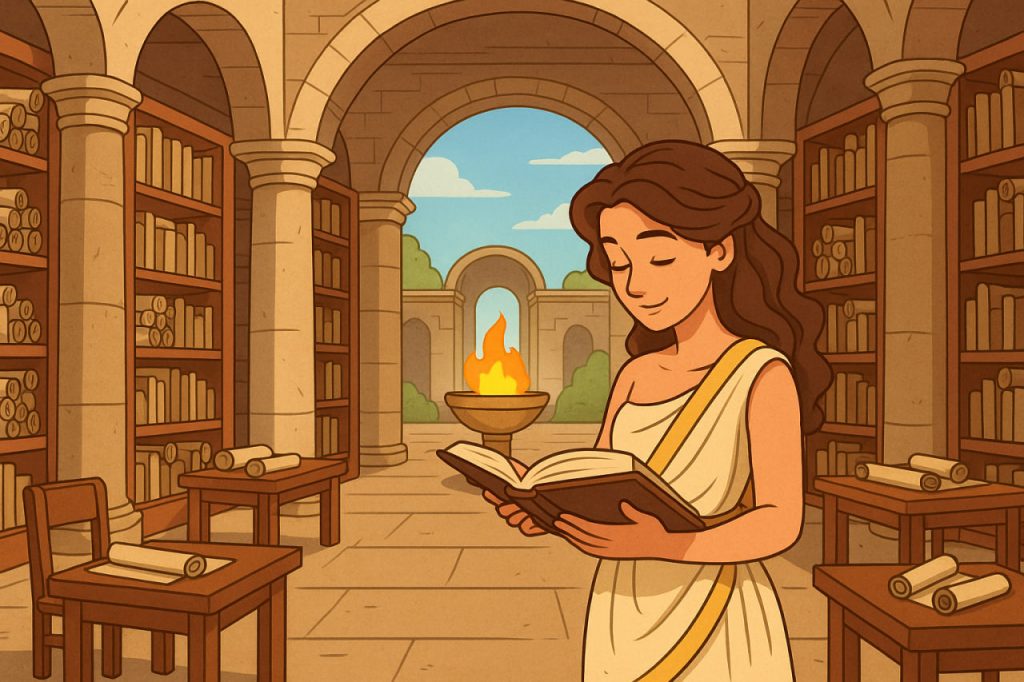
The Library of Alexandria remains one of the most legendary and influential institutions in human history. Founded in the 3rd century BCE in the Egyptian city of Alexandria, it served as a monumental center of learning, research, and cultural exchange. Scholars from Greece, Egypt, Persia, India, and other regions gathered there to study mathematics, astronomy, medicine, philosophy, geography, and literature. At its height, the Library may have contained hundreds of thousands of scrolls, making it the largest repository of written knowledge in the ancient world. The ambition of the Library was unprecedented: it sought to collect all knowledge of humanity, a mission that shaped the foundations of modern science and scholarship.
More than just a storage place for scrolls, the Library functioned as an academic institution that encouraged debate, experimentation, translation, and innovation. Many breakthroughs in ancient science emerged from its halls. Researchers studied celestial motions, developed early medical theories, calculated the size of Earth, and explored the nature of language. The Museum — an associated research complex — provided scholars with tools, classrooms, botanical gardens, and laboratories. The environment fostered creativity and cross-cultural dialogue, earning Alexandria a reputation as the intellectual capital of the ancient Mediterranean.
How the Library Was Founded
The Library was established during the reign of Ptolemy I, one of Alexander the Great’s generals. His successor, Ptolemy II, expanded its collection and recruited scholars from across the known world. The Ptolemies aimed to elevate Alexandria into a global center of culture and scientific excellence. According to classical historian Dr. Helena Vaughn:
“The Library of Alexandria embodied an extraordinary vision —
a belief that knowledge, preserved and shared, could transform civilization.”
This vision drove ambitious collection policies, including purchasing entire libraries and copying scrolls from every ship entering Alexandria’s harbor.
What Was Inside the Library
Although no catalog survives, ancient writers describe a vast collection of works by:
- mathematicians
- philosophers
- astronomers
- physicians
- poets
- historians
The Library preserved texts from Greece, Egypt, Babylon, Persia, and India. Scholars such as Euclid, Eratosthenes, Archimedes, and Herophilus were associated with Alexandria’s intellectual community. It was here that Eratosthenes calculated Earth’s circumference with remarkable accuracy, using only shadows and geometry.
Why the Library Was Lost
The destruction of the Library remains one of history’s enduring mysteries. Rather than a single catastrophic event, historians believe the Library suffered multiple periods of damage — including accidental fires, political unrest, and gradual decline under Roman rule. The exact timeline is uncertain, but by the 5th century CE, the Library had effectively disappeared. Its loss symbolizes the fragility of knowledge and the profound impact that cultural destruction can have on human progress.
Its Legacy in Science and Culture
Despite its disappearance, the Library’s influence endures. It inspired modern universities, research institutions, and global knowledge-sharing networks. The idea that information should be collected, organized, and accessible traces back to Alexandria’s original mission. As cultural historian Dr. Marcus Levin notes:
“Every library, archive, and scientific institution today
carries a piece of Alexandria’s legacy.”
In 2002, Egypt inaugurated the Bibliotheca Alexandrina, a modern reinterpretation of the ancient Library, symbolizing humanity’s renewed commitment to learning.
Why the Library Still Fascinates Us
The story of the Library blends wonder, ambition, tragedy, and hope. It represents both the heights of human curiosity and the dangers of forgetting our shared knowledge. The Library of Alexandria continues to inspire writers, scientists, filmmakers, and educators who dream of a world where learning is limitless and preserved for future generations.
Interesting Facts
- The Library may have held up to 500,000 scrolls, an enormous number for its time.
- Scholars at Alexandria were among the first to use scientific methods in research.
- Ships entering Alexandria’s port were required to surrender scrolls for copying.
- Eratosthenes, a librarian, accurately calculated Earth’s circumference in the 3rd century BCE.
- The modern Bibliotheca Alexandrina holds millions of books and international research centers.
Glossary
- Scroll — a rolled manuscript used in the ancient world.
- Museum (Mouseion) — a research institution associated with the ancient Library.
- Manuscript — handwritten text created before the invention of printing.
- Classical Antiquity — the historical period of ancient Greece and Rome.
- Archive — a collection of documents preserved for historical or scholarly use.