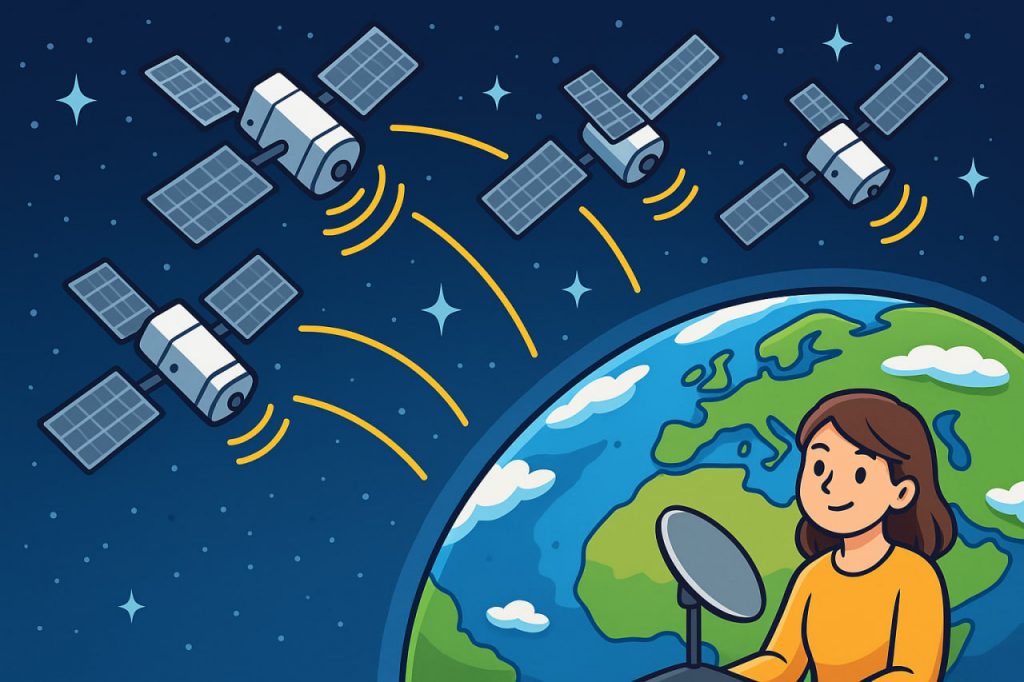
Starlink is a satellite-based internet system developed by SpaceX with the goal of providing high-speed, low-latency broadband access anywhere on Earth. Unlike traditional satellite internet, which relies on a few large satellites placed high above the planet, Starlink uses a massive constellation of thousands of small satellites operating in low Earth orbit (LEO). Their closer proximity allows faster data transmission, reduced signal delay, and more stable connectivity, even in remote or underserved regions. Starlink represents a major technological shift in global communications, reshaping how people access information, work online, and stay connected.
The project aims to close the digital divide by offering stable internet access to rural communities, ships, aircraft, research stations, and areas affected by natural disasters. It also serves as an essential backup system for national infrastructure, supporting communication when ground networks fail. As the constellation grows, its coverage becomes increasingly global, bringing high-speed access to regions that previously had no reliable internet service. The combination of innovative design, mass production, and reusable rockets allows Starlink to expand at a pace unprecedented in satellite history.
How Starlink Works
Starlink satellites orbit the Earth at altitudes of about 550 km, far lower than traditional geostationary satellites. They form a dynamic mesh network, communicating with ground stations and user terminals through radio waves and laser links. The network automatically routes signals through the fastest available path. According to aerospace systems expert Dr. Helena Ward:
“Starlink’s innovation lies in scale and coordination —
thousands of satellites working together as one global network.”
User terminals, often called “dishes,” automatically track satellites overhead, ensuring consistent data flow even as satellites move rapidly across the sky.
Benefits and Applications
Starlink’s biggest advantage is accessibility. It can deliver high-speed internet to:
- remote villages and rural communities
- scientific bases in deserts, mountains, and polar regions
- vehicles, aircraft, and ships
- disaster-stricken zones where communication lines are down
For many users, Starlink offers performance comparable to or better than ground-based broadband options, especially in places where fiber-optic installation is difficult.
Challenges and Concerns
Despite its success, Starlink faces several challenges:
- Space debris risks: a large constellation increases congestion in low Earth orbit
- Light pollution: astronomers worry about satellite brightness interfering with telescopes
- Regulatory issues: different countries impose varying rules on satellite internet use
- Competition: other companies and agencies are building their own constellations
SpaceX is working to reduce brightness, improve deorbiting procedures, and enhance collision-avoidance systems.
Global Impact and the Future of Connectivity
Starlink is reshaping the global internet landscape. It demonstrates that space-based networks can complement or even rival terrestrial infrastructure. As more satellites with optical laser links join the constellation, speeds and coverage will improve further. According to telecommunications specialist Dr. Marcus Lee:
“Starlink is not just an internet service —
it is the beginning of a new global communications architecture.”
Future generations of Starlink satellites may support autonomous vehicles, remote industries, and even interplanetary communication.
Interesting Facts
- Starlink plans to deploy over 12,000 satellites, with possible expansion to 42,000.
- Satellites use ion thrusters powered by krypton to maintain orbit.
- Each satellite weighs about 260 kg and has foldable solar panels.
- Starlink can provide internet even over oceans, mountains, and polar regions.
- Newer satellites use laser communication to create ultra-fast inter-satellite links.
Glossary
- LEO (Low Earth Orbit) — an orbit close to Earth, allowing low-latency communication.
- Mesh Network — a system where multiple nodes communicate with each other dynamically.
- Laser Link — optical communication between satellites for faster data transfer.
- Deorbiting — controlled re-entry of satellites to reduce space debris.
- User Terminal — a ground receiver for connecting to the Starlink network.