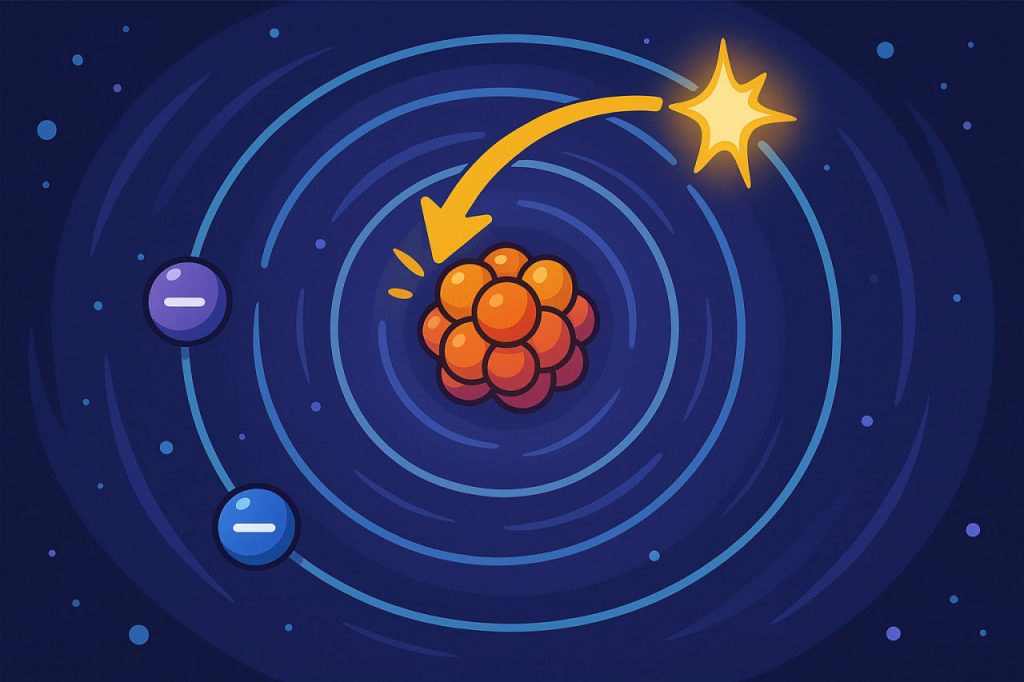
A “quantum leap,” or quantum jump, is one of the most fascinating ideas in modern physics — yet also one of the most misunderstood. In everyday language, people often use “quantum leap” to describe a dramatic or revolutionary change. But in science, the term has a much more precise meaning. A quantum leap refers to the sudden transition of an electron within an atom from one energy level to another. This process happens instantly and does not involve moving through the space in between. Instead, the electron absorbs or emits a specific amount of energy — a “quantum” — and immediately appears in a different state. Understanding quantum leaps is essential for explaining atomic structure, light emission, lasers, electronics, and many aspects of quantum technology.
Quantum leaps were first proposed in the early 20th century, when scientists noticed that atoms emit light at very specific wavelengths. This observation implied that electrons do not move smoothly like planets orbiting a star. Instead, they occupy discrete energy levels and transition between them only when absorbing or releasing exact amounts of energy. This discovery helped form the foundation of quantum mechanics, a field that radically transformed our understanding of matter and energy.
How a Quantum Leap Happens
Inside an atom, electrons cannot exist at arbitrary distances from the nucleus. They occupy quantized energy levels, each corresponding to a defined amount of energy. When an electron absorbs a photon, it “jumps” to a higher level. When it releases a photon, it falls back to a lower level. According to quantum physicist Dr. Helena Moore:
“A quantum leap is not a large change —
it is the smallest possible change allowed by the laws of physics.”
These transitions occur in incredibly short timescales — so fast that classical motion cannot describe them.
Why Quantum Leaps Matter in Science
Quantum leaps explain many everyday technologies and natural phenomena:
- How atoms emit light, creating colors in fireworks and neon signs
- How lasers work, producing highly focused beams
- How solar panels generate electricity from photons
- How chemical reactions occur, as electrons shift between states
- How quantum computers process information, using controlled transitions in quantum systems
Understanding these jumps enables scientists and engineers to design devices that manipulate energy at the atomic level.
Quantum Leaps and Misconceptions
Popular culture often describes a quantum leap as a huge transformation. But scientifically, a quantum leap is the opposite: it is a very small, highly controlled change. The misconception persists because quantum physics feels mysterious and powerful. In reality, quantum jumps are predictable and measurable using modern instruments. They do not violate physics — they reveal the rules of atomic behavior.
Modern Research and Quantum Technologies
Today, scientists can observe quantum jumps in real time using advanced sensors. Some experiments even allow partial prediction of when a jump will occur, a breakthrough in quantum measurement. These discoveries support emerging technologies such as quantum computing, quantum communication, and ultra-precise spectroscopy. As quantum engineer Dr. Marcus Lee states:
“Quantum leaps form the foundation of quantum technology —
controlling them means controlling the building blocks of the universe.”
This research continues to open new scientific and technological frontiers.
Why Quantum Leaps Fascinate Us
Quantum leaps challenge classical intuition and reveal that reality operates at multiple levels — some continuous, some discrete. The idea that particles can instantly switch states captures the imagination and highlights the unique beauty of the quantum world. Although invisible to the naked eye, these transitions shape light, energy, chemistry, and technological progress. Understanding them deepens our appreciation of the hidden rules governing nature.
Interesting Facts
- Quantum leaps occur in just 10⁻¹⁵ to 10⁻⁸ seconds, depending on the atom.
- Each element emits a unique pattern of light because its quantum leaps release photons with specific energies.
- Lasers rely entirely on synchronized quantum leaps inside excited atoms.
- Quantum jumps were first proposed by Niels Bohr in 1913.
- Recent experiments have observed quantum leaps in progress, challenging the idea that they are completely instantaneous.
Glossary
- Quantum Leap (Quantum Jump) — a sudden transition of an electron between energy levels.
- Photon — a particle of light absorbed or emitted during a quantum leap.
- Energy Level — a discrete state an electron can occupy within an atom.
- Spectroscopy — the study of light emitted or absorbed by matter.
- Quantum Mechanics — the branch of physics describing behavior at atomic and subatomic scales.