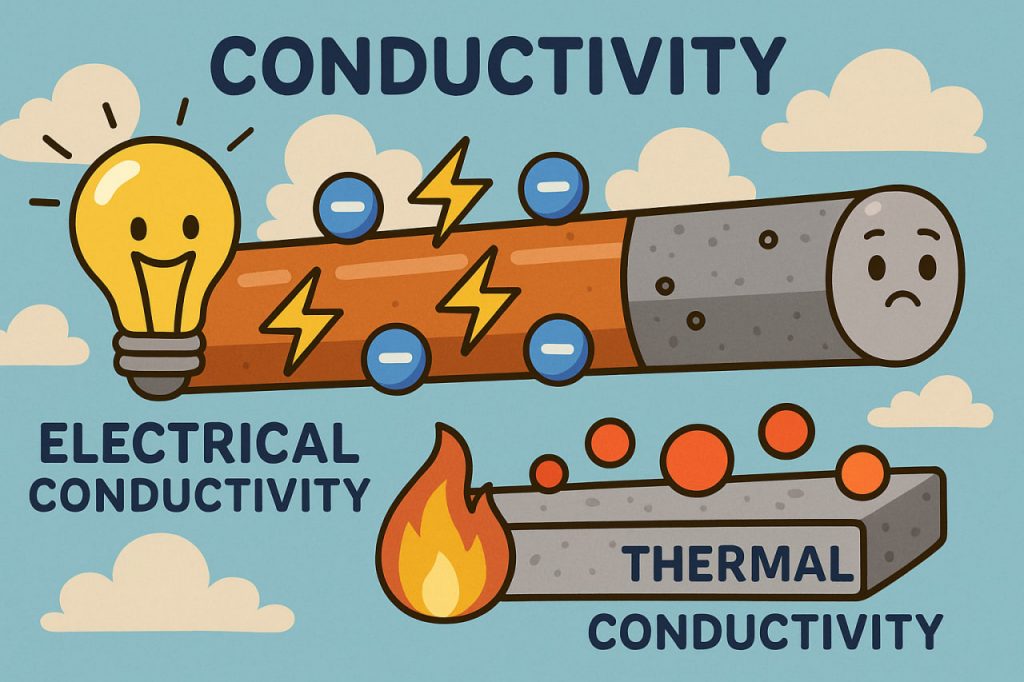
Conductivity is a fundamental property of matter that describes how easily a material allows the flow of electric charge or heat. This ability plays a central role in physics, engineering, electronics, energy systems, and even biological processes. Materials with high conductivity — such as metals — allow electric currents to move freely, while poor conductors resist the flow of electricity and instead act as insulators. Conductivity also determines how efficiently heat spreads through solids, liquids, and gases. Understanding conductivity helps explain why certain objects feel colder to the touch, why electrical wires are made of copper, and how the human body transmits nerve signals. It forms the basis for technologies ranging from microchips to household appliances and renewable energy systems.
Although conductivity is often associated with electricity, it reflects deeper principles of atomic and molecular motion. In metals, electrons move freely, allowing fast current flow. In fluids, ions carry charge, making salty water more conductive than pure water. In biological tissues, electrolytes enable signals to travel through nerves and muscles. Conductivity varies widely across natural and synthetic materials, and its measurement provides insight into composition, purity, structure, and physical state.
Electrical Conductivity: The Flow of Charge
Electrical conductivity measures how easily electrons or ions can move through a material. Metals such as silver, copper, and aluminum are excellent conductors because their electrons are loosely bound and move freely. Insulators, like rubber, plastic, and glass, hold their electrons tightly and resist current. Semiconductors — used in electronics — fall between these extremes. According to materials scientist Dr. Helena Moore:
“Conductivity is not just a property of materials —
it is the foundation of every electronic device in the modern world.”
Temperature, impurities, and physical structure can all affect conductivity, making it a flexible and tunable property in advanced technologies.
Thermal Conductivity: How Heat Moves
Conductivity also describes how efficiently heat travels through a material. Metals again excel because their mobile electrons transfer energy quickly. Materials like wood, wool, and foam have low thermal conductivity, making them effective insulators. Thermal conductivity shapes building design, cooking tools, and industrial processes. For example, pots and pans rely on highly conductive metals, while homes use low-conductivity materials to retain heat.
Conductivity in Liquids and Biological Systems
In liquids, electrical conductivity depends on dissolved ions. Saltwater, for example, conducts electricity far better than pure water. This principle affects oceanography, chemistry, and environmental science. In biology, conductivity enables essential functions: nerve impulses rely on ion exchange, and electrolytes allow muscles to contract. Medical devices often measure conductivity to monitor hydration, tissue health, or chemical balance in the body.
Factors That Influence Conductivity
Several conditions change a material’s conductivity:
- Temperature: metals conduct better when cold; semiconductors conduct better when warm
- Composition: impurities can increase or decrease conductivity
- Structure: crystalline materials often conduct better than amorphous ones
- State of matter: solids, liquids, and gases behave differently
Engineers manipulate these factors to design specialized materials for sensors, wires, circuits, and scientific instruments.
Applications of Conductivity in Modern Technology
Conductivity enables countless technologies:
- electrical wiring
- batteries and energy storage
- high-speed electronics and microchips
- sensors and diagnostic devices
- solar panels and renewable energy systems
- superconductors used in powerful magnets
Understanding conductivity helps scientists develop faster, more efficient, and more sustainable technologies.
Why Conductivity Matters
Conductivity connects fundamental physics with real-world innovation. It explains how lightning forms, why metals shine, how electronics function, and how organisms communicate internally. As technology advances, conductivity research continues to reveal new materials — such as graphene and superconductors — that may transform future electronics, energy transmission, and medical diagnostics.
Interesting Facts
- Silver is the best electrical conductor of all metals.
- Pure water has almost no conductivity — it becomes conductive only when ions are present.
- Superconductors can conduct electricity with zero resistance, but only at very low temperatures.
- The human body conducts electricity due to electrolytes like sodium and potassium.
- Graphene is one of the most conductive materials ever discovered.
Glossary
- Electrical Conductivity — the ability of a material to allow electric charge to flow.
- Thermal Conductivity — how efficiently heat moves through a material.
- Electrolytes — charged particles that enable conductivity in biological systems.
- Semiconductor — a material with conductivity between a conductor and an insulator.
- Superconductor — a material that conducts electricity with zero resistance under special conditions.