The Kirlian effect refers to a visual phenomenon in which a glowing, colorful aura appears around objects or living organisms when they are photographed using high-voltage, high-frequency electrical fields. Discovered accidentally in 1939 by Soviet inventor Semyon Kirlian, this effect captured global attention because the resulting images seemed to show “energy fields” surrounding plants, leaves, coins, and even human fingertips. For decades, the Kirlian effect inspired scientific curiosity, artistic exploration, and widespread myths. While often misunderstood, the phenomenon remains a fascinating intersection of physics, photography, and cultural imagination.
At its core, the Kirlian effect is not supernatural but electrical. When a high-voltage current passes across the surface of an object placed on photographic film or a plate, the object emits a corona discharge — a faint electrical glow caused by ionizing surrounding air. This glow imprints itself on the film, creating distinctive, radiant images. These patterns are influenced by moisture, pressure, conductivity, and environmental conditions. Although the effect is visually striking, modern science does not interpret it as evidence of emotions, spirits, or life energy. Instead, it is a physical interaction between electricity and matter.
How Kirlian Photography Works
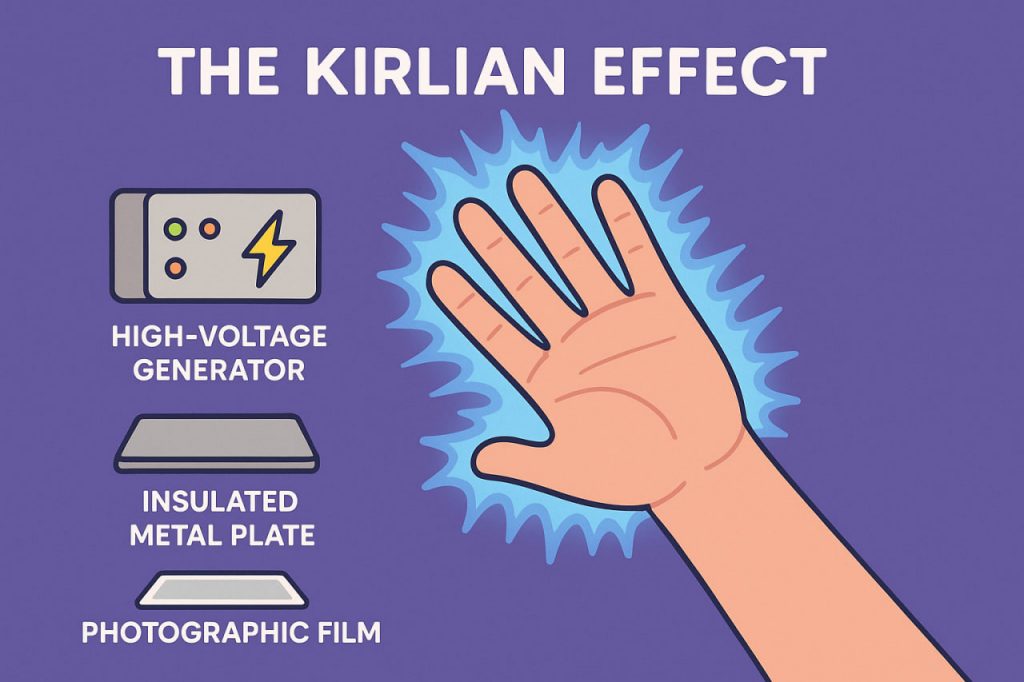
Kirlian photography requires a high-voltage generator, an insulated metal plate, and either photographic film or a digital capture system. When an object touches the plate, electricity travels across its surface, creating small electrical discharges. These discharges ionize air molecules, producing visible patterns that vary based on conductivity, shape, and local humidity. Different objects produce different corona patterns, making the effect both predictable and visually fascinating.
Why Living Organisms Produce Stronger Kirlian Images
Living tissues often appear brighter in Kirlian photographs because they contain water and electrolytes that conduct electricity more efficiently. The moisture surrounding skin or plant surfaces amplifies electrical discharge, creating more vivid patterns. Changes such as sweating, temperature, or pressure can alter the glow. This variability led early researchers to believe they were capturing “auras,” though the effect is purely physical. Still, the correlation between biological activity and electrical conductivity remains an interesting field of study.
Myths and Misinterpretations
The Kirlian effect became widely associated with metaphysics, alternative healing, and paranormal claims. Some believed that Kirlian photographs revealed emotions, health conditions, or spiritual energy. However, controlled scientific studies show that the patterns are influenced by measurable physical factors — not mental or emotional states. The “aura” disappears or changes when moisture levels change, when pressure is altered, or when objects are dried.
Scientific Value and Modern Applications
Although no scientific evidence supports supernatural interpretations, the Kirlian effect has value in research and visualization. It helps scientists study electrical properties of materials, humidity levels, and corona discharge behavior. In art, Kirlian photography produces unique, luminous images that continue to intrigue audiences. Some experiments also explore whether the method can help monitor plant vitality by tracking changes in moisture conductivity — an area of ongoing investigation.
Why the Kirlian Effect Still Fascinates People
The glowing halos and branching light patterns evoke a sense of mystery and beauty that resonates deeply with human imagination. Even when understood through physics, the images resemble living energy or cosmic light, blending science with art. As photography researcher Dr. Marcus Lee explains:
“The Kirlian effect endures because it reveals invisible interactions —
ordinary objects suddenly appear alive with electric light.”
This blend of aesthetics and science keeps the phenomenon relevant in both artistic and cultural contexts.
Interesting Facts
- The Kirlian effect was discovered accidentally when a high-voltage device sparked near photographic film.
- Moisture levels dramatically change the brightness and color of Kirlian images.
- Non-living objects such as coins also produce a “glow,” showing the effect is not tied to life energy.
- Early Kirlian photos became popular in paranormal magazines during the 1970s.
- Some modern artists use digital Kirlian devices to create luminous, abstract photographs.
Glossary
- Corona Discharge — a glow produced when electricity ionizes surrounding air.
- Ionization — the process of creating charged particles from neutral atoms or molecules.
- Conductivity — the ability of a material to carry electric current.
- Electrolytes — electrically charged particles in biological tissues that influence conductivity.
- High-Voltage Generator — a device used to create the electrical field needed for Kirlian photography.