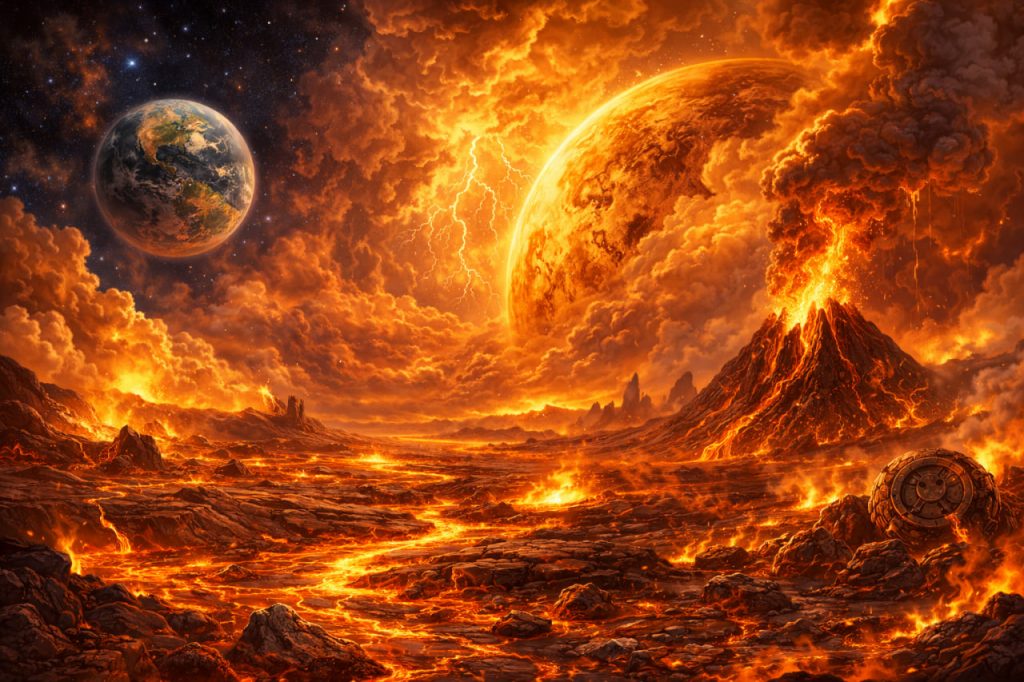
Venus is often called Earth’s sister planet because of its similar size, mass, and rocky composition, yet its environment could not be more different. While Earth supports life, Venus is a world of extreme heat, crushing pressure, and toxic clouds. Surface temperatures are hot enough to melt lead, and the atmosphere is dominated by carbon dioxide and sulfuric acid. These conditions make Venus one of the most hostile places in the Solar System. Understanding why two seemingly similar planets evolved so differently is one of the most important questions in planetary science. Venus offers a powerful lesson about climate, planetary evolution, and the fragility of habitability.
Why Venus Is Called Earth’s Sister
Venus and Earth formed from similar materials in the same region of the early Solar System. They have nearly the same diameter, mass, and internal structure, including a metallic core and rocky mantle. Gravity on Venus is only slightly weaker than on Earth, which once led scientists to speculate that it might host Earth-like conditions. However, similarity in size does not guarantee similarity in climate. According to planetary scientist Dr. David Grinspoon:
“Venus shows us that planets with Earth-like properties
can follow radically different evolutionary paths.”
This contrast makes Venus especially valuable for comparative planetology.
The Runaway Greenhouse Effect
The defining feature of Venus’s climate is its runaway greenhouse effect. The planet’s atmosphere is composed of more than 96% carbon dioxide, trapping enormous amounts of heat. Unlike Earth, Venus lacks oceans that could absorb carbon dioxide and regulate temperature. As the planet warmed, any surface water likely evaporated, adding water vapor—a powerful greenhouse gas—to the atmosphere. This feedback loop caused temperatures to rise uncontrollably. Today, Venus maintains surface temperatures around 460°C, regardless of day or night.
Atmospheric Pressure and Toxic Clouds
Venus’s atmosphere is not only hot, but also incredibly dense. Surface pressure is about 90 times greater than Earth’s, equivalent to being nearly one kilometer underwater. Thick clouds of sulfuric acid reflect sunlight, giving Venus its bright appearance from space. These clouds prevent direct observation of the surface in visible light and play a key role in atmospheric chemistry. Despite the brightness, very little sunlight reaches the ground. The atmosphere itself is in constant motion, with winds circling the planet much faster than the planet rotates.
Slow Rotation and Extreme Day Length
Venus rotates extremely slowly and in the opposite direction to most planets. A single day on Venus is longer than a Venusian year. This slow rotation contributes to unusual atmospheric dynamics, including super-rotation, where the atmosphere moves faster than the planet’s surface. Temperature differences between day and night are surprisingly small due to efficient heat distribution by the atmosphere. These factors further complicate climate modeling and challenge our understanding of planetary systems.
Why Venus Matters for Earth’s Future
Studying Venus is not just about understanding another planet; it is also about understanding Earth. Venus represents a possible outcome of unchecked greenhouse warming. While Earth is not on the same path, Venus serves as a natural laboratory for extreme climate processes. By studying Venus, scientists refine models used to predict climate behavior on Earth and on exoplanets. Venus reminds us that planetary climates can change dramatically and irreversibly.
Interesting Facts
- Venus is the hottest planet in the Solar System, hotter than Mercury.
- A day on Venus is longer than its year.
- Atmospheric pressure on Venus can crush unprotected spacecraft.
- The planet reflects so much light that it is visible from Earth without a telescope.
- Venus has no liquid water on its surface today.
Glossary
- Runaway Greenhouse Effect — a process where warming amplifies itself through greenhouse gases.
- Super-Rotation — atmospheric movement faster than a planet’s rotation.
- Carbon Dioxide Atmosphere — an atmosphere dominated by CO₂, trapping heat efficiently.
- Planetary Albedo — the fraction of sunlight a planet reflects.
- Comparative Planetology — the study of planets by comparing their characteristics.