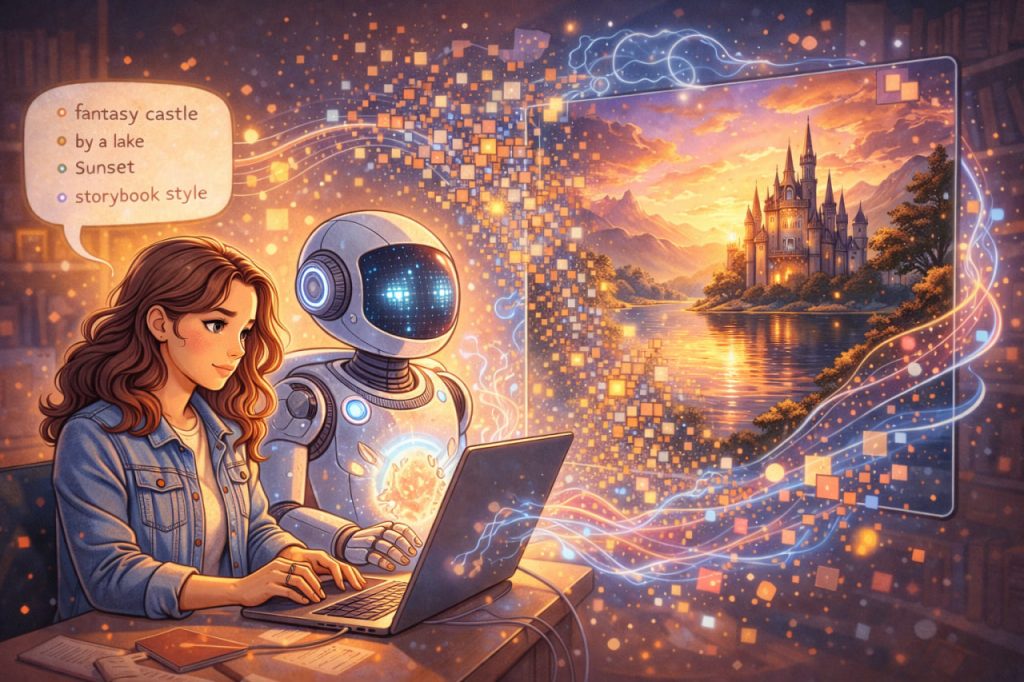
Image generation in ChatGPT is based on advanced artificial intelligence models that translate text descriptions into visual representations. Instead of searching for existing images, the system creates new images from scratch, guided entirely by the user’s prompt. This process relies on large neural networks trained on vast datasets that include relationships between words, concepts, styles, and visual patterns. When a user requests an image, the model interprets not only objects and scenes, but also mood, composition, lighting, and artistic style. The result is a synthetic image that has never existed before. Understanding how this process works helps explain both its strengths and its limitations.
From Text to Visual Meaning
The first step in image generation is semantic interpretation of the prompt. The system analyzes words, context, and structure to understand what is being requested. It identifies key elements such as subjects, environment, style, perspective, and level of detail. Ambiguous or abstract phrases are resolved probabilistically based on training data. According to AI researcher Dr. Kevin Marshall:
“The model does not see images as humans do.
It predicts visual structure based on learned statistical relationships.”
This means the quality of the result strongly depends on how clearly the request is formulated.
Diffusion Models and Image Construction
Most modern AI image generators, including those integrated with ChatGPT, are based on diffusion models. These models start with visual noise and gradually refine it into a coherent image. At each step, the system removes randomness while reinforcing patterns that match the text prompt. This process happens over many iterations in a fraction of a second. Rather than assembling images from parts, the model continuously reshapes the entire image until it aligns with the description. This approach allows for high creativity and fine-grained detail.
Why Style and Detail Matter
Style instructions play a crucial role in generation. Phrases describing artistic approach, lighting, color palette, or realism guide the model toward specific visual aesthetics. Without style constraints, the system defaults to statistically common representations. Highly detailed prompts reduce randomness and increase consistency. However, too many conflicting instructions can degrade results. Image generation therefore balances precision with creative freedom.
Limits and Sources of Errors
Despite its capabilities, AI image generation has clear limitations. The model does not understand reality, physics, or intent—only patterns. This can lead to visual inconsistencies, incorrect proportions, or stylistic drift if instructions are vague. The system also cannot truly “correct” an image unless guided with refined prompts. These limitations explain why repeated iterations and reference styles are often necessary to achieve high-quality results.
Why Human Guidance Is Essential
AI image generation is not autonomous creativity, but collaborative creation. The human user defines goals, constraints, and aesthetic direction, while the model executes probabilistic visual synthesis. The best results emerge when prompts are precise, consistent, and aligned with a clear visual reference. Image generation in ChatGPT is therefore best understood as a tool that amplifies human intent rather than replaces it.
Interesting Facts
- AI images are generated from noise, not from photo libraries.
- The same prompt can produce different results each time.
- Style instructions significantly affect image composition.
- Diffusion models generate images in dozens of rapid refinement steps.
- AI does not “see” images, it predicts pixel relationships.
Glossary
- Image Generation — the creation of new images using artificial intelligence.
- Diffusion Model — an AI model that transforms noise into structured images.
- Prompt — a text instruction guiding image creation.
- Semantic Interpretation — analysis of meaning and context in text.
- Visual Noise — random pixel patterns used as a starting point for generation.