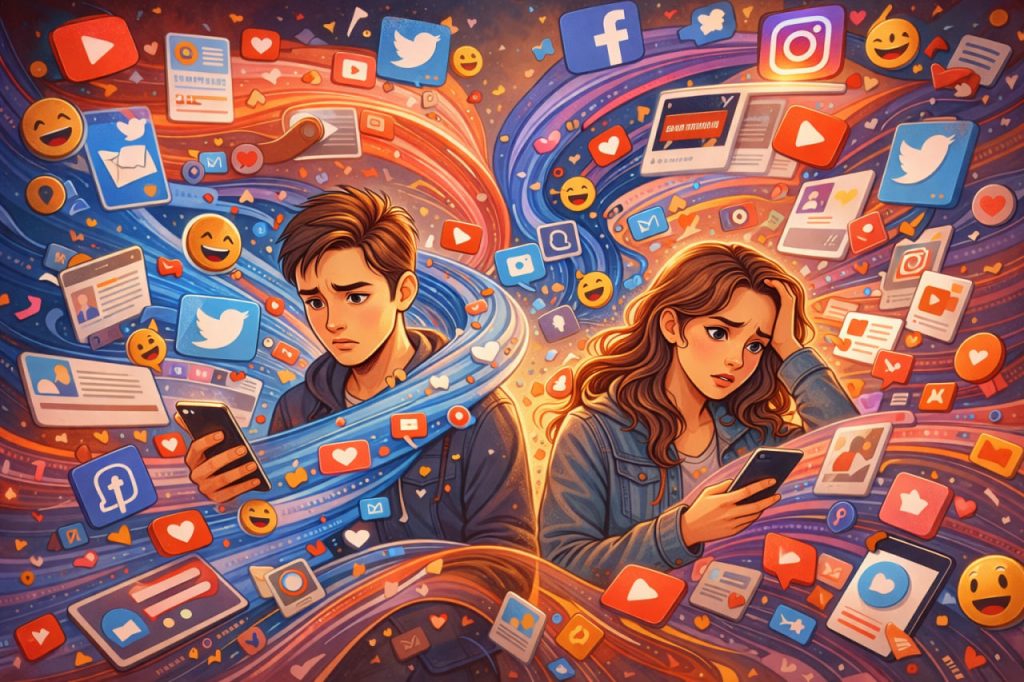
Modern social networks operate within a powerful system known as the attention economy, where human focus has become one of the most valuable resources. Platforms no longer compete primarily on functionality or content quality, but on how effectively they can capture, удержать, and repeatedly reclaim user attention. Every notification, scroll, recommendation, and autoplay feature is designed to reduce friction between stimulus and reaction. This competition is largely invisible to users, yet it strongly influences daily habits, emotions, and decision-making. Over time, the struggle for attention reshapes not only individual behavior but also social norms and cultural dynamics. Understanding this mechanism is essential for recognizing its long-term consequences.
The Attention Economy as the Core Driver
Social networks generate revenue by monetizing time spent on the platform, primarily through advertising and data-driven targeting. The longer users stay engaged, the more behavioral data platforms collect and the more valuable advertising placements become. This creates a structural incentive to maximize engagement rather than user well-being. Platforms therefore optimize interfaces to minimize stopping points and maximize continuous interaction. According to media researcher Dr. Jonathan Reed:
“Social platforms are not designed to serve content efficiently,
but to keep attention circulating within the system as long as possible.”
This economic logic underpins nearly all major design decisions in social media.
Algorithms and Emotional Amplification
At the center of attention competition are algorithmic feeds that constantly adapt to user behavior. These systems learn which content provokes the strongest emotional reactions, such as outrage, excitement, fear, or validation. Content that triggers high engagement is promoted more aggressively, regardless of depth or accuracy. Over time, algorithms create highly personalized feedback loops that reinforce existing preferences and biases. As platforms compete, these systems become increasingly refined, accelerating emotional stimulation and reducing neutrality in information exposure.
Short-Form Content and the Escalation of Competition
The global rise of short-form video formats represents a turning point in attention competition. These formats are engineered to deliver rapid stimulation with minimal cognitive effort. Platforms imitate each other’s successful features, leading to convergence in design and user experience. The result is an environment where speed, novelty, and emotional intensity dominate. This escalation conditions users to expect constant stimulation, making slower, more complex content harder to consume and sustain attention on.
Psychological and Behavioral Consequences
Continuous competition for attention produces measurable psychological effects. Users may experience fragmented attention, reduced concentration, and increased mental fatigue. Constant exposure to emotionally charged content can heighten stress and reactivity. Notification systems and feedback metrics reinforce habitual checking behaviors, gradually reducing tolerance for boredom or silence. Psychologist Dr. Elena Morris notes:
“When attention is continuously interrupted and redirected,
the brain adapts by favoring immediacy over reflection.”
These adaptations may persist beyond digital environments, influencing offline behavior.
Long-Term Social and Cultural Impact
On a broader scale, attention competition reshapes public discourse and cultural values. Information becomes more fragmented, nuanced discussion declines, and visibility often outweighs accuracy. News cycles accelerate, favoring reaction over analysis. Younger generations growing up in attention-optimized environments may develop different cognitive expectations regarding learning and communication. Without structural changes, digital ecosystems may increasingly prioritize engagement intensity over collective understanding and long-term societal health.
Interesting Facts
- Algorithms tend to amplify content that triggers strong emotions, not accuracy.
- The average user checks social media dozens of times per day.
- Short-form content is optimized for dopamine-driven feedback loops.
- Platforms frequently copy features to neutralize competitors.
- Attention scarcity is becoming a defining challenge of modern cognition.
Glossary
- Attention Economy — an economic system where human attention is treated as a limited resource.
- Algorithmic Feed — a content-ranking system driven by user behavior data.
- Engagement Metrics — indicators such as watch time, likes, shares, and clicks.
- Cognitive Fragmentation — reduced ability to sustain prolonged focus.
- Behavioral Optimization — design strategies aimed at shaping user habits and reactions.