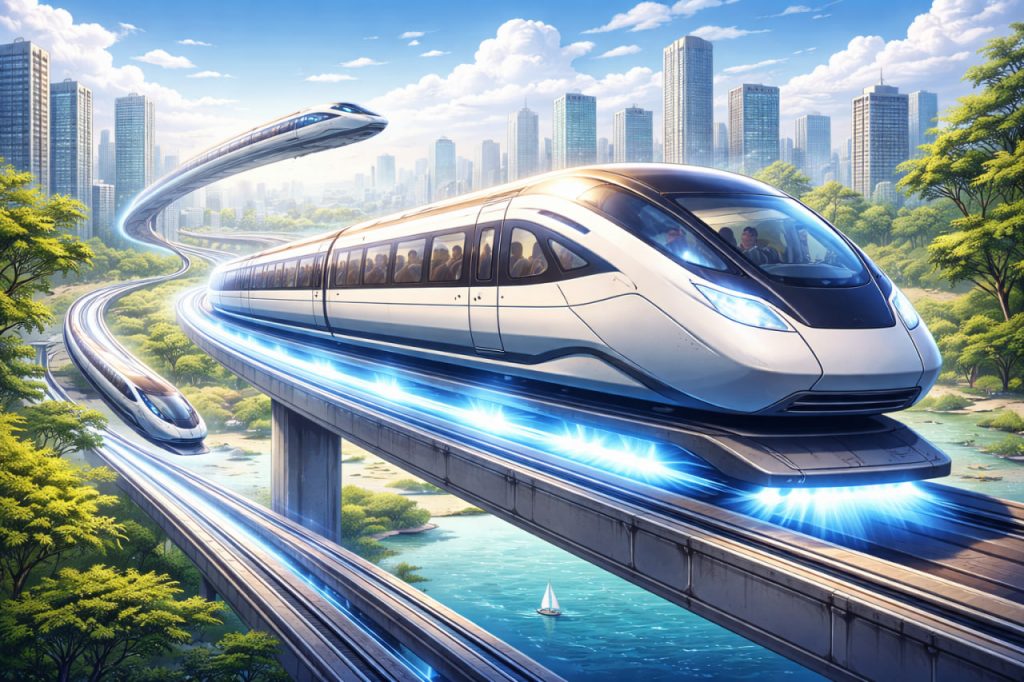
The idea of flying trains has fascinated engineers, futurists, and the public for decades, appearing in science fiction long before becoming a serious subject of scientific research. Today, this concept refers not to traditional trains with wings, but to advanced transportation systems that eliminate physical contact with rails by using magnetic fields, air pressure, or enclosed vacuum tubes. Flying trains promise extreme speeds, reduced friction, and quieter operation compared to conventional railways. As global cities grow and the demand for fast, sustainable transport increases, these technologies are gaining renewed attention. While fully airborne trains remain theoretical, several real-world systems already operate on principles that closely resemble “flight.” Understanding these technologies helps clarify what is realistic today and what may become possible in the future.
Magnetic Levitation as the Foundation
The most established form of flying train technology is magnetic levitation, commonly known as maglev. Instead of wheels, maglev trains use powerful magnetic fields to lift the train a few centimeters above the guideway, eliminating rolling friction. Once levitating, the train is propelled forward by electromagnetic forces, allowing it to reach exceptionally high speeds. Because there is no physical contact with the track, wear and noise are significantly reduced. According to transportation engineer Dr. Alan Meyer:
“Maglev trains don’t fly through the air,
but they fly over the track in every practical sense.”
This technology is already in commercial use in countries such as Japan and China, demonstrating that near-flight conditions can be achieved safely and reliably.
Vacuum Tubes and Near-Flight Conditions
An even more ambitious concept involves placing levitating trains inside low-pressure or vacuum tubes. By removing most of the air, aerodynamic drag is drastically reduced, allowing vehicles to travel at speeds comparable to aircraft while remaining ground-based. In these systems, trains effectively “fly” through controlled environments, guided by magnetic or electric propulsion. Engineers see this approach as a way to combine the speed of air travel with the efficiency of rail transport. However, maintaining long vacuum tubes, ensuring safety, and handling emergency situations present significant technical challenges. Despite this, research and prototype testing continue, driven by the potential for ultra-fast intercity travel.
Energy Efficiency and Environmental Impact
Flying train concepts are often promoted for their energy efficiency compared to airplanes. Because maglev and tube-based systems reduce friction and can be powered by electricity, they produce lower direct emissions when supplied by clean energy sources. These systems also avoid fuel-intensive takeoffs and landings, which account for a large portion of aviation emissions. Additionally, their precise guidance systems allow for smoother acceleration and deceleration, further reducing energy waste. Environmental researchers note that if powered sustainably, flying trains could play a major role in reducing the carbon footprint of long-distance travel.
Engineering Challenges and Safety
Despite their promise, flying trains face major engineering and economic hurdles. Infrastructure costs are extremely high, especially for long-distance routes requiring precise alignment and advanced materials. Safety systems must account for power failures, earthquakes, and extreme weather conditions. Engineers also need to ensure passenger comfort at very high speeds, where acceleration forces and pressure changes can affect the human body. According to systems safety expert Dr. Nina Rodriguez:
“The physics are achievable,
but large-scale deployment depends on trust, redundancy, and flawless system design.”
These challenges explain why flying trains are advancing gradually rather than replacing conventional transport overnight.
Future Visions and Practical Outlook
Looking ahead, flying trains are likely to coexist with traditional railways and aviation rather than fully replacing them. High-speed maglev lines may connect major metropolitan areas, while experimental tube systems could serve ultra-fast corridors where demand justifies investment. Advances in materials science, automation, and energy storage will play a critical role in making these systems more practical and affordable. While the dream of fully airborne trains remains speculative, the reality of trains that hover, glide, and race forward without touching the ground is already reshaping how engineers think about transportation.
Interesting Facts
- Some maglev trains have reached speeds of over 600 km/h in test conditions.
- Magnetic levitation reduces mechanical wear, significantly lowering maintenance costs.
- Vacuum-tube train concepts could theoretically exceed 1,000 km/h.
- Maglev systems are quieter than conventional trains because they lack wheel–rail contact.
- Flying train concepts inspired many early science fiction visions of future cities.
Glossary
- Magnetic Levitation (Maglev) — a technology that lifts vehicles using magnetic forces, eliminating contact with the track.
- Aerodynamic Drag — resistance caused by air acting against a moving object.
- Propulsion System — the mechanism that moves a vehicle forward.
- Low-Pressure Tube — an enclosed structure with reduced air density to minimize resistance.
- Infrastructure — the physical systems required to support transportation, such as tracks, tunnels, and power supply.