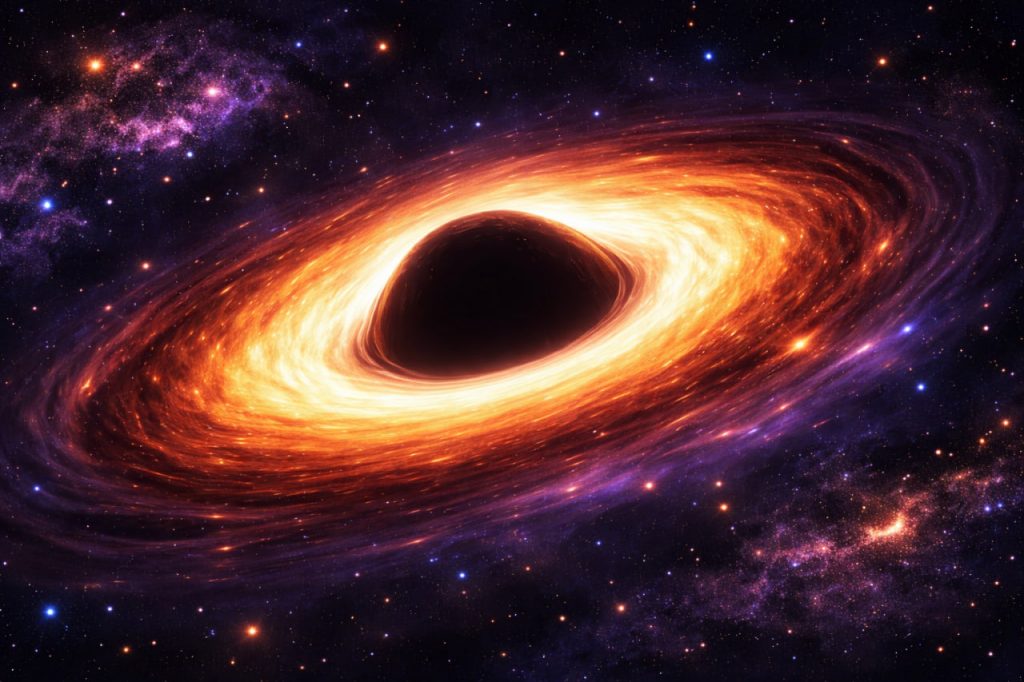
For decades, black holes were considered fundamentally unobservable objects, detectable only through indirect effects on surrounding matter and light. The idea of actually photographing a black hole once belonged more to science fiction than to real science. However, advances in radio astronomy, data processing, and global scientific collaboration made what seemed impossible a reality. The first images of black holes did not capture the object itself, but rather the shadow it casts against glowing material around it. These photographs marked a historic moment, confirming predictions made by Einstein’s theory of general relativity over a century ago. Understanding how black holes are photographed reveals both the limits of human technology and the extraordinary ingenuity used to overcome them.
Why Black Holes Cannot Be Photographed Directly
A black hole does not emit light, which means it cannot be photographed in the traditional sense. Its gravity is so strong that even photons crossing the event horizon are trapped forever. As a result, astronomers focus on observing the accretion disk, a ring of superheated gas and dust spiraling around the black hole at nearly the speed of light. This material glows intensely in radio and millimeter wavelengths, creating a bright background against which the black hole appears as a dark central region. The visible “image” is therefore not the black hole itself, but its gravitational influence on nearby matter. According to astrophysicist Dr. Laura Chen:
“What we image is not the black hole,
but the absence of light where gravity becomes absolute.”
This distinction is essential for correctly interpreting black hole photographs.
The Event Horizon Telescope
The breakthrough in black hole imaging came with the creation of the Event Horizon Telescope (EHT), a global network of radio observatories working together as a single virtual telescope the size of Earth. By synchronizing antennas across continents using atomic clocks, scientists achieved unprecedented resolution. This technique, known as very-long-baseline interferometry, allows astronomers to detect extremely fine details from across the universe. The EHT does not operate continuously; instead, it observes targets during carefully selected periods when atmospheric and orbital conditions are optimal. Massive amounts of data are recorded and later combined using advanced algorithms. This collaborative approach represents one of the most ambitious observational efforts in modern astronomy.
The First Black Hole Image
In 2019, scientists released the first-ever image of a black hole located at the center of the galaxy Messier 87. The image showed a glowing, asymmetrical ring surrounding a dark central shadow, exactly as predicted by theory. This shadow corresponds to the event horizon region, distorted by extreme gravitational lensing. Later, a second image was produced of the black hole at the center of our own Milky Way galaxy, Sagittarius A*. Despite being closer, this black hole was more difficult to image due to rapid changes in the surrounding plasma. These images provided direct observational evidence that black holes behave as Einstein’s equations predict under extreme conditions.
What Black Hole Images Tell Scientists
Photographs of black holes are not merely symbolic achievements; they provide valuable scientific data. By analyzing the shape, brightness, and distortion of the glowing ring, researchers can estimate the black hole’s mass, spin, and orientation. Deviations from predicted shapes could indicate new physics beyond general relativity. So far, observations align remarkably well with theoretical models, reinforcing confidence in current gravitational theory. However, scientists continue refining techniques to improve image clarity and capture dynamic changes over time. Future images may even allow astronomers to observe matter falling into black holes in real time.
Future of Black Hole Imaging
The future of black hole photography lies in expanding observational networks and moving instruments into space. Planned upgrades to the EHT include additional telescopes and higher-frequency observations, which will sharpen resolution. Space-based interferometers could one day eliminate atmospheric interference entirely, producing clearer and more detailed images. Scientists also aim to create time-lapse sequences, effectively turning still images into black hole “movies.” These advances promise deeper insights into gravity, spacetime, and the most extreme environments in the universe.
Interesting Facts
- The first black hole image required petabytes of data, physically transported on hard drives for processing.
- The glowing ring seen in images is formed by gravitational lensing, bending light around the black hole.
- The black hole in Messier 87 has a mass of over six billion Suns.
- Imaging Sagittarius A* was harder because the surrounding matter changes minute by minute.
- Future black hole images may test theories that go beyond Einstein’s relativity.
Glossary
- Black Hole — a region of spacetime where gravity is so strong that nothing, including light, can escape.
- Event Horizon — the boundary beyond which no information can return.
- Accretion Disk — superheated matter spiraling around a black hole.
- Gravitational Lensing — the bending of light caused by massive objects.
- Interferometry — a technique that combines signals from multiple telescopes to increase resolution.