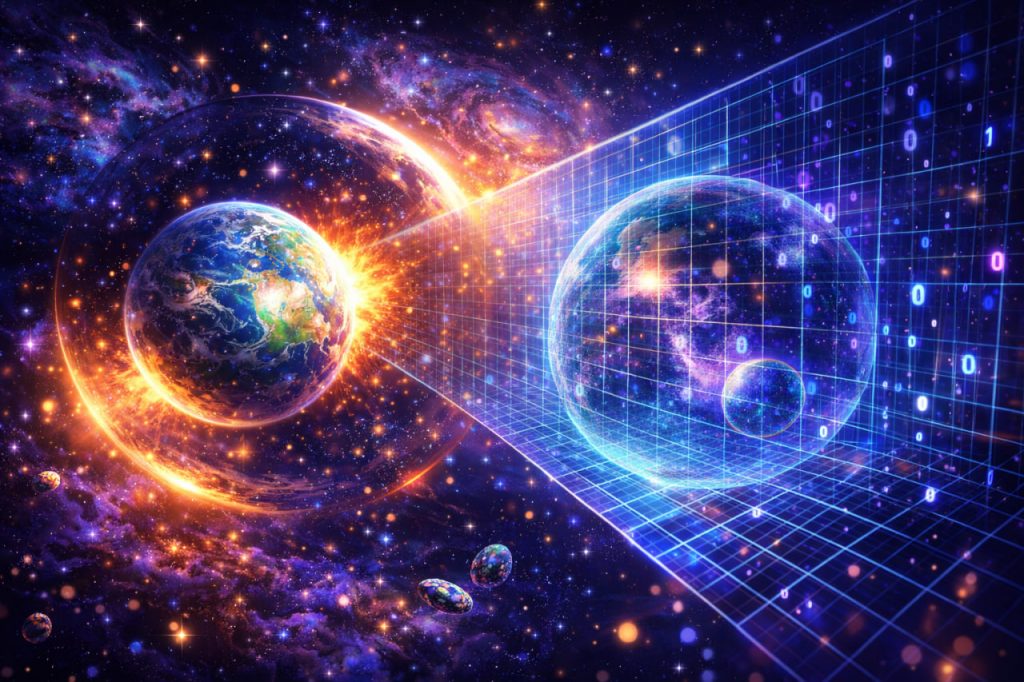
The holographic principle is one of the most radical ideas in modern theoretical physics, proposing that all the information contained within a volume of space can be fully described by data encoded on its boundary. In simple terms, this means that a three-dimensional reality may emerge from information stored on a two-dimensional surface. What sounds like science fiction arises directly from attempts to reconcile gravity, quantum mechanics, and thermodynamics. The principle challenges everyday intuition about space, depth, and locality, forcing physicists to rethink what “inside” and “outside” truly mean. Over the past decades, the holographic principle has become a powerful conceptual tool in the search for a unified description of nature. Understanding it offers a glimpse into how reality itself may be structured at the deepest level.
Origins of the Idea
The holographic principle emerged from studies of black hole physics, particularly the surprising relationship between entropy and surface area. Physicists discovered that the entropy of a black hole is proportional not to its volume, but to the area of its event horizon. This contradicted classical expectations, where information content usually scales with volume. The implication was profound: information about everything that falls into a black hole appears to be stored on its boundary. From this insight grew the idea that spacetime itself might obey similar rules. The principle was later generalized beyond black holes to apply to entire regions of the universe.
Information, Boundaries, and Reality
At the core of the holographic principle lies the concept of information as a fundamental building block of physics. Instead of treating space as a container filled with objects, the principle suggests that physical reality emerges from informational relationships defined on surfaces. These boundaries encode all possible states of the system they enclose. The three-dimensional world we experience may therefore be a kind of projection, much like a hologram appears three-dimensional despite being encoded on a flat surface. This does not mean reality is an illusion, but rather that its deepest description may exist in fewer dimensions than we perceive.
Connections to Quantum Gravity
One of the main motivations for the holographic principle is the problem of quantum gravity—the challenge of unifying general relativity with quantum mechanics. Traditional approaches struggle because gravity behaves very differently from other fundamental forces at small scales. The holographic principle offers a new perspective by suggesting that gravitational physics in a volume can be equivalent to non-gravitational physics on its boundary. This dual description allows complex gravitational systems to be studied using more manageable quantum theories. As a result, the principle has become central to many modern approaches to quantum gravity.
Implications for Space and Time
If the holographic principle is correct, space and time may not be fundamental ingredients of the universe. Instead, they could be emergent properties, arising from deeper informational structures. Distance, depth, and even the flow of time might result from patterns of quantum entanglement on lower-dimensional boundaries. This idea radically alters how physicists think about causality and locality. It suggests that what we perceive as smooth spacetime could be a large-scale approximation of something far more abstract and discrete underneath.
Experimental and Theoretical Challenges
Despite its elegance, the holographic principle remains difficult to test experimentally. Its most precise formulations apply to highly idealized universes rather than the exact conditions of our own cosmos. Nevertheless, researchers explore indirect signatures through studies of black holes, quantum information, and cosmology. Advances in mathematics, simulation, and quantum computing are helping scientists probe these ideas more deeply. While direct experimental confirmation may be distant, the principle continues to guide theoretical progress.
Why the Holographic Principle Matters
The importance of the holographic principle extends beyond any single theory. It reshapes how physicists think about information, reality, and the limits of knowledge. By linking gravity, quantum mechanics, and information theory, it provides a unifying language for some of the deepest problems in physics. Even if future discoveries modify or replace it, the holographic principle has already changed the direction of fundamental research. It stands as a reminder that reality may be far stranger—and more elegant—than our everyday experience suggests.
P.S. Please don’t forget – this is just a theory…
Interesting Facts
- The holographic principle was inspired by black hole entropy paradoxes.
- It suggests that volume information scales with surface area, not depth.
- Some theories describe gravity as an emergent phenomenon, not fundamental.
- The idea links physics with information theory at a deep level.
- Holographic models are widely used in theoretical simulations of spacetime.
Glossary
- Holographic Principle — the idea that all information in a region of space can be encoded on its boundary.
- Entropy — a measure of information or disorder in a physical system.
- Event Horizon — the boundary beyond which information cannot escape a black hole.
- Quantum Gravity — the field of study aiming to unify quantum mechanics and gravity.
- Emergent Property — a feature that arises from underlying structures rather than existing fundamentally.