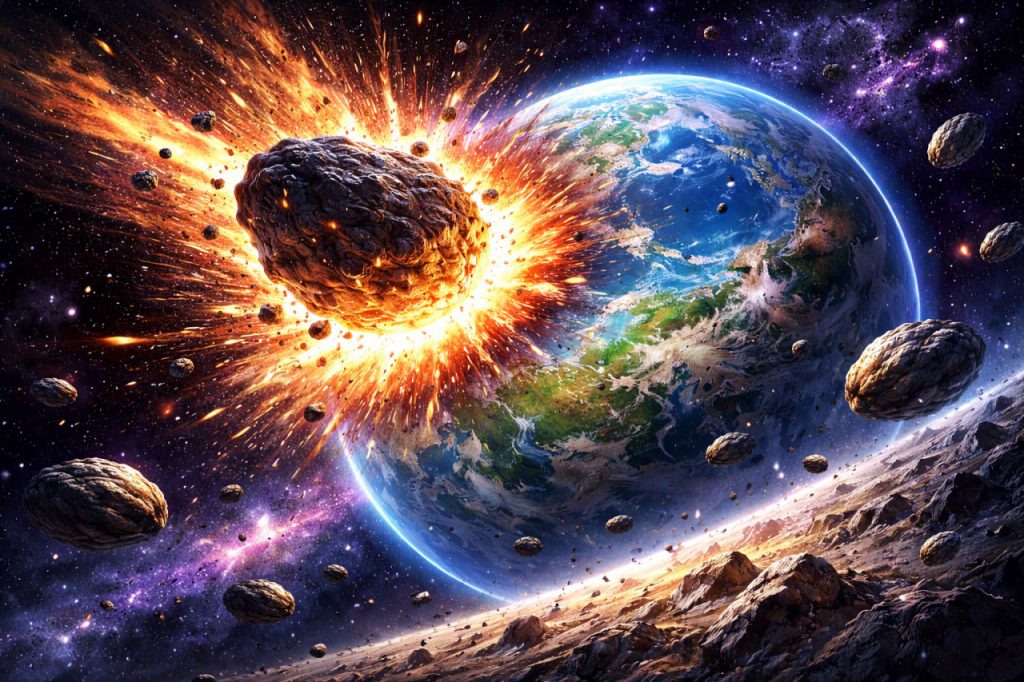
Collisions between planets and cosmic objects are among the most powerful and transformative events in the universe. Asteroids, comets, and even protoplanets have repeatedly reshaped planetary surfaces, atmospheres, and evolutionary paths since the birth of the solar system. Although such impacts are rare on human timescales, they play a fundamental role in shaping worlds over millions and billions of years. From the formation of moons to mass extinctions and the delivery of water and organic compounds, planetary collisions are deeply connected to the history of life and geology. Modern astronomy studies these events not as distant catastrophes, but as key mechanisms of planetary evolution. Understanding how and why planets collide with cosmic objects reveals how dynamic and interconnected the universe truly is.
Types of Cosmic Objects Involved in Collisions
Planetary collisions can involve a wide range of cosmic objects, each with different consequences. Asteroids are rocky bodies that primarily originate from asteroid belts and can cause regional or global damage depending on their size. Comets, composed largely of ice and dust, often travel at higher velocities, increasing their impact energy despite lower density. In the early solar system, collisions between protoplanets were common, shaping the final sizes and compositions of planets. Smaller objects strike planetary surfaces frequently, while large impacts are rare but profoundly influential. Scientists classify these events based on object size, velocity, angle of impact, and planetary environment.
Impact Energy and Planetary Consequences
The effects of a collision depend largely on the kinetic energy released at impact. Even a relatively small object traveling at tens of kilometers per second can release energy comparable to millions of nuclear explosions. Large impacts can melt crustal rock, trigger massive earthquakes, and eject material into space. In extreme cases, impacts can alter a planet’s rotation, tilt, or orbit. Earth’s geological record preserves evidence of ancient impacts in the form of craters, shocked minerals, and global sediment layers. These records allow scientists to reconstruct events that occurred long before human history began.
Collisions and the Origin of Moons
Some planetary collisions are constructive rather than destructive. One of the most widely accepted theories for the origin of Earth’s Moon involves a giant impact between early Earth and a Mars-sized object. The debris from this collision is believed to have formed a disk around Earth, eventually coalescing into the Moon. Similar processes may explain the formation of moons around other planets. These events demonstrate that collisions can create stable systems rather than simply causing destruction. Planetary science increasingly views impacts as creative forces in cosmic evolution.
Mass Extinctions and Biological Impact
On planets with life, collisions can dramatically influence biological history. The most famous example on Earth is the asteroid impact linked to the extinction of the dinosaurs. Such events can inject vast amounts of dust and aerosols into the atmosphere, blocking sunlight and disrupting climate systems. Rapid environmental change can overwhelm ecosystems, leading to widespread extinction. However, impacts may also open ecological niches, allowing new life forms to evolve. In this way, collisions act as both destroyers and reset mechanisms in the history of life.
Modern Monitoring and Planetary Defense
Today, scientists actively monitor near-planet objects to assess collision risks. Telescopes and space missions track thousands of asteroids and comets, calculating their trajectories decades into the future. While the probability of a catastrophic impact in the near term is low, even smaller objects can cause regional damage. Research into planetary defense focuses on early detection and potential deflection methods. These efforts highlight humanity’s growing ability to understand and respond to cosmic threats, transforming planetary collisions from unpredictable dangers into manageable risks.
Collisions Beyond the Solar System
Planetary collisions are not limited to our solar system. Astronomers observe debris disks around distant stars that likely result from ongoing collisions between planetary bodies. Infrared observations reveal clouds of dust generated by massive impacts, offering insights into how planetary systems evolve. Studying these distant events helps scientists compare the history of our own solar system with others across the galaxy. Planetary collisions are thus a universal process, shaping worlds throughout the cosmos.
Interesting Facts
- Large impacts can release more energy than all nuclear weapons on Earth combined.
- Many planetary surfaces are covered with ancient impact craters.
- Some meteorites found on Earth originated from Mars and the Moon.
- Planetary collisions were far more common in the early solar system.
- Debris from impacts can remain in orbit for millions of years.
Glossary
- Asteroid — a rocky object orbiting a star, typically smaller than a planet.
- Comet — an icy cosmic body that releases gas and dust when near a star.
- Impact Crater — a depression formed by the collision of a cosmic object with a surface.
- Kinetic Energy — energy possessed by an object due to its motion.
- Planetary Defense — efforts to detect and mitigate potential collision threats.