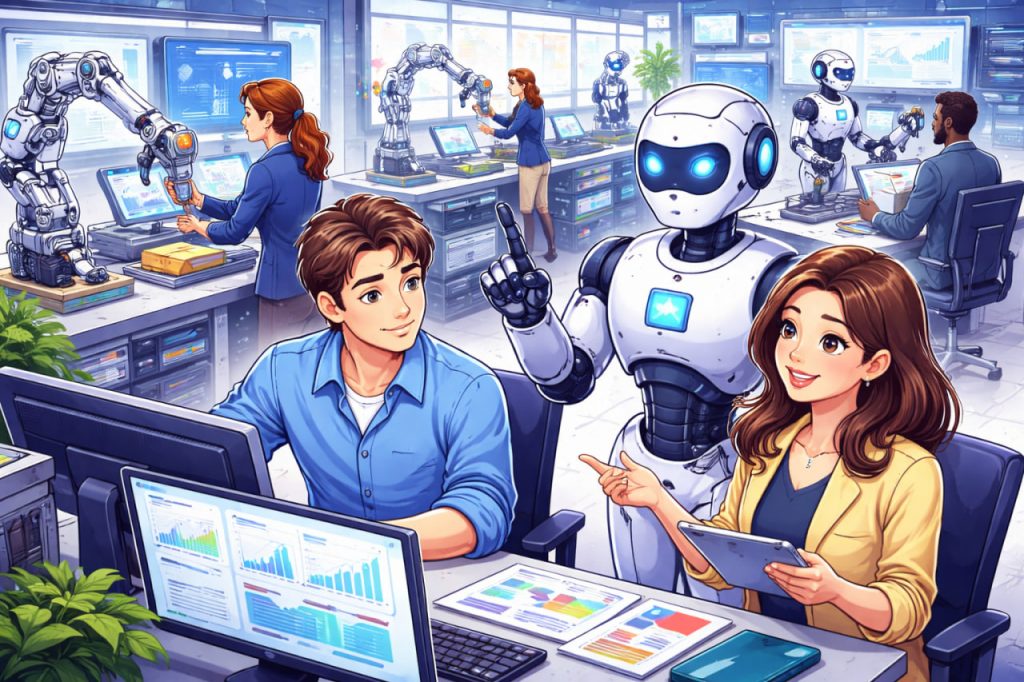
The rapid development of artificial intelligence has sparked widespread debate about the future of human work. As algorithms become capable of performing tasks once reserved for skilled professionals, concerns about mass unemployment grow stronger. From automated customer support to self-driving vehicles, AI systems are already reshaping entire industries. However, history shows that technological progress rarely eliminates work altogether; instead, it transforms the nature of jobs and the skills required to perform them. Understanding whether AI will truly take jobs away requires a deeper look at how technology changes economies, workplaces, and human roles. The real question is not whether jobs will disappear, but which jobs will change and how society will adapt.
Why AI Replaces Certain Types of Work
Artificial intelligence excels at tasks that are repetitive, predictable, and data-driven. Jobs involving routine data processing, basic analysis, or standardized decision-making are the most vulnerable to automation. AI systems can perform these tasks faster, cheaper, and with fewer errors than humans once properly trained. This explains why automation first appears in areas such as manufacturing, logistics, customer service, and basic administrative work. According to labor economist Dr. Samuel Brooks:
“AI does not replace people because it is intelligent,
but because it is efficient at narrow, well-defined tasks.”
This distinction is crucial for understanding where real job displacement is likely to occur.
Jobs That Are Changing Rather Than Disappearing
While some roles decline, many jobs are evolving instead of vanishing. AI often takes over specific tasks within a profession rather than eliminating the entire role. For example, software tools can automate parts of accounting, medicine, or journalism, but human judgment, creativity, and responsibility remain essential. In these cases, workers shift from manual execution to supervision, interpretation, and strategic decision-making. This transformation can increase productivity and reduce routine workload. Rather than replacing humans, AI frequently becomes a collaborative tool, augmenting human capabilities.
New Professions Created by Artificial Intelligence
Technological change has historically created new types of work, and AI is no exception. Entirely new professions are emerging around data science, AI training, system monitoring, ethics, and human–machine interaction. Additionally, industries that did not previously exist—such as app development or digital content creation—have expanded rapidly due to technological innovation. Economists note that many future jobs will require skills that are difficult to automate, including creativity, emotional intelligence, complex problem-solving, and interdisciplinary thinking. AI may reduce demand for certain jobs, but it also generates new opportunities that were unimaginable just decades ago.
The Role of Education and Adaptation
The impact of AI on employment depends largely on how societies respond through education and retraining. Workers whose skills become outdated face greater risk if they lack access to learning opportunities. At the same time, flexible education systems can help people transition into new roles created by technological change. Lifelong learning, digital literacy, and adaptability become central to job security in an AI-driven economy. According to workforce researcher Dr. Elena Morris:
“The greatest risk is not artificial intelligence itself,
but the failure to prepare people for technological change.”
This highlights that policy and education play as much of a role as technology itself.
Will AI Lead to Mass Unemployment?
Most experts agree that widespread, permanent mass unemployment is unlikely in the near future. Instead, the labor market is expected to undergo continuous restructuring, with some sectors shrinking while others expand. Short-term disruption is possible, especially in regions or industries slow to adapt. However, human work has repeatedly adjusted to past technological revolutions, from industrial machinery to computers and the internet. AI represents another powerful shift, but not an unprecedented one. The challenge lies in managing the transition fairly and responsibly.
Human Skills AI Cannot Replace
Despite rapid progress, AI still lacks genuine understanding, consciousness, and moral responsibility. Skills such as empathy, ethical judgment, leadership, creativity, and complex social interaction remain uniquely human. Many professions depend on trust, human connection, and contextual awareness that machines cannot replicate. As a result, future work is likely to emphasize these strengths rather than compete directly with automation. In this sense, AI may push societies to redefine the value of human work, not eliminate it.
Interesting Facts
- Many jobs affected by AI lose tasks, not entire professions.
- Past technological revolutions initially caused fear but later created more diverse job markets.
- AI systems require human oversight, training, and ethical control.
- Creative and social professions are among the least automatable.
- Education level strongly influences how workers are affected by automation.
Glossary
- Artificial Intelligence — computer systems designed to perform tasks that normally require human intelligence.
- Automation — the use of technology to perform tasks with minimal human involvement.
- Reskilling — learning new skills to adapt to changing job requirements.
- Labor Market — the supply and demand of jobs and workers within an economy.
- Human–AI Collaboration — cooperation between people and intelligent systems in the workplace.