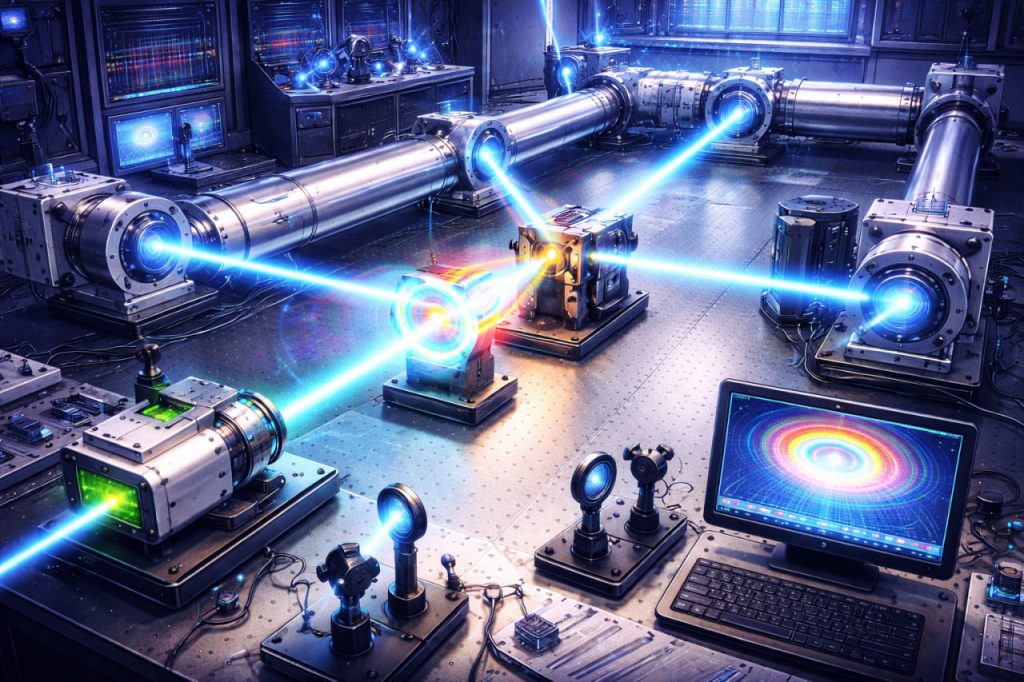
Interferometers are among the most precise scientific instruments ever created, designed to detect changes so small they are almost impossible to imagine. They work by comparing waves—most commonly light or radio waves—to measure extremely tiny differences in distance, motion, or time. Thanks to interferometers, scientists can observe phenomena that would otherwise remain completely hidden, from atomic-scale shifts to cosmic events billions of light-years away. These instruments play a central role in modern physics, astronomy, and engineering, transforming abstract wave behavior into measurable data. Although the underlying concept is elegant, interferometers are capable of extraordinary sensitivity. Understanding how interferometers work reveals how humanity measures reality at its most subtle levels.
The Principle of Interference
At the heart of every interferometer lies the phenomenon of wave interference. When two or more waves overlap, they combine to form a new pattern of constructive and destructive interference. In an interferometer, a single wave is split into two separate paths and later recombined. If the paths are exactly equal, the waves reinforce each other in a predictable way. However, even the smallest difference in path length—often smaller than the width of an atom—changes the interference pattern. According to physicist Dr. Alan Hoffman:
“Interferometry turns wave behavior into a ruler,
capable of measuring distances far beyond the reach of physical tools.”
This sensitivity makes interferometers uniquely powerful for precision measurement.
Types of Interferometers
There are many types of interferometers, each optimized for specific applications. Michelson interferometers use mirrors and beam splitters to compare light paths and are widely used in physics experiments. Fabry–Pérot interferometers trap light between reflective surfaces, enhancing sensitivity through repeated reflections. In radio astronomy, radio interferometers combine signals from multiple antennas spread across large distances, effectively creating a telescope the size of the entire array. Despite their differences, all interferometers rely on the same fundamental principle: extracting information from interference patterns. This versatility explains why interferometry appears in so many scientific disciplines.
Interferometers in Astronomy
Astronomy has been revolutionized by interferometers. Optical and radio interferometers allow astronomers to resolve distant objects with unprecedented clarity. By combining light from multiple telescopes, scientists can study the surfaces of stars, map gas clouds, and observe the environments around black holes. One of the most remarkable achievements enabled by interferometry is the detection of gravitational waves, ripples in spacetime produced by massive cosmic events. These discoveries confirmed predictions made by Einstein more than a century ago. Interferometers have effectively expanded the universe’s observable detail without building impossibly large single telescopes.
Precision Measurement and Earth-Based Applications
Beyond astronomy, interferometers are essential tools in laboratories and industry. They are used to calibrate instruments, test materials, and measure vibrations with extreme accuracy. In semiconductor manufacturing, interferometry ensures that components are aligned at the nanometer scale. Engineers use interferometers to monitor structural stability in bridges, tunnels, and spacecraft. Because they can detect motion and deformation at incredibly small scales, interferometers help prevent failures before they occur. Their role in precision engineering highlights how fundamental physics directly supports modern technology.
Limits, Challenges, and Future Developments
Despite their power, interferometers face significant challenges. Environmental noise, such as temperature changes or seismic vibrations, can interfere with measurements. Advanced systems require isolation, vacuum chambers, and complex data analysis to separate true signals from background noise. Researchers continuously develop new techniques to increase sensitivity and stability. Future interferometers may operate in space, free from many terrestrial disturbances, allowing even more precise measurements. As technology advances, interferometry will continue to push the boundaries of what can be observed and measured.
Interesting Facts
- Some interferometers can detect distance changes thousands of times smaller than a proton.
- Radio interferometers can simulate telescopes as large as the distance between antennas.
- Gravitational waves were first directly detected using laser interferometry.
- Interferometers rely on wave behavior, not physical contact, for measurement.
- Environmental noise must be reduced to extreme levels for high-precision experiments.
Glossary
- Interferometer — an instrument that measures interference patterns of waves to detect tiny changes.
- Interference — the combination of waves that produces patterns of reinforcement and cancellation.
- Beam Splitter — an optical device that divides a wave into separate paths.
- Gravitational Wave — a ripple in spacetime caused by accelerating massive objects.
- Precision Measurement — the ability to measure extremely small differences accurately.