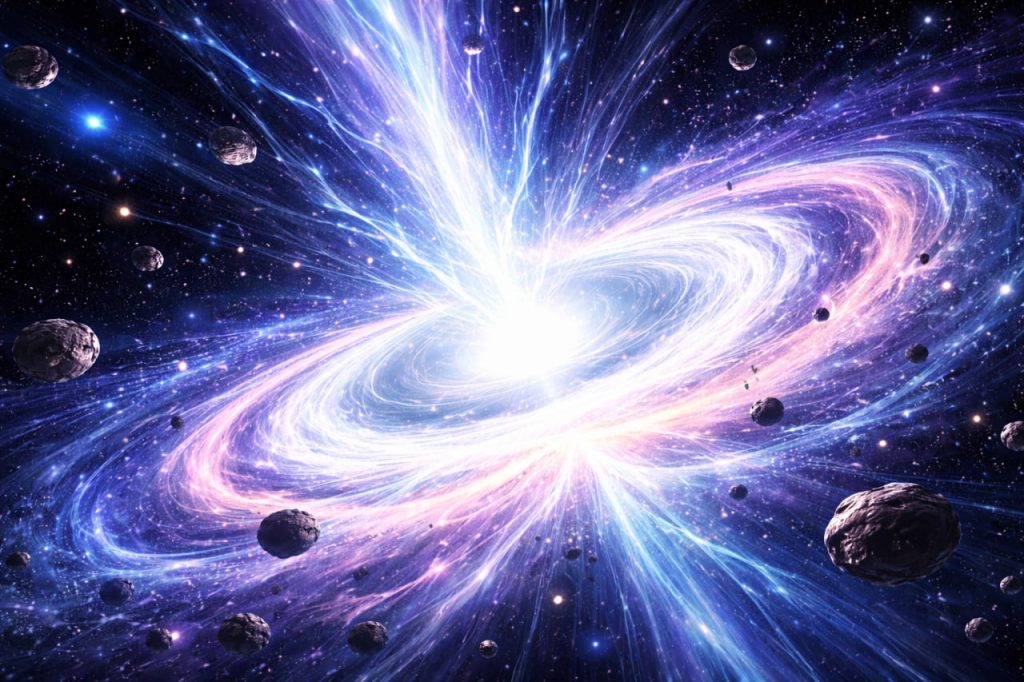
White holes are one of the most intriguing and speculative concepts in modern theoretical physics. Unlike black holes, which trap everything that crosses their event horizon, white holes are imagined as regions of space where matter and energy can only escape, never enter. They emerge not from direct observation, but from mathematical solutions to Einstein’s equations of general relativity. While black holes are now well-documented astronomical objects, white holes remain hypothetical, challenging scientists to rethink the nature of time, gravity, and the structure of the universe. The idea of white holes pushes physics to its conceptual limits, blending rigorous mathematics with deep philosophical questions. Understanding white holes helps illuminate how much we still do not know about spacetime.
Origins in General Relativity
The concept of white holes arises naturally when the equations describing black holes are mathematically extended. In these solutions, reversing the direction of time transforms a black hole into a white hole. Instead of collapsing inward, spacetime appears to expand outward from a central point. This makes white holes time-reversed black holes, existing only as long as the laws of physics allow such symmetry. Physicists emphasize that mathematical possibility does not guarantee physical reality. According to theoretical physicist Dr. Leon Hartmann:
“White holes are not inventions of imagination.
They appear when we follow Einstein’s equations to their logical extremes.”
This origin explains why white holes are taken seriously in theory, even without observational evidence.
Key Properties of White Holes
White holes are defined by a set of extreme and counterintuitive properties. Nothing can enter a white hole from the outside, as its boundary repels all incoming matter and radiation. At the same time, material may emerge from its interior, seemingly appearing out of nowhere. This behavior directly violates everyday intuition about cause and effect. Unlike black holes, which form from collapsing stars, white holes have no known formation mechanism in the observable universe. Their instability is another issue: theoretical models suggest that white holes would collapse almost instantly if exposed to even minimal disturbances. These challenges make their physical existence highly questionable.
White Holes and the Arrow of Time
One of the most fascinating aspects of white holes is their relationship with time. White holes appear to operate backward relative to the familiar flow of time, raising questions about causality. In a universe governed by increasing entropy, objects that spontaneously eject matter without absorbing anything seem fundamentally incompatible. This conflict places white holes at the center of debates about whether time-reversal symmetry truly applies to macroscopic phenomena. Some physicists argue that white holes could exist only in extremely constrained or early-universe conditions. Others suggest they may exist only as fleeting quantum events rather than stable cosmic objects.
Connections to Black Holes and Wormholes
White holes are sometimes discussed alongside wormholes, hypothetical tunnels connecting distant regions of spacetime. In certain models, a black hole and a white hole form two ends of a wormhole, allowing matter to enter one side and exit the other. However, these structures require exotic conditions and matter not known to exist in nature. While such ideas remain speculative, they provide useful thought experiments for testing theories of gravity and quantum mechanics. Exploring these connections helps scientists identify inconsistencies and gaps in current models of the universe.
Modern Perspectives and Scientific Debate
Today, most physicists view white holes as mathematical curiosities rather than real astrophysical objects. No telescope has detected phenomena that clearly require a white hole explanation. However, white holes continue to inspire research in quantum gravity, cosmology, and the foundations of spacetime. Some modern theories propose that black holes could eventually transition into white-hole-like states at the quantum level, releasing information over vast timescales. Whether white holes exist or not, they play an important role in expanding the boundaries of scientific thinking.
P.S. Please don’t forget – this is just a theory…
Interesting Facts
- White holes appear naturally in time-reversed solutions of Einstein’s equations.
- No confirmed observational evidence of white holes currently exists.
- White holes would be extremely unstable under realistic conditions.
- Some theories link white holes to information release from black holes.
- The concept challenges fundamental ideas about causality and entropy.
Glossary
- White Hole — a hypothetical region of spacetime that cannot be entered, only exited.
- Black Hole — a region where gravity prevents anything, including light, from escaping.
- Event Horizon — the boundary separating accessible space from a black or white hole.
- General Relativity — Einstein’s theory describing gravity as the curvature of spacetime.
- Entropy — a measure of disorder that generally increases over time.