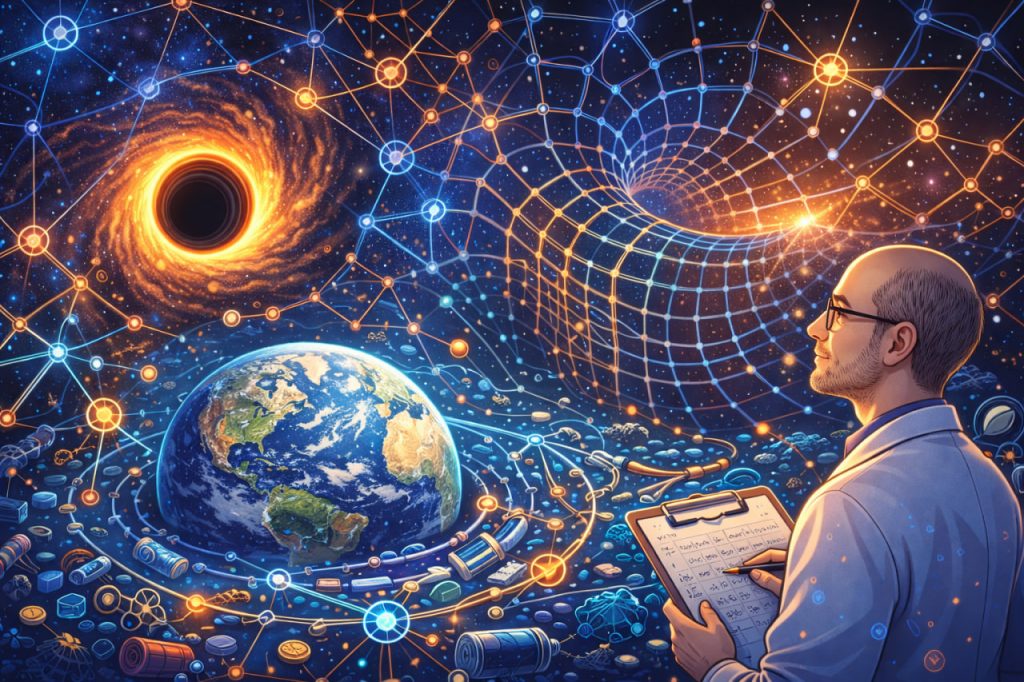
Loop quantum gravity is one of the leading theoretical attempts to unify quantum mechanics with general relativity. Unlike approaches that add extra dimensions or rely on unobserved entities, this theory focuses on quantizing spacetime itself. It proposes that space is not smooth and continuous, but instead has a discrete, granular structure at the smallest possible scales. These fundamental “loops” form a network that gives rise to geometry, distance, and volume. By rethinking the nature of space and time, loop quantum gravity challenges deeply rooted assumptions about the fabric of reality.
Why Quantum Gravity Is a Problem
Modern physics rests on two highly successful frameworks: quantum mechanics and general relativity. Quantum mechanics describes the behavior of particles at microscopic scales, while general relativity explains gravity and the structure of spacetime at cosmic scales. However, these theories become incompatible under extreme conditions, such as inside black holes or at the beginning of the universe. Attempts to apply standard quantum rules to gravity lead to mathematical inconsistencies. Loop quantum gravity emerged as a response to this conflict, aiming to describe gravity using quantum principles without breaking the geometric foundations of relativity.
The Core Idea: Quantized Spacetime
At the heart of loop quantum gravity lies the idea that spacetime is quantized, much like energy levels in an atom. Instead of being infinitely divisible, space is composed of tiny, discrete units. These units are represented mathematically by networks of loops, often called spin networks. Areas and volumes take on specific, minimum values rather than continuous ranges. This implies that below a certain scale, the concept of smooth space loses meaning. According to theoretical physicist Dr. Elena Rossi:
“In loop quantum gravity, space is not a background stage.
It is built from quantum relationships themselves.”
This perspective removes the need for a fixed spacetime backdrop.
Time Without a Background Clock
One of the most radical aspects of loop quantum gravity is its treatment of time. In this framework, time does not exist as a universal external parameter. Instead, change is described through relationships between physical processes. This idea aligns closely with general relativity, where time depends on gravity and motion. In quantum gravity, this leads to a “timeless” fundamental description, from which our familiar experience of time emerges. This challenges intuition but may be necessary for a consistent theory of gravity at the quantum level.
Black Holes and the Early Universe
Loop quantum gravity offers new ways to think about extreme cosmic environments. In black holes, the theory suggests that singularities—points of infinite density—may be replaced by highly compressed but finite quantum states. Similarly, the classical Big Bang may be replaced by a quantum bounce, where a previous contracting universe transitions into expansion. These ideas remain theoretical, but they provide mathematically consistent alternatives to singularities. Such predictions make loop quantum gravity especially interesting for cosmology.
Strengths and Open Challenges
A major strength of loop quantum gravity is that it is mathematically rigorous and does not require extra dimensions or speculative particles. It remains closely tied to known physical principles. However, significant challenges remain. Connecting the theory to observable predictions is difficult, and experimental tests are currently beyond reach. Researchers continue working on ways to derive measurable effects, such as subtle imprints in cosmological data. The theory’s success will ultimately depend on whether it can be linked to observation.
Its Place in Modern Physics
Loop quantum gravity represents a minimalist and conceptually bold approach to one of physics’ greatest problems. Rather than modifying matter or forces, it redefines space and time themselves. Even if future discoveries alter or replace it, the theory has already deepened understanding of what a quantum theory of gravity might require. It encourages physicists to question assumptions about continuity, time, and geometry. In this sense, loop quantum gravity plays a crucial role in expanding the horizon of theoretical physics.
Interesting Facts
- Loop quantum gravity predicts minimum possible areas and volumes.
- It does not require extra dimensions to function mathematically.
- Spacetime is described using networks of loops, not smooth geometry.
- The theory may replace the Big Bang with a quantum bounce.
- Time emerges from relations, not from an external clock.
Glossary
- Quantum Gravity — the field seeking to unify quantum mechanics and gravity.
- Spin Network — a mathematical structure representing quantized space.
- Quantization — the process of describing physical quantities as discrete units.
- Singularity — a point where classical physics predicts infinite values.
- Quantum Bounce — a hypothetical transition replacing a classical singularity.