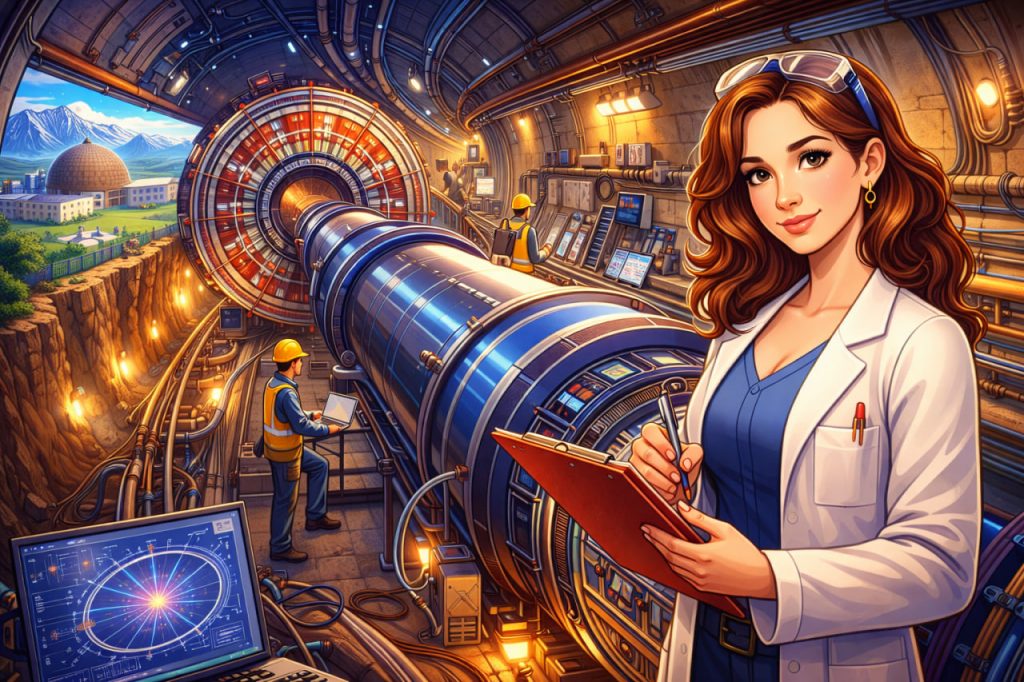
The Large Hadron Collider (LHC) is the most powerful particle accelerator ever built and one of the most complex scientific instruments in human history. Its creation was not a single engineering project, but a multi-decade international effort combining physics, engineering, computing, and diplomacy. Designed to explore the fundamental structure of matter, the LHC ensures collisions at energies never before achieved in a laboratory. The path from early ideas to a functioning collider involved theoretical debates, technological breakthroughs, and unprecedented global collaboration. Understanding how the LHC was created reveals how modern “big science” operates at the limits of human capability. It is a story of patience, precision, and collective ambition.
The Scientific Motivation Behind the Collider
The original motivation for building the LHC came from unanswered questions in particle physics. Scientists sought to understand why particles have mass, how fundamental forces unify, and whether unknown particles exist beyond established theories. Earlier accelerators had confirmed many predictions, but they lacked the energy to probe deeper layers of reality. Physicists proposed a new machine capable of recreating conditions similar to those fractions of a second after the Big Bang. This required collision energies far beyond previous experiments. According to theoretical physicist Dr. Martin Keller:
“The Large Hadron Collider was designed not to confirm what we already knew,
but to reach energy scales where entirely new physics could emerge.”
This ambition shaped every aspect of the project.
Choosing the Location and Tunnel
Rather than excavating a new tunnel from scratch, engineers decided to reuse an existing underground tunnel originally built for an earlier accelerator. This tunnel, approximately 27 kilometers in circumference, runs beneath the French–Swiss border near Geneva. Using the existing tunnel significantly reduced costs and environmental impact, but it also imposed strict design constraints. The collider had to fit precisely within a limited underground space while achieving extreme performance goals. Engineers redesigned nearly every component to meet these conditions. The decision to reuse the tunnel defined the physical scale and geometry of the LHC.
Engineering Extreme Conditions
One of the greatest challenges in building the LHC was managing extreme physical conditions. Protons circulate inside the collider at speeds approaching the speed of light, guided by thousands of powerful magnets. These magnets must operate at temperatures colder than outer space, requiring one of the largest cryogenic systems ever constructed. The vacuum inside the beam pipes is more rarefied than interplanetary space to prevent unwanted particle interactions. Maintaining stability under such conditions demanded innovations in materials science, superconductivity, and precision engineering. Every system had to function flawlessly for the collider to operate safely.
International Collaboration and Construction
The LHC was built and is operated by CERN, but its construction relied on contributions from thousands of scientists and engineers across the world. Components were designed, manufactured, and tested in dozens of countries before being transported to Geneva. Coordinating this effort required new management strategies and shared technical standards. Scientists from different cultures and disciplines worked toward a common goal, often over many years. This level of international cooperation became a defining feature of the project. The LHC stands as both a scientific and diplomatic achievement.
Detectors and Data Challenges
Building the collider itself was only part of the challenge. Equally complex were the massive detectors designed to observe particle collisions. These detectors record vast amounts of data, capturing traces of short-lived particles produced in collisions. Advanced computing networks were developed to store, process, and analyze this information. Data from the LHC is distributed globally, allowing researchers worldwide to participate in analysis. This transformed how scientific data is handled, pushing the limits of computing infrastructure and collaboration.
Testing, Setbacks, and First Operations
Before full operation, the LHC underwent extensive testing to ensure safety and reliability. Early in its operation, technical failures caused delays and required major repairs. These setbacks highlighted the difficulty of working at the edge of technological possibility. Engineers and scientists used these experiences to improve systems and procedures. When the collider finally reached full operational energy, it opened a new era in experimental physics. The first successful collisions marked the culmination of decades of work.
Scientific Legacy and Ongoing Development
The creation of the LHC did not mark an endpoint, but the beginning of continuous exploration. Its experiments have already reshaped understanding of fundamental particles and confirmed key theoretical predictions. Ongoing upgrades aim to increase collision rates and sensitivity, extending the machine’s scientific life. The LHC demonstrates how large-scale scientific infrastructure evolves over time. Its creation set a new standard for what humanity can achieve through collective knowledge and cooperation.
Interesting Facts
- The collider ring is about 27 kilometers in circumference.
- LHC magnets operate at temperatures colder than deep space.
- Protons make over 11,000 revolutions per second inside the collider.
- The project involved thousands of scientists from over 100 countries.
- The LHC generates petabytes of data each year.
Glossary
- Particle Accelerator — a machine that increases the energy of subatomic particles.
- Superconducting Magnet — a magnet operating without electrical resistance at very low temperatures.
- Cryogenic System — equipment designed to maintain extremely low temperatures.
- Detector — a device that records particle interactions.
- Big Science — large-scale scientific research involving extensive collaboration and infrastructure.