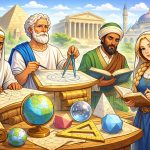
Omar Khayyam is widely known to the modern world as a poet, yet his scientific legacy is just as remarkable as his literary one. Living during the Islamic Golden Age, Khayyam worked at the intersection of mathematics, astronomy, philosophy, and logic. His scientific contributions were rooted in rigorous reasoning, careful observation, and a deep respect for knowledge inherited from earlier civilizations. At a time when poetry and science were not seen as separate domains, Khayyam embodied the ideal of the universal scholar. Understanding his role in science reveals a thinker whose influence extended far beyond verse and metaphor.
Mathematics as a Foundation of Knowledge
Mathematics was central to Khayyam’s scientific work, particularly his studies of algebra and geometry. He is best known among mathematicians for his systematic classification and solution of cubic equations, which he approached using geometric methods rather than symbolic algebra. By intersecting conic sections, Khayyam demonstrated solutions that were both elegant and logically consistent. His work moved mathematics away from purely computational techniques toward conceptual structure and proof. According to historian of mathematics Dr. Richard Turner:
“Khayyam treated algebra not as a toolbox,
but as a logical system deserving the same rigor as geometry.”
This approach anticipated later developments in mathematical theory by several centuries.
Reforming the Calendar
Beyond pure mathematics, Khayyam played a key role in one of the most accurate calendar reforms in history. He led a team of scholars tasked with improving the solar calendar, resulting in a system that measured the length of the year with exceptional precision. This calendar corrected accumulated errors in earlier systems and aligned civil timekeeping more closely with astronomical reality. Its accuracy rivals—and in some aspects exceeds—that of the modern Gregorian calendar. Khayyam’s work in this area demonstrates how abstract science can directly influence everyday life.
Astronomy and Observation
Astronomy formed another important pillar of Khayyam’s scientific activity. Working with observational data rather than myth or speculation, he emphasized measurement, verification, and consistency. His astronomical work supported calendar reform and contributed to a more precise understanding of solar motion. Khayyam’s approach reflected a broader scientific culture that valued empirical evidence while remaining grounded in mathematical theory. This balance between observation and abstraction remains a hallmark of good scientific practice today.
Philosophy, Logic, and Scientific Thought
Khayyam’s scientific work cannot be separated from his philosophical outlook. He engaged deeply with questions of causality, certainty, and the limits of human knowledge. His writings reveal skepticism toward unfounded claims and an insistence on logical coherence. This philosophical rigor shaped how he approached scientific problems, encouraging careful reasoning over authority or tradition. In this sense, Khayyam contributed not only specific results, but also a scientific mindset grounded in critical thinking.
Science and Poetry as Complementary Paths
While modern audiences often separate Khayyam’s poetry from his science, for him they were complementary expressions of inquiry. His verses reflect themes of uncertainty, time, and cosmic order—ideas closely related to his astronomical and philosophical interests. Rather than diminishing his scientific stature, his poetry reveals the human dimension of scientific curiosity. It shows how reflection and imagination can coexist with rigor and logic. Khayyam stands as an example of a thinker for whom science and art were different languages addressing the same fundamental questions.
Legacy and Influence
Omar Khayyam’s scientific contributions influenced scholars across the Islamic world and later reached Europe through translations and intellectual exchange. His methods in algebra and his emphasis on logical structure left a lasting mark on mathematical thought. Although his poetry eventually overshadowed his science in popular culture, modern historians increasingly recognize his importance as a scientist. Khayyam’s legacy reminds us that scientific progress is often driven by minds willing to cross boundaries between disciplines.
P.S. This remarkable scientist also worked diligently on his own development, demonstrating that science and the true path to God go hand in hand…
Interesting Facts
- Omar Khayyam classified cubic equations centuries before modern algebraic notation.
- His calendar reform achieved extraordinary astronomical accuracy.
- Khayyam emphasized logical proof over authority in scientific work.
- He worked as part of a state-supported scientific institution.
- His poetry reflects themes closely tied to time, astronomy, and uncertainty.
Glossary
- Cubic Equation — an algebraic equation of the third degree.
- Conic Section — a curve formed by intersecting a plane with a cone.
- Solar Calendar — a calendar based on Earth’s revolution around the Sun.
- Empirical Observation — knowledge gained through measurement and evidence.
- Islamic Golden Age — a period of major scientific and cultural advancement.