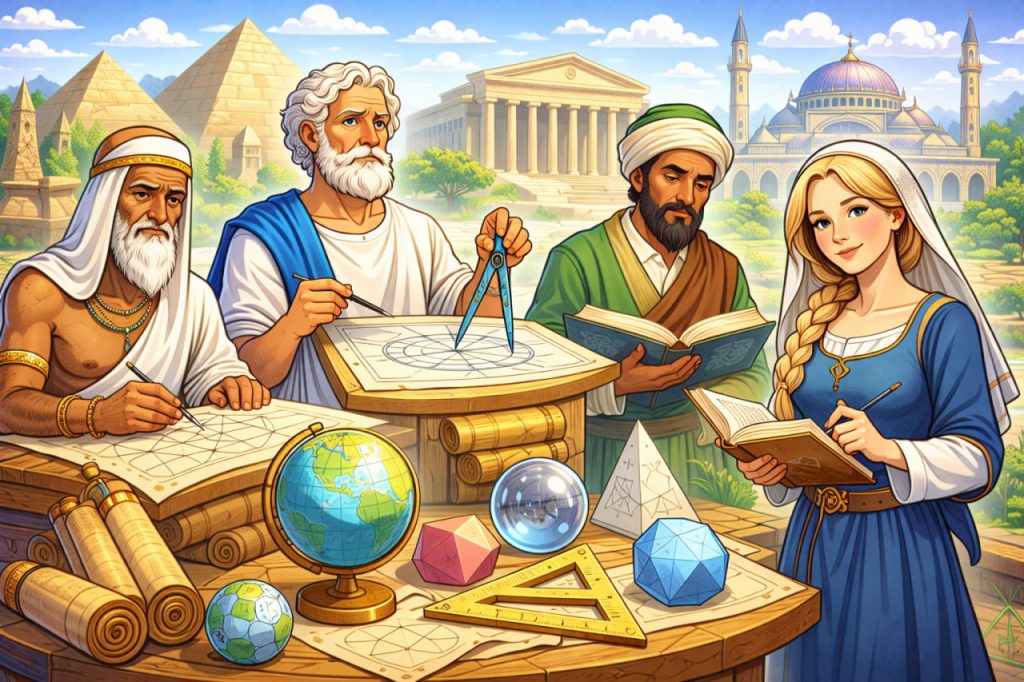
The history of geometry reflects humanity’s long effort to understand space, shape, and order in the world around us. From the earliest markings on stone and sand to abstract mathematical systems, geometry has evolved alongside civilization itself. Initially driven by practical needs such as land measurement, construction, and astronomy, geometry gradually became a theoretical science concerned with logic and proof. Over thousands of years, different cultures contributed ideas that expanded geometric thinking far beyond simple shapes. Geometry not only shaped mathematics but also influenced art, architecture, engineering, and philosophy. Tracing its history reveals how humans learned to move from visual intuition to abstract reasoning.
Geometry in Ancient Civilizations
The earliest forms of geometry emerged in ancient civilizations such as Egypt and Mesopotamia. In these cultures, geometry was primarily practical, used to measure land, build structures, and manage irrigation systems. The annual flooding of the Nile required Egyptian surveyors to repeatedly redefine property boundaries, leading to early geometric rules. In Mesopotamia, clay tablets show calculations involving areas, volumes, and angles. These early methods relied on observation and experience rather than formal proof. Geometry at this stage was a tool for survival and organization rather than a purely intellectual pursuit.
Greek Geometry and Logical Proof
A major transformation occurred in ancient Greece, where geometry became a deductive science. Greek mathematicians sought not just to measure shapes, but to understand why geometric relationships were true. This period introduced formal definitions, axioms, and logical proofs. The most influential work of this era systematized geometric knowledge into a coherent structure that could be built step by step. According to historian of mathematics Dr. Andrew Collins:
“Greek geometry marked the moment when mathematics became a science of reasoning,
not merely a collection of rules.”
This shift laid the foundation for mathematics as a rigorous intellectual discipline.
Geometry in the Islamic Golden Age
During the medieval period, scholars in the Islamic world preserved, expanded, and refined Greek geometric knowledge. Geometry was deeply connected to astronomy, architecture, and art. Islamic mathematicians explored geometric constructions, symmetry, and the relationship between algebra and geometry. Geometric patterns became central to architectural decoration, reflecting both mathematical sophistication and cultural values. Translation and commentary efforts ensured that ancient works were not lost and later reintroduced to Europe. This period served as a crucial bridge between ancient and modern geometry.
The Renaissance and the Rise of Coordinate Geometry
The Renaissance brought a renewed interest in science, perspective, and measurement. Artists and architects used geometry to create realistic representations of space. At the same time, mathematicians developed coordinate geometry, linking algebra with geometric shapes through numerical coordinates. This innovation allowed curves and figures to be described by equations, dramatically expanding what geometry could express. Geometry was no longer limited to ruler-and-compass constructions; it became a powerful analytical tool. This integration reshaped both mathematics and physics.
Non-Euclidean Geometry and New Worlds
For centuries, Euclidean geometry was considered the only possible description of space. In the nineteenth century, mathematicians discovered non-Euclidean geometries, in which parallel lines and angles behave differently. These new systems showed that geometry depends on underlying assumptions rather than absolute truths. Initially controversial, non-Euclidean geometry later became essential to modern physics, particularly in understanding curved space. This discovery transformed geometry from a single framework into a family of possible systems.
Geometry in the Modern Era
Today, geometry appears in many forms, from topology and differential geometry to computational and fractal geometry. Modern geometry plays a key role in physics, computer graphics, robotics, and data science. Digital tools allow visualization of complex geometric structures unimaginable in earlier centuries. Despite its advanced forms, modern geometry still builds on ideas developed thousands of years ago. The history of geometry demonstrates how abstract thinking evolves while remaining deeply connected to practical reality.
Interesting Facts
- Early geometry developed from land measurement and construction needs.
- Greek mathematicians introduced formal proofs still used today.
- Islamic architecture uses geometry as a core artistic principle.
- Coordinate geometry unified algebra and geometry.
- Non-Euclidean geometry changed how scientists understand space.
Glossary
- Geometry — the branch of mathematics dealing with shapes, space, and spatial relationships.
- Axiom — a statement accepted without proof as a starting point.
- Proof — a logical argument demonstrating the truth of a statement.
- Coordinate Geometry — geometry using numerical coordinates to describe shapes.
- Non-Euclidean Geometry — geometric systems that differ from classical Euclidean rules.