The Sun is the central engine of the Solar System and the primary source of energy for life on Earth. Although it feels permanent and unchanging on a human timescale, the Sun is a dynamic star with a well-defined life cycle. Astronomy allows scientists to understand not only how the Sun works today, but also how it will evolve over billions of years. The fate of the Sun is governed by physical laws that apply to stars across the universe. Studying this future helps place humanity in a broader cosmic context.
The Sun’s Current Stage
At present, the Sun is a main-sequence star, steadily converting hydrogen into helium in its core through nuclear fusion. This process releases enormous amounts of energy that balance the inward pull of gravity. The Sun has been in this stable phase for about 4.6 billion years. It is roughly halfway through its main life cycle. During this stage, changes occur very slowly and are barely noticeable over millions of years.
What Will Happen When Hydrogen Runs Out
Eventually, the Sun’s core will exhaust its hydrogen fuel. When this happens, the balance between gravity and fusion will change. The core will begin to contract and heat up, while the outer layers expand. This marks the transition from a stable star to a more dramatic phase of stellar evolution. These changes will not be sudden, but gradual over hundreds of millions of years.
The Red Giant Phase
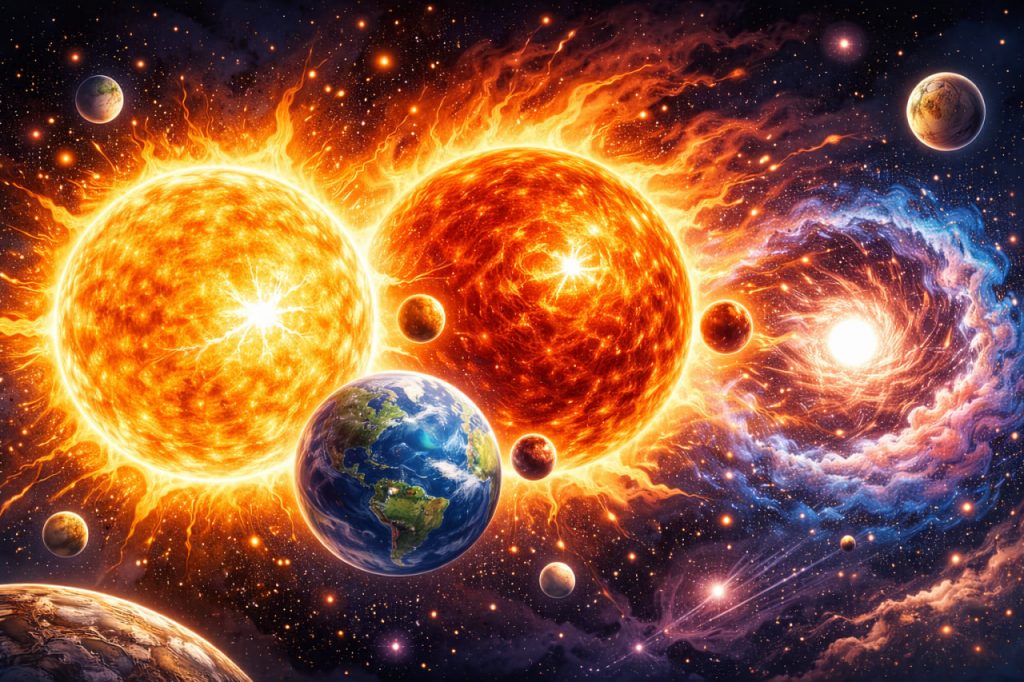
As the Sun evolves, it will enter the red giant stage. Its outer layers will expand enormously, potentially engulfing the inner planets. The surface temperature will decrease, giving the Sun a reddish appearance, even as its total energy output increases. Conditions on Earth, long before any physical engulfment, will become hostile to life due to rising temperatures. This phase represents the beginning of the Sun’s final transformation.
Expert Perspective
According to astrophysicist Dr. Caroline Weiss:
“The Sun’s evolution is slow but inevitable.
Long before it reaches its final stages,
conditions in the inner Solar System will fundamentally change.”
This highlights that the end of life on Earth will precede the physical end of the Sun itself.
The Final Stages: Planetary Nebula and White Dwarf
After the red giant phase, the Sun will shed its outer layers into space, forming a glowing planetary nebula. The remaining core will collapse into a white dwarf, a dense, Earth-sized remnant that no longer produces energy through fusion. This white dwarf will slowly cool over billions of years. It will be a silent remnant of what was once a life-sustaining star.
What This Means for the Solar System
The Sun’s transformation will dramatically reshape the Solar System. Inner planets will be destroyed or heavily altered, while outer planets and moons may survive in changed orbits. The loss of mass from the Sun will weaken its gravitational grip, allowing surviving objects to drift outward. The Solar System will become a colder, darker place. Its structure will reflect the Sun’s final evolutionary state.
Timescales and Perspective
All these changes will occur over billions of years. On human timescales, the Sun is remarkably stable and safe. There is no threat to current or near-future generations. Understanding the Sun’s fate is not about fear, but about perspective. It reminds us that even the most constant features of our world are part of a larger cosmic process.
Why the Sun’s Fate Matters
Studying the Sun’s future helps scientists understand stellar evolution across the universe. It also informs the search for life around other stars, showing how long habitable conditions can last. The Sun’s story is not unique—it is a typical path for stars of its size. By learning its fate, we learn about the life cycles of stars and the temporary nature of planetary environments.
Interesting Facts
- The Sun is about 4.6 billion years old.
- It will remain stable for another 5 billion years.
- Earth will become uninhabitable long before the Sun’s final stages.
- The Sun will never explode as a supernova.
- Its final form will be a white dwarf.
Glossary
- Main-Sequence Star — a star in a stable phase of hydrogen fusion.
- Red Giant — a late stage of stellar evolution with expanded outer layers.
- Planetary Nebula — gas expelled by a dying star.
- White Dwarf — a dense stellar remnant with no active fusion.
- Nuclear Fusion — process that powers stars by combining atomic nuclei.