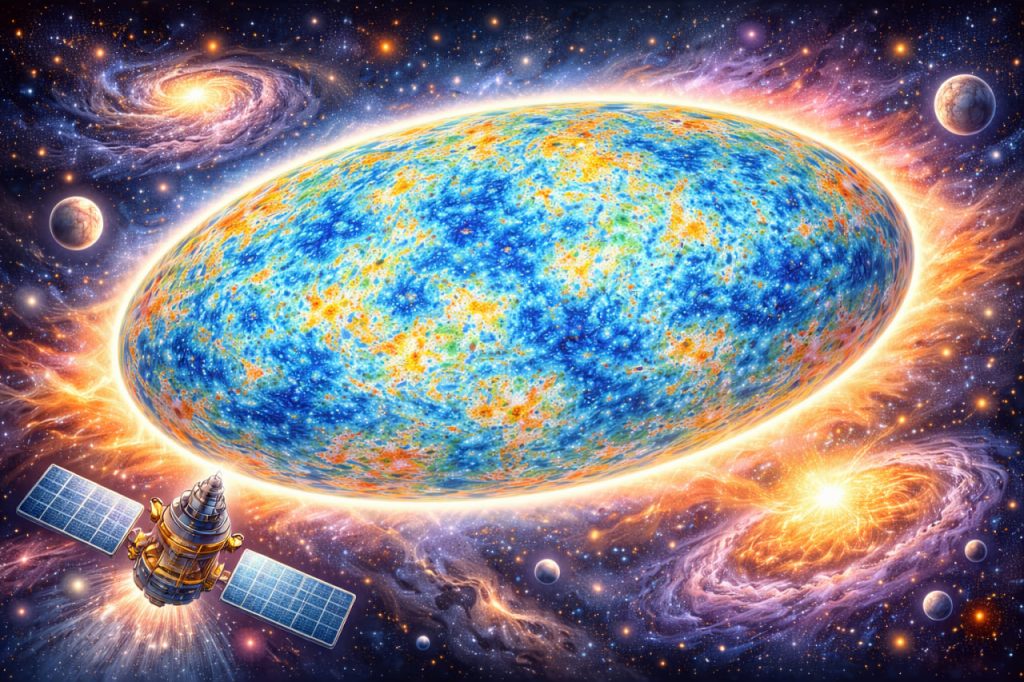
The cosmic microwave background (CMB) is one of the most important discoveries in modern cosmology. It is often described as the “baby photograph” of the Universe because it shows what the cosmos looked like shortly after its birth. This faint radiation fills all of space and comes from a time when the Universe was extremely young, hot, and dense. Although invisible to the naked eye, the CMB carries crucial information about the origin, structure, and evolution of the Universe. By studying it, scientists can look back almost to the moment when the Universe first became transparent.
What Is the Cosmic Microwave Background
The cosmic microwave background is relic radiation left over from the early Universe. It originated when the Universe was about 380,000 years old, a moment known as recombination. Before this time, the Universe was filled with a hot plasma of charged particles that scattered light. Once it cooled enough, atoms formed and light was finally able to travel freely through space. That ancient light has been stretching and cooling ever since as the Universe expanded, becoming microwave radiation detectable today.
Why It Is Called a “Baby Picture”
The CMB is not a photograph in the usual sense, but it is the earliest snapshot of the Universe we can observe. It captures tiny variations in temperature that reflect slight differences in density in the early cosmos. These small fluctuations later grew into galaxies, stars, and clusters. In this way, the CMB shows the initial conditions from which all cosmic structure emerged. It represents the Universe in its infancy, long before any stars or planets existed.
What the Patterns in the CMB Mean
Although the CMB appears almost uniform, it contains subtle patterns. These temperature differences are extremely small, but they are scientifically crucial. They reveal how matter was distributed in the early Universe. By analyzing these patterns, scientists can determine the Universe’s age, composition, and geometry. The CMB also provides evidence for dark matter and dark energy, even though these components cannot be seen directly.
How Scientists Study the CMB
The cosmic microwave background cannot be observed with ordinary telescopes. Specialized instruments are required to detect microwave radiation with extreme precision. Satellites and observatories map the sky to measure tiny temperature differences across vast regions. These measurements are then converted into detailed maps of the early Universe. Each improvement in measurement sharpens our understanding of cosmic history.
Expert Perspective
According to cosmologist Dr. Nathan Cole:
“The cosmic microwave background is the closest thing
we have to a photograph of the early Universe.
It allows us to test cosmological theories
against direct evidence from the past.”
This highlights the CMB’s role as a cornerstone of modern cosmology.
What the CMB Tells Us About the Universe
The CMB confirms that the Universe began in a hot, dense state and has been expanding ever since. It supports the Big Bang model and constrains alternative theories. Measurements of the CMB help determine the Universe’s age with remarkable accuracy. They also reveal how much of the cosmos is made of ordinary matter, dark matter, and dark energy. Few observations provide such a complete picture of cosmic origins.
Why the CMB Still Matters Today
Even decades after its discovery, the cosmic microwave background remains a focus of active research. New data refine existing models and sometimes reveal tensions that push theory forward. The CMB connects the smallest fluctuations in the early Universe to the largest structures seen today. It reminds us that everything—from galaxies to life—emerged from tiny irregularities in an otherwise smooth beginning. The “baby picture” continues to shape our understanding of the cosmos.
Interesting Facts
- The CMB dates back to about 380,000 years after the Big Bang.
- Its temperature today is just a few degrees above absolute zero.
- Tiny fluctuations in the CMB led to all cosmic structure.
- The CMB fills all of space, not just distant regions.
- It provides strong evidence for the Big Bang model.
Glossary
- Cosmic Microwave Background — ancient radiation from the early Universe.
- Recombination — the moment when atoms first formed and light could travel freely.
- Big Bang — the model describing the Universe’s hot, dense beginning.
- Dark Matter — unseen matter influencing cosmic structure.
- Dark Energy — a mysterious component driving cosmic expansion.