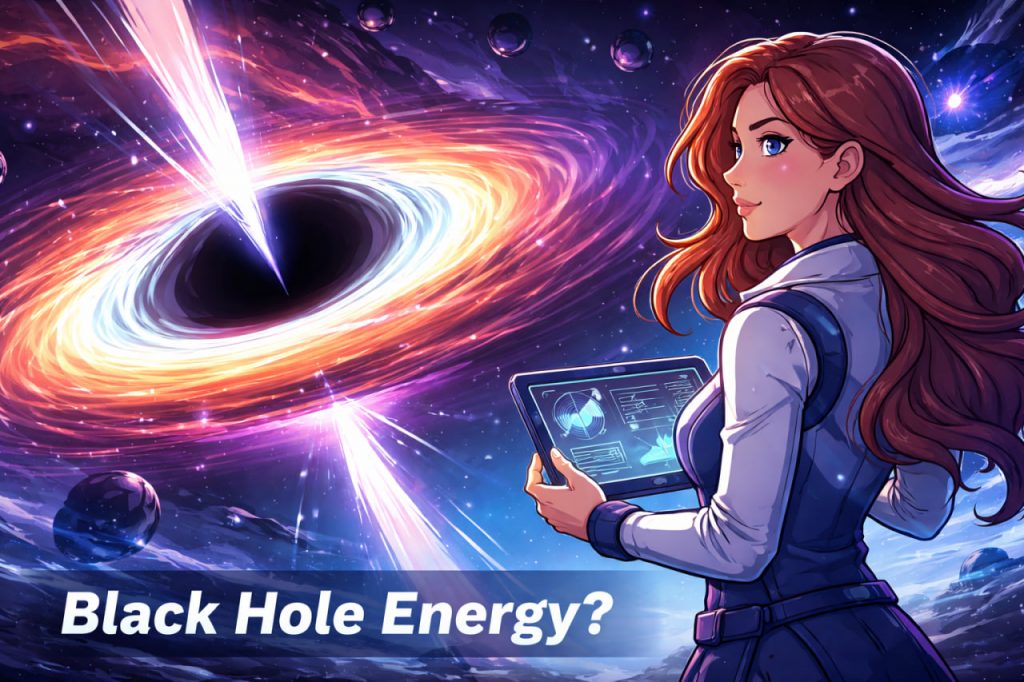
Black holes are often imagined as cosmic destroyers that consume everything around them, but modern physics suggests a far more complex picture. Under certain conditions, black holes may act not only as sinks of matter and energy, but also as potential sources of usable energy. This idea, once purely theoretical, has been explored seriously by physicists studying general relativity, quantum mechanics, and astrophysics. While harvesting energy from a black hole remains far beyond current technological capabilities, the underlying principles reveal fascinating insights into how extreme objects interact with space, time, and energy. Understanding these mechanisms helps scientists test the limits of known physics and imagine future civilizations operating on cosmic scales.
Why Black Holes Contain Enormous Energy
A black hole forms when a massive amount of matter collapses into an extremely small volume, creating an object with immense gravitational and rotational energy. Especially important are rotating black holes, known as Kerr black holes, which spin at tremendous speeds. This rotation stores vast amounts of energy in the warped space-time around the black hole. In fact, theoretical models suggest that up to 29% of a rotating black hole’s mass-energy could, in principle, be extracted without destroying the black hole itself. This makes black holes some of the most energy-dense objects in the universe, far exceeding stars or nuclear reactions in terms of potential output.
The Penrose Process and Energy Extraction
One of the earliest proposed methods for extracting energy from a black hole is the Penrose process, developed by physicist Roger Penrose. This mechanism relies on a region outside a rotating black hole called the ergosphere, where space-time itself is dragged around by the black hole’s spin. According to the theory, particles entering the ergosphere can split into two, with one falling into the black hole and the other escaping with more energy than the original particle had. Astrophysicist Dr. Elena Markov explains:
“The ergosphere allows energy to be extracted from a black hole’s rotation without violating the laws of physics.
In essence, the black hole slows down very slightly, and that lost rotational energy is transferred outward.”
While elegant in theory, the Penrose process would require precise control over particles and trajectories at extreme gravitational conditions, making it impractical with current or near-future technology.
Hawking Radiation: Energy From Quantum Effects
Another often-discussed concept is Hawking radiation, a quantum phenomenon proposed by Stephen Hawking. According to this theory, black holes emit tiny amounts of radiation due to quantum effects near the event horizon. Over incredibly long timescales, this radiation causes black holes to slowly lose mass and energy. However, for astrophysical black holes, Hawking radiation is extremely weak, far less than the cosmic microwave background. Physicist Dr. Samuel Ortiz notes:
“Hawking radiation is real in theory, but for stellar or supermassive black holes, it is far too faint to be considered a practical energy source.”
Only hypothetical microscopic black holes, which may not exist naturally, would emit significant radiation—making this method largely speculative.
Accretion Disks and Indirect Energy Use
In reality, the most practical way black holes already act as energy sources is through their accretion disks. As matter spirals toward a black hole, it heats up due to friction and gravitational compression, releasing enormous amounts of energy in the form of radiation and jets. Active galactic nuclei and quasars powered by supermassive black holes can outshine entire galaxies. Importantly, this energy comes not from the black hole itself, but from infalling matter converting gravitational potential energy into radiation. Advanced civilizations could theoretically harness energy from such disks, similar to how humans extract energy from stars, but on a much more extreme scale.
Engineering Challenges and Cosmic Limitations
Even if the physics allows energy extraction from black holes, the engineering challenges are almost unimaginable. Any structure operating near a black hole would face intense tidal forces, extreme radiation, and relativistic time distortions. Precise navigation and materials far beyond current science would be required to survive near the event horizon. Additionally, ethical and safety concerns arise when dealing with objects capable of destroying entire planetary systems if misused. Because of these obstacles, black holes remain a subject of theoretical energy research, not practical engineering.
What This Means for the Future of Physics
Exploring black holes as energy sources pushes science to its conceptual limits. These ideas help researchers test general relativity, quantum field theory, and thermodynamics under extreme conditions. Even if humanity never directly harvests energy from a black hole, studying these mechanisms deepens our understanding of the universe and its fundamental laws. For now, black holes serve as natural laboratories, showing what is possible when gravity, energy, and space-time reach their most extreme forms.
Interesting Facts
- A rotating black hole can theoretically store more usable energy than billions of stars combined.
- The ergosphere exists only around rotating black holes, not non-spinning ones.
- Quasars powered by black holes are among the brightest objects in the universe.
- Hawking radiation becomes significant only for hypothetical tiny black holes.
- Extracting energy from a black hole would slightly slow its rotation, not destroy it.
Glossary
- Black Hole — an object with gravity so strong that not even light can escape from within its event horizon.
- Ergosphere — a region around a rotating black hole where space-time is dragged along with the rotation.
- Penrose Process — a theoretical method of extracting energy from a rotating black hole.
- Hawking Radiation — weak radiation emitted by black holes due to quantum effects near the event horizon.
- Accretion Disk — a rotating disk of matter that heats up and emits radiation as it falls toward a black hole.