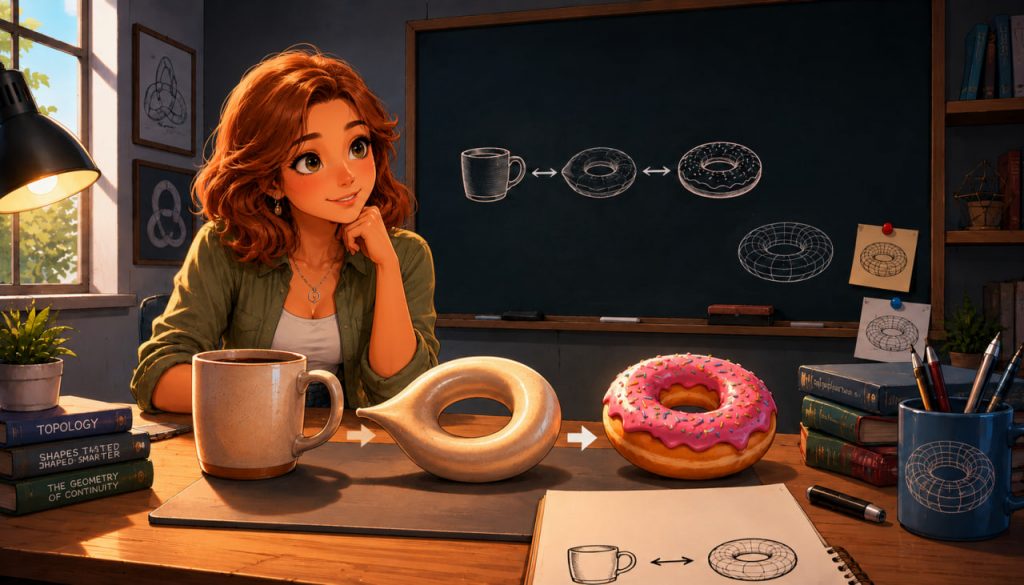
In everyday life, a coffee cup and a donut are clearly different objects. One holds tea or coffee, the other is something you eat. They have different materials, functions, colors, and sizes. But in topology, one of the most fascinating branches of mathematics, they can be considered the same kind of shape.
This strange idea comes from the way topology studies objects. Instead of focusing on exact measurements, angles, distances, or rigid geometry, topology asks what remains unchanged when a shape is stretched, bent, twisted, or smoothly deformed. If one object can be transformed into another without cutting, tearing, gluing, or creating new holes, topologists may treat them as equivalent.
That is why a cup with one handle and a donut are mathematically similar: both have exactly one hole. This simple example opens the door to a completely different way of thinking about space, form, continuity, and hidden structure.
What Is Topology?
Topology is a branch of mathematics that studies the properties of shapes and spaces that remain unchanged under continuous deformation.
In simpler words, topology is interested in what happens when shapes are allowed to bend and stretch like rubber.
A topologist does not care about:
- Exact length
- Exact angle
- Exact size
- Exact color
- Exact material
- Exact position
Instead, topology focuses on deeper structural properties, such as:
- Holes
- Connections
- Boundaries
- Continuity
- Inside and outside
- Whether one shape can transform into another
Topology is sometimes called “rubber-sheet geometry” because it studies shapes as if they were made from perfectly flexible material.
Why a Cup and a Donut Are Topologically Equivalent
A donut, or torus, has one central hole.
A coffee cup with one handle also has one hole: the opening inside the handle.
If both objects were made from soft clay or rubber, you could imagine gradually reshaping the cup into a donut without cutting it or attaching new pieces.
The cup’s bowl could be rounded and flattened.
The handle could become the central hole.
The final object would resemble a torus.
From the point of view of topology, the most important fact is not that one object is a cup and the other is food.
The important fact is that both have one continuous hole.
What Transformations Are Allowed?
Topology allows smooth transformations known as continuous deformations.
These include:
- Stretching
- Bending
- Twisting
- Compressing
- Expanding
But topology does not allow:
- Cutting
- Tearing
- Gluing separate parts together
- Punching new holes
- Filling existing holes
This is why a sphere and a cube are topologically equivalent. A soft rubber sphere could be reshaped into a cube without cutting or tearing.
But a sphere and a donut are not equivalent because a donut has a hole and a sphere does not.
In topology, holes matter more than measurements.
The Torus: The Mathematical Donut
The mathematical name for a donut-shaped surface is a torus.
A torus is one of the most famous objects in topology because it clearly demonstrates the idea of a hole.
A torus can be imagined as:
- The surface of a donut
- The shape of an inner tube
- A ring-shaped surface
- A flexible looped tube
A cup with one handle belongs to the same topological class as a torus.
This does not mean they are physically identical.
It means they share the same underlying connectivity.
Topology sees the invisible skeleton of a shape rather than its outer appearance.
The Role of Holes in Topology
One of the simplest ways to classify shapes topologically is by counting holes.
This idea is connected to a concept called genus.
The genus of a surface roughly means the number of holes it has.
Examples:
- A sphere has genus 0.
- A donut has genus 1.
- A double donut has genus 2.
- A pretzel with three holes has genus 3.
A coffee cup with one handle has genus 1, just like a donut.
A teapot with a handle and a spout may be more complicated depending on how the shape is idealized.
The number of holes is one of the most important topological features of a surface.
Geometry vs. Topology
Geometry and topology both study shapes, but they ask different questions.
Geometry asks:
- How long is this side?
- What is this angle?
- What is the area?
- What is the curvature?
- What is the distance between two points?
Topology asks:
- Is the shape connected?
- How many holes does it have?
- Can it be deformed into another shape?
- Does it have a boundary?
- Can a loop shrink to a point?
For example, in geometry, a circle and an ellipse are different because their measurements differ.
In topology, they are equivalent because one can be smoothly stretched into the other.
Geometry cares about measurement; topology cares about structure.
Homeomorphism: When Two Shapes Are “The Same”
The formal word for topological sameness is homeomorphism.
Two shapes are homeomorphic if one can be continuously transformed into the other and back again without cutting or gluing.
A donut and a coffee cup with one handle are often used as a popular example of homeomorphic objects.
This idea helps mathematicians classify spaces in a very general way.
Instead of asking whether two objects look the same, topology asks whether they are structurally equivalent.
Homeomorphism is the mathematical reason a cup and a donut can be considered the same shape.
Why Topology Matters in Real Science
Topology may sound abstract, but it has many real-world applications.
It appears in:
- Physics
- Chemistry
- Robotics
- Computer science
- Data analysis
- Neuroscience
- Cosmology
- Materials science
- DNA research
For example, topology helps scientists study how DNA strands knot and unknot.
It helps physicists understand unusual states of matter.
It helps computer scientists analyze networks and data structures.
It helps roboticists plan movement through complicated spaces.
Topology turns abstract shape theory into a practical tool for understanding complex systems.
Topology in Modern Technology
One exciting modern field is topological data analysis.
This approach studies the “shape” of data.
Instead of looking only at individual data points, researchers examine patterns, clusters, loops, gaps, and connections.
This can be useful when analyzing:
- Medical data
- Brain networks
- Social networks
- Financial systems
- Biological structures
- Sensor data
- Machine learning models
Topology gives scientists a way to find structure in data that may look chaotic at first.
Sometimes the shape of data reveals patterns that ordinary statistics may miss.
Expert Perspective
Mathematician Henri Poincaré is often considered one of the founders of modern topology. His work helped shift mathematics toward studying deep structural properties of spaces rather than only their measurements.
One of the most famous problems inspired by his ideas was the Poincaré Conjecture, which asked a profound question about three-dimensional spaces. It remained unsolved for nearly a century until mathematician Grigori Perelman proved it in the early 2000s.
This history shows why topology is so important: it studies the hidden architecture of space itself.
Why the Cup and Donut Example Is So Powerful
The cup-and-donut example is memorable because it changes how people think about shape.
At first, it feels absurd.
Then it becomes logical.
A cup and a donut are not the same in daily life, but topology is not daily life. It is a mathematical lens that ignores surface details and focuses on deeper continuity.
This idea teaches a powerful lesson: the same object can look completely different depending on the questions we ask about it.
Topology reminds us that mathematics often reveals similarities hidden beneath ordinary appearances.
Interesting Facts
- A coffee cup with one handle and a donut are topologically equivalent because each has one hole.
- A sphere and a cube are topologically equivalent because one can be smoothly deformed into the other.
- A sphere and a donut are not topologically equivalent because a sphere has no hole while a donut has one.
- The mathematical name for a donut-shaped surface is a torus.
- Topology is sometimes called rubber-sheet geometry.
- Topological ideas are used in physics, robotics, DNA research, data science, and computer graphics.
- The Poincaré Conjecture was one of the most famous problems in topology and was solved by Grigori Perelman.
Glossary
- Topology – A branch of mathematics that studies properties of shapes preserved under continuous deformation.
- Torus – A donut-shaped surface with one hole.
- Homeomorphism – A mathematical relationship between two shapes that can be continuously transformed into each other without cutting or gluing.
- Continuous Deformation – A smooth transformation such as stretching, bending, or twisting.
- Genus – A number that roughly counts how many holes a surface has.
- Geometry – The branch of mathematics concerned with measurements, angles, distances, and shapes.
- Surface – A two-dimensional outer layer or boundary of a three-dimensional object.
- Topological Data Analysis – A modern method that studies the shape and structure of complex data.