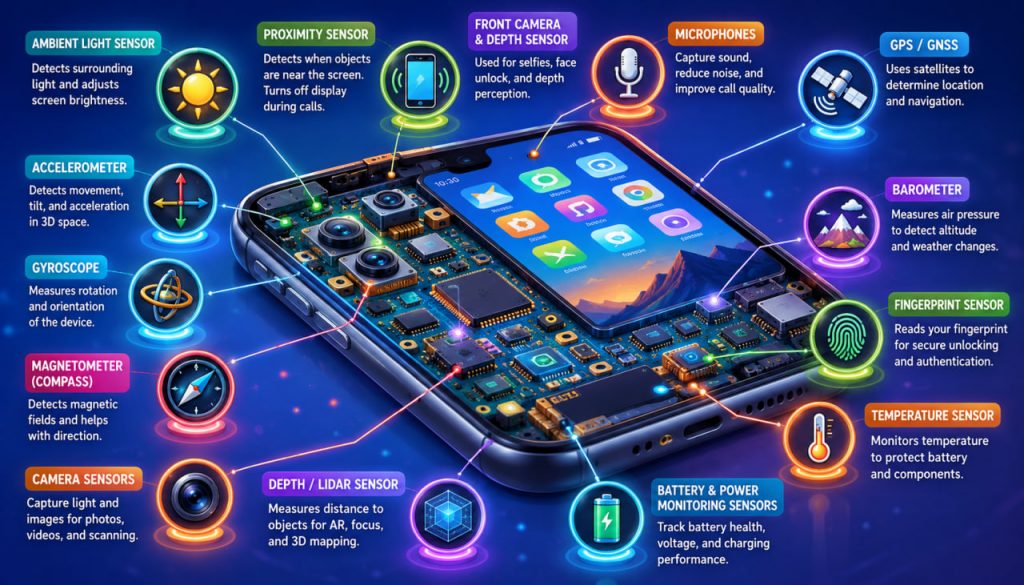
A smartphone is much more than a screen, camera, battery, and processor. Inside its thin body is a collection of tiny sensors that constantly measure movement, light, sound, pressure, location, distance, orientation, and even biometric information. These sensors are the reason your phone can rotate the screen, count steps, unlock with your face, adjust brightness, stabilize videos, navigate streets, and detect when it is near your ear during a call.
Most users never see these components, but they work every second in the background. A modern phone is almost like a pocket-sized laboratory filled with microscopic measuring instruments.
Smartphone sensors turn physical reality into digital information, allowing apps and operating systems to understand what is happening around the device.
Accelerometer: Detecting Motion and Tilt
The accelerometer measures acceleration and movement.
It helps your phone understand whether it is standing upright, lying flat, being shaken, falling, or moving in a certain direction.
Common uses include:
- Screen rotation
- Step counting
- Fitness tracking
- Gaming controls
- Fall detection
- Motion-based gestures
- Camera stabilization support
When you turn your phone sideways and the display switches from portrait to landscape, the accelerometer is one of the main sensors involved.
The accelerometer gives your phone a sense of movement.
Gyroscope: Measuring Rotation
The gyroscope measures rotation and angular motion.
While the accelerometer detects general movement, the gyroscope helps track how the phone turns around its axes.
It is especially important for:
- Augmented reality
- Virtual reality
- 360-degree video
- Image stabilization
- Mobile gaming
- Navigation support
- Motion tracking
For example, when you play a racing game and steer by tilting your phone, the gyroscope helps detect precise rotational movement.
The gyroscope gives your phone a sense of direction and spin.
Magnetometer: The Digital Compass
The magnetometer detects magnetic fields.
In smartphones, it works like a digital compass by sensing Earth’s magnetic field.
It helps with:
- Compass apps
- Map orientation
- Navigation
- Augmented reality
- Direction detection
When your map rotates to show which way you are facing, the magnetometer often works together with GPS, the gyroscope, and the accelerometer.
However, magnetometers can be affected by nearby magnets, metal objects, car interiors, or electronic devices.
That is why compass apps sometimes ask you to move the phone in a figure-eight motion for calibration.
GPS and Satellite Positioning
Strictly speaking, GPS is not a single sensor in the same way as an accelerometer. It is a satellite navigation receiver.
Still, users often think of it as a location sensor.
Modern smartphones can use multiple satellite systems, such as:
- GPS
- Galileo
- GLONASS
- BeiDou
- QZSS in some regions
Location data is essential for:
- Maps
- Ride-hailing apps
- Delivery tracking
- Weather apps
- Fitness routes
- Emergency location
- Geotagged photos
Phones often combine satellite data with Wi-Fi, cellular towers, Bluetooth beacons, and motion sensors to improve accuracy.
Your phone’s location system is not one sensor — it is a combination of technologies working together.
Proximity Sensor: Knowing When the Phone Is Near Your Face
The proximity sensor detects nearby objects without physical contact.
Its most familiar job is during phone calls.
When you hold the phone to your ear, the proximity sensor turns off the screen to prevent accidental touches.
It also helps save battery and improve usability.
Some phones use infrared proximity sensors, while others rely on different optical or software-based systems.
The proximity sensor prevents your cheek from pressing buttons during a call.
Ambient Light Sensor: Automatic Brightness
The ambient light sensor measures surrounding light levels.
It helps your phone adjust screen brightness automatically.
In bright sunlight, the screen becomes brighter.
In a dark room, it becomes dimmer.
This improves:
- Readability
- Eye comfort
- Battery life
- Display performance
Some phones also use light sensors to adjust color temperature, making the screen warmer or cooler depending on the environment.
Automatic brightness works because your phone can measure the light around you.
Barometer: Measuring Air Pressure
Some smartphones include a barometer, which measures atmospheric pressure.
This sensor can help estimate altitude changes.
It is useful for:
- Weather apps
- Hiking apps
- Fitness tracking
- Floor detection inside buildings
- Improved GPS altitude accuracy
For example, when climbing stairs, the barometer can help detect elevation change more accurately than GPS alone.
Not every phone includes a barometer, but it is common in many premium models.
Microphones: Sound Sensors
Smartphones usually contain multiple microphones.
They do more than record your voice.
Microphones support:
- Calls
- Voice assistants
- Video recording
- Noise cancellation
- Voice memos
- Audio zoom
- Sound recognition
- Hearing accessibility features
Multiple microphones allow the phone to separate your voice from background noise.
This is why calls can sound clearer even on a busy street.
A phone’s microphone system is a sensor network for sound.
Camera Sensors: Seeing the World
The camera is one of the most important sensor systems in a smartphone.
A camera sensor converts light into electrical signals, creating digital images and videos.
Modern phones may include several cameras:
- Wide camera
- Ultra-wide camera
- Telephoto camera
- Macro camera
- Depth camera
- Front-facing camera
Camera systems support more than photography.
They also enable:
- Face unlock
- Document scanning
- Augmented reality
- QR code scanning
- Object recognition
- Video stabilization
- Computational photography
The smartphone camera is not just a lens — it is a complex light-sensing computer system.
Depth Sensors and LiDAR
Some smartphones include depth-sensing systems.
These may use:
- Time-of-flight sensors
- Structured light
- LiDAR
- Stereo camera depth estimation
Depth sensors measure how far objects are from the phone.
They are useful for:
- Portrait mode
- Face recognition
- 3D scanning
- Augmented reality
- Room measurement
- Better autofocus in low light
LiDAR is especially useful because it can map depth quickly by measuring how long light takes to return after bouncing off surfaces.
Fingerprint Sensor
Many smartphones include a fingerprint sensor for biometric security.
It may be located:
- Under the display
- On the power button
- On the back of the phone
- In a home button on older models
Fingerprint sensors can be:
- Capacitive
- Optical
- Ultrasonic
Capacitive sensors detect tiny electrical differences in fingerprint ridges.
Optical sensors use light.
Ultrasonic sensors use sound waves to create a more detailed fingerprint map.
Biometric sensors help make smartphones more secure and convenient.
Face Recognition Sensors
Face unlock systems vary by phone.
Some use only the front camera.
More advanced systems use additional components such as:
- Infrared cameras
- Dot projectors
- Flood illuminators
- Depth sensors
These systems can create a 3D map of the face, improving security compared with simple 2D image recognition.
Face recognition is used for unlocking the phone, approving payments, and protecting apps.
Temperature and Battery Sensors
Smartphones include internal temperature sensors, especially for battery and processor safety.
These sensors help prevent overheating during:
- Fast charging
- Gaming
- Video recording
- Wireless charging
- Hot weather use
- Heavy multitasking
If the phone gets too hot, it may reduce performance, dim the screen, slow charging, or show a warning.
Temperature sensors protect both the battery and the user.
Expert Perspective
Smartphone engineers often describe modern phones as sensor-fusion devices. This means the phone does not rely on one sensor alone. Instead, it combines data from many sensors to create a more accurate understanding of movement, position, orientation, and environment.
For example, navigation may use GPS, cellular signals, Wi-Fi, accelerometer data, gyroscope data, magnetometer readings, and barometer measurements together.
Sensor fusion is what makes smartphone behavior feel smooth, accurate, and intelligent.
Why Smartphone Sensors Matter
Sensors are what allow smartphones to respond to the real world.
Without them, phones would be far less useful.
There would be no automatic screen rotation, no accurate fitness tracking, no face unlock, no camera autofocus, no navigation, no augmented reality, and no smart brightness control.
As smartphones evolve, sensors will become even more important for:
- Health monitoring
- Smart homes
- AR glasses
- AI assistants
- Mobile photography
- Safety features
- Accessibility tools
- Environmental sensing
The future smartphone will not only process information — it will understand more of the world around it.
Interesting Facts
- A smartphone usually combines data from several sensors at once instead of relying on only one.
- The accelerometer helps detect motion, while the gyroscope helps detect rotation.
- The magnetometer works like a digital compass but can be disturbed by metal and magnets.
- Some phones include barometers that help estimate altitude changes.
- Multiple microphones help reduce background noise during calls.
- Advanced face unlock systems may use infrared light and depth mapping.
- Smartphone cameras are also sensors used for scanning, recognition, measurement, and augmented reality.
Glossary
- Sensor — A device that detects physical information and converts it into digital data.
- Accelerometer — A sensor that measures acceleration, tilt, and movement.
- Gyroscope — A sensor that measures rotation and angular motion.
- Magnetometer — A sensor that detects magnetic fields and works as a digital compass.
- Proximity Sensor — A sensor that detects nearby objects without touching them.
- Ambient Light Sensor — A sensor that measures surrounding light to adjust screen brightness.
- Barometer — A sensor that measures atmospheric pressure and can help estimate altitude.
- Sensor Fusion — The process of combining data from multiple sensors to improve accuracy.